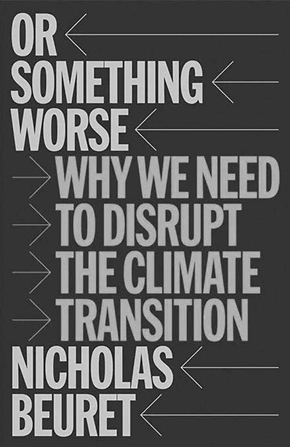
Jim Walker reviews Or Something Worse by Nic Beuret (Verso, 2025)
and examines whether it holds ideas our movements need to disrupt
the unjust transition.
I was recently introduced to the concept of Verso Slop by a friend of mine. In Sunny Lu’s Bad nonfiction, part 1: Verso Slop, she lays out a scathing taxonomy of political nonfiction books; slam poetry/memoir, manife(slop)to, and literature review but bad. Something about this must be true. The rapidity of underwhelming book publications can be bewildering. How can so many people have such profound ideas all the time to warrant so many books with such intriguing and promising titles?
Nicholas Beuret is an activist turned academic. Formerly of Friends of the Earth England, he now teaches International Busi ness Environment and Innovation and Sustainability at the Uni versity of Essex, a fitting establishment for an established radical. Although this is the first book he has written, much of his earlier writing deals with similar themes, and as early as 2019 he was asking “A Green New Deal Between Whom and For What?”
Or Something Worse develops this question into a full critique of the current transition to a lower carbon world, and then some what unconvincingly lays out a proposed solution. The first half of the book is an onslaught of negative statistics, pushing the reader’s head deeper into their chest. “Only two-thirds of households have insurance”, in 2023 “food inflation peaked at 19 per cent” and “British households saw energy bills increase by up to 80 per cent”. There are so many of these statistics, from all around the world, that it’s sometimes hard to know which countries or nations exactly Beuret is talking about, but the point is made. (The worst statistic, “‘Incremental innovation’ constitutes around 75 per cent of all innovation work” is uncited.)
Beuret’s important contribution is his identification of the transition’s installation economy, which covers jobs like solar panel and heat pump installation, glazing and insulation. This sector is especially vulnerable to political patronage, and tends towards small, precarious, location bound businesses, which echo patterns of deprivation rather than push against them, as a re-shored manufacturing economy was hoped to do. It is often mistakenly assumed that a transition will lead to more, better jobs, but that was never guaranteed. The structurally enforced norms of neo-liberal capital ism, with its low wages and insecure jobs, will reassert themselves in a neo-liberal capitalist transition. Beuret does well to point out that many of the jobs being created, both outside and within the installation economy, are jobs which are traditionally done by women, such as education and care, and that these jobs will have some of the worst wages and the worst precarity.
To take control of the transition, Beuret proposes three strands; blockades, refusals, and community-based counter planning. There are heartening case studies and good proposals, but unfortunately Beuret falls foul of the siloed organising he argues against, by calling for political strikes, which are illegal in many countries (UK, USA, France, Spain) and severely curtailed in the few nations where they are. The political strike is a potent weapon for the working classes, which is why it has been so heavily repressed. Beuret also calls for a fuzzily defined radical municipalism, like transition towns combined with platformism, but with very little on the strategy or tactics of movement building. Beuret tacitly acknowledges this, saying there “are no easy victories to be claimed”. However, for those looking to take action, the listed case studies should provide ample inspiration.
The designation of which books are indeed Verso Slop is ultimately a limiting one, relying too heavily on the reader’s prejudices and is such a damning label that it is almost a thought terminating cliché. There is a grain of utility to it, and it’s fun to say, but reading Or Something Worse through such a cynical lens only serves to shield the reader from the truth: that rather than a climate change induced collapse of society, we are more likely to see a re-entrenching of the neo-liberal’s state’s worst impulses towards fascism as the world burns around us. The fight against it seems impossible and yet, fight we must.