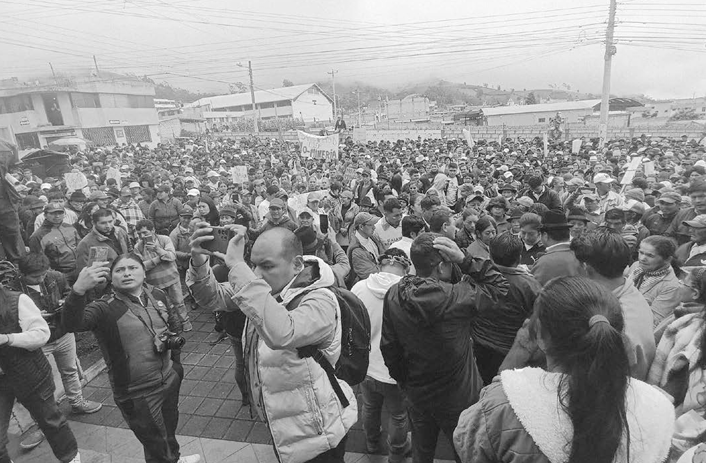
Ecuador’s Indigenous people faces a new alliance between the far right and extractivist mining industries. Patricio Mesa reports back on the fight on the frontline of the climate crisis.
Ecuador is entering a new phase of even more intense entrenchment of extractive industries. The current reopening of the National Mining Register, the new oil licensing rounds, together with reforms aimed at strengthening so-called strategic sectors, show that the state is once again expanding the boundaries of natural resource exploitation.
Extractivism is part of Ecuador’s economic history. For decades, oil was one of the main pillars of the country’s economy. Today, metal mining is promoted as a new source of investment, employment and foreign exchange. However, replacing or supplementing oil with gold, copper and other minerals does not mean moving beyond the primary-export model; it simply means diversifying extractivism.
The gradual reopening and expansion of the National Mining Register is one of the clearest signs of this new phase. For several years, it had been suspended due to resistance from local communities. Now, the state has resumed the process for applications for new concessions. This is happening while countless communities are already facing the pollution and silting of their rivers, deforestation, loss of biodiversity, damage to their water sources and land conflicts linked to mining. The key question should not be just how much mining can contribute to the economy, but which territories will be affected, who decides on their fate, and who will bear the social and environmental costs – in other words, which territories will be sacrificed next.
The same approach can be seen in the oil sector. The government has proposed new bidding rounds for the South-East and the Sub-Andean region. This plan represents a further expansion of the fossil fuel frontier into Amazonian territories home to forests, water sources and Indigenous peoples and nationalities.
This new assault is taking place against a backdrop of the strengthening of the right in Latin America. In various countries, conservative and far-right governments and movements are prioritising legal protection for transnational corporations, private investment and the removal of barriers to business activity. The militarisation of territories is becoming the norm, while social and environmental safeguards are rolled back.
The dispute over Ecuador’s natural resources is becoming increasingly intertwined with trade and geopolitical relations with the major powers. The Free Trade Agreement (FTA) with Canada, signed in 2026, strengthens the framework for trade and investment, against a backdrop of growing Canadian interest in mining and critical minerals. With the United States, Ecuador is deepening a trade and economic security agenda linked to the diversification of supply chains, in a global landscape characterised by competition for critical minerals and rare earths. At the same time, the FTA with China, in force since 2024, has deepened trade relations and cooperation in strategic sectors such as mining, energy and infra structure. Ecuador is thus becoming increasingly important in the global contest for access to strategic resources.
Peasant and Indigenous territories in Ecuador, as in some other countries in the region, occupy a strategic position in this dispute. Their forests, rivers, biodiversity, knowledge, minerals and oil are viewed as resources of economic and geopolitical importance. For the market, they may represent reserves of raw materials; for the peoples who live there, they are territories of life and memory, upon which the future of humanity depends.
In the face of this assault, the struggle and resistance of the peoples and communities have been fundamental in holding back, for decades, the advance of extractive industries into their territories. Although the current situation is extremely difficult, this resistance continues and shows that the Indigenous Peoples and local communities have not given up their struggles; still less have they relinquished their right to decide on their territories and ways of life. However, defending life and territory comes at an ever-increasing cost today. The criminalisation of protest, the persecution and prosecution of leaders and land defenders, the economic strangulation of activists and organisations, as well as direct physical threats and attacks – in some cases leading to the murder of those who oppose policies and projects that put their territories at risk – have all intensified.
There is an urgent need to strengthen community organisation, territorial monitoring and control, the integration of ancestral and scientific knowledge, independent media and communications, legal defence, social mobilisation, and national and international solidarity. In this regard, Peoples Against Extractivism provides a concrete platform for international coordination, enabling the struggles of peoples and communities to join forces against the advance of extractivist policies and new forms of imperialist domination, which seek the dispossession, plunder and control over natural resources and territories.
The defence of territories is, therefore, at the same time a struggle for a different vision of society: a society where nature is not seen as an inexhaustible source of resources in the service of accumulation, but as an essential part of life; where peoples can exercise their self-determination; and where development is subordinated to collective well-being, rather than life being subordinated to the needs of capital