This is an edited extract from a longer contribution to the discussions of Peoples Against Extractivism, an international coalition of social movements resisting predatory, extractive projects on their territories.
The reconfiguration of US imperialism has once again turned the spotlight on Latin America. The 2025 National Security Strategy sets out a shift towards what might be described as an open recolonisation of the Western Hemisphere, reviving the Monroe Doctrine under the so-called ‘Donroe Doctrine’. This doctrine, which predates Latin American independence, redefines the region as an exclusive reserve of raw materials and a subordinate labour force, and is complemented by a strategy of direct military coercion, which has manifested itself in the militarisation of the Caribbean, the intervention in Venezuela and the economic strangulation of Cuba.
This process is facilitated by three structural conditions. Firstly, the historical subservience of the Latin American bourgeoisies, which are financially intertwined with Wall Street and reduced to agents of recolonisation. Secondly, the relative failure of the progressive cycles, which, whilst promoting redistributive and educational reforms, did not alter the primary-export production structure nor break financial dependence, thereby eroding support among the popular base and facilitating the far-right’s offensive. So-called ‘gangster capitalism’ describes a mode of operation in which executives of major military-technological corporations act as geopolitical agents with decision-making power over nation states and their regulatory frameworks. This decision-making power manifests itself in a growing tension between the logic of transnational accumulation and the institutions of bourgeois democracy, a tension which corporate actors resolve through strategies of capture, circumvention or deregulation, as exemplified by the deregulation policies promoted by the Trump administration, Musk’s influence on electoral processes, or Peter Thiel’s funding of far-right candidates who subsequently award multi-million contracts to companies such as Palantir in countries like Argentina and Ecuador, where their mass surveillance systems operate in conjunction with these technology firms.
In the face of this power, the response requires, from an eco-socialist perspective, the socialisation under workers’ control of strategic technological infrastructures and the building of inter nationalist networks that prevent artificial intelligence and digital surveillance systems from becoming entrenched as mechanisms for disciplining labour and displacing populations. A discussion amongst social movements regarding the technological horizon is essential, as is a deeper exploration of experiences of democratisation and technological sovereignty for the management of data, educational and productive processes, but also to promote prefigurative processes in energy generation and territorial management, in a context where the multiple structural crisis demonstrates that there are no solutions within capitalism.
In this context, as the Latin American Left, we have shown ourselves to be fragmented and lacking a shared vision of liberation, oscillating between conciliatory reformism and symbolic pro test without practical application. Faced with the ideological and cognitive war waged by ‘surveillance capitalism’, and in the face of the energy and ecological crisis that capitalism cannot resolve without deepening dispossession and extractivism—as is the case with the so-called ‘energy transition’, which merely shifts devastation to new territories and the commons—the only way forward is to overcome historical divisions and build a popular bloc which, from an eco-socialist perspective, confronts transnationalised capital. The link between the climate crisis and the class struggle thus becomes an inescapable strategic axis. Young environmentalists and organisations defending a historic socialist project are called upon to recognise one another as participants in the same anti-capitalist struggle.
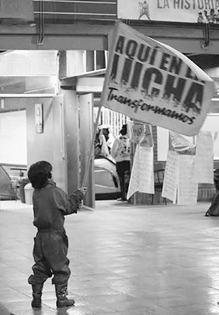
Against a backdrop of intensifying conflict, it is imperative to reaffirm the conviction that peace is not limited to the signing of agreements with armed groups, but arises from popular power and from overcoming the structural conditions that impoverish us. We must strengthen the prefigurative processes that shape our vision for the country, the world and life itself, based on human dignity and on the care of nature and the ecological processes upon which life on the planet depends. We cannot wait to carry out the socialist revolution before addressing the climate and environmental crises; we must build eco-socialist revolutions today through popular power. In the face of a capitalism based on extractivism, war, drug trafficking and the techno-financial apparatus, it is essential to deepen our internationalist strategies and coordination so that we may recognise one another and build bridges between the pro cesses we are constructing day by day, with an eco-socialist vision, an economy for life and the self-management of the territory. We must overcome the limitations of representative democracy to build a participatory democracy with bodies of real power, one that en gages in dialogue with the national aspirations and life plans of our peasant, Indigenous and Afro-Colombian communities, with ‘buen vivir’, ‘sumak kawsay’, ‘vivir sabroso’ and a life of dignity.
As the political and social movement that is the People’s Congress—which brings together trade unions, indigenous, peasant and Afro-Colombian organisations, as well as student groups and broad sectors of the Colombian popular movement—we have forged our internationalist character out of an urgent necessity: to confront the crisis of civilisation facing the world. On this path, we recognise that our struggles do not occur in isolation, but are interwoven with those of other peoples, shaping solidarities that span territories and fuel proposals for our country and the world. We recognise the urgency of moving towards territories free from extractivism, where communities and ecosystems no longer bear the cost of mining and oil extraction. We also recognise the need to strengthen the leading role played by indigenous peoples, people of African descent and peasant farmers—who are the guardians of the land, memory and life—in the construction of Latin American eco-socialism. We must also engage with workers in the energy sectors.
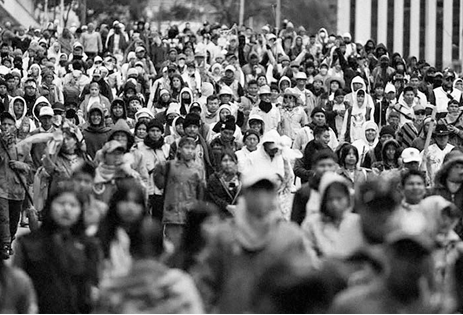
No transformative process can take place in isolation; that is why we reaffirm the importance of forging a solid alliance between the world’s eco-socialist movements – a network capable of transcending borders and sustaining common struggles. For Colombia, this means driving a just and people-centred transition that em braces clean energy, agroecology and food sovereignty. We remain convinced that social movements must preserve their autonomy, continue to mobilise, and defend nature and life above all economic interests. We champion direct action.
Because ecosocialism, more than a concept, is a vision, a commitment to building another possible and urgent world, where just energy transitions engage with ancestral and community knowledge. And where our prefigurative proposals—or embryos of popular power—such as self-managed economies, Peasant Agri-Food Territories, alternative popular media, and centres for training, research and independent thought flourish as seeds of the future.