In the second part of an interview with Cailean Gallagher and Stephen Smellie, Karren Morrison and Charlie McArthur discuss the pitfalls and potential power of trade union community organising.
“So, we set up the trade unions in the community”.
TUIC Falkirk, set up earlier this year on the model of TUIC Craigmillar, represents an initiative by lay trade unionists both to respond to the rise of the far right, and to provide the kind of local street-based support that can build community strength.
While at first support from central union bureaucracies was limited, in the intervening months it has drawn support from the STUC and unions including UNISON. The process has raised important questions about how the unions respond to a changing landscape. “I think people see that the far right is a real and present danger”, Karren explained. “It needs to be responded to really quickly and people need support with it.”
But Karren detects a risk of fatigue among the left resistance, in contrast with with the dynamics of some of the small but regular far right network. While far right activity has dwindled, a hard core remains: “These are family groups, these are friend groups, this is their social life, this is probably the best thing that’s ever happened to them. They are on the telly, they’re able to speak, they’re able to abuse people over the other side of the street with impunity.” For Karren, where the motivation for the left to resist comes from duty and often involves fear, for the far right “the problem is they have nothing to gain from it stopping, because they enjoy it.”
One dynamic that remains unclear is whether these niche, self-sustaining networks are being isolated in the community. “From day one”, Charlie explained, “it’s been obvious that there were your professional fascists there, but the vast majority of people were the genuinely concerned, as a result of misinformation”. Much of this was due to the messaging by the far right and fascist groups.
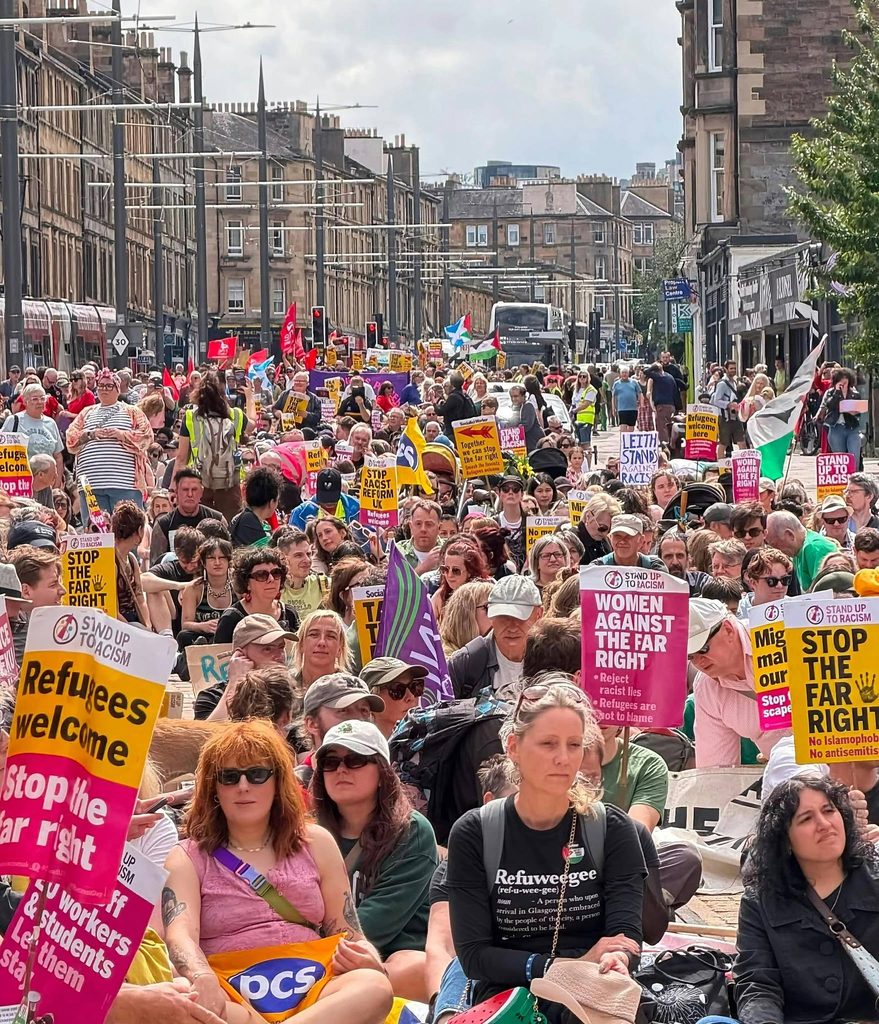
“They tried to claim the ground of being protectors of women and children. And it’s something that’s always on the back burner. It’s not their frontline campaign, but it’s a constant message of protecting women from gender-based violence and so forth. I think tackling that needs to be a priority moving forward now. The trade union movement needs to identify a small number of key things that we do not stray from, and I think that gender based violence has to be one of them”, Charlie suggests. “We cannot let people who are shouting obscenities and threatening violence against women claim that they are the protectors of women.”
But the ramping up of this rhetoric has alienated those closer to the middle ground. “The people who are protesting have alienated the kind of middle grounds, by the Nazi salutes, by the signs, by the abuse. People who might have had genuine concerns, through misinformation, are coming and standing next to somebody who is threatening rape on others. They say, ‘Oh, wait a minute…’. And as it’s got more extreme, the people left are real abusers, who alienate more and more people.”
Karren noticed something else: they all fell out with each other. “The original person who set up it is no longer doing it. Now they spend more time fighting each other than they do fighting, you know, us. That doesn’t mean that the community doesn’t have sympathy for some of the things they say. I do think people are emboldened to vocalise very racist stuff that they would never have vocalised. But they have also alienated the majority.”
As a movement, then, do unions focus on working class issues, or anti-racist work and education, or messaging around gender based violence? Should the priority be migrant organising, when already there is kickback when unions spend resources for migrant workers. Where does the mandate rest to make these decisions?
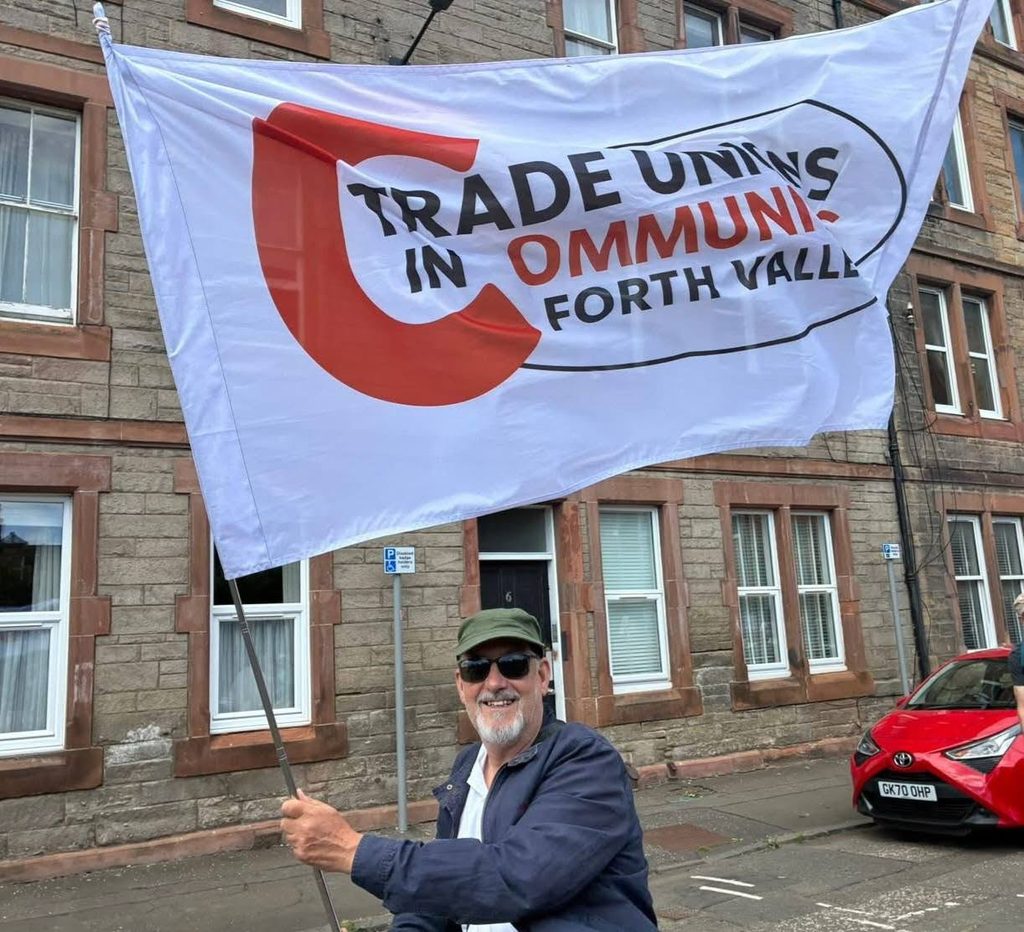
For Karren, trade unions in the community is part of the answer. “Trade unions are based in workplaces, but what affects our communities affects our workplace. How do we get people to understand what trade unions are? I think people think they provide some insurance policies. We need to explain why this stuff is our bread and butter. Trade unions have been involved in the fight against fascism for decades. Nobody would have questioned it in the past. Why are people questioning it now?”
Part of making unions relevant links back to the workplace, and involves showing what action looks like. The Serco campaign described in the first part of this interview (see issue 150) is for Karren a good example. “If you go and talk to people and if you spend time engaging with people, you can get them to trust you and to see you as something. We need to do that as trade unions and help people understand what it is we do.”
“Gender-based violence isn’t necessarily the issue that unions are known for, but if we’re engaging in our trade union community hubs with Women’s Aid, or other things around migrant workers, then people will see us as doing all sorts of work. Maybe then we can then start having conversations with people in the community around stuff like that.
“There is a massive battle here. I am terrified that reform is going to drag our politics so far to the right that we’re not getting an opportunity to do this. Often all I see trade unions doing is having debates and conversations. We need to take action, and trade unions in communities is a model here. It might be a disaster, and folk might be asking what we’re doing this for. But we need to do something.
What is a community?
TUIC Forth Valley is partly based on TUIC in Craigmillar, with a similar constitutional model. But whereas the Lothian TUIC is situated in a very specific area, the Forth Valley setup is different. The hub will not be a separate building as in Craigmillar, but based in UNISON’s shop in Newmarket Street, which is in the centre of Falkirk, opening periodically through the week. People are able to drop in and ask for trade union advice. There is engagement with local groups, referrals to food banks, and support for asylum seekers. For instance, there has been work with local employers to arrange for asylum seekers to do volunteering work, and to encourage them to organise PVG checks that allow them to do so. “These people may not be our members, but they are future members, because if they can get a volunteer position, and get leave to remain, and get work, then they will be able to join a trade union, and will want to do so because they understand what it does.”
The work of community organising, for Charlie, also has to address the fact that neoliberalism has eaten away at the foundations of the left, and “the adoption of neoliberalism by certain aspects of the trade union movement and socialist movement”. He explains: “in order for neoliberalism to work, they have to destroy the idea of class, which has meant the people who are meant to represent the working class have moved away from that being the key objective. This has allowed a gap for Farage and Reform to come in and say that they are the party that represent working class people. So one of the key things is that we need to have an honest discussion: has neoliberalism worked? Has it worked in full, or in part? And what, if any, has been the damage to trade unions, and to the working class movements in general?”

For Charlie, there needs to be more understanding of what a community is now, post neoliberalism, in order for the unions to tackle racism. “Because it seems obvious what a community was when I was a wee boy. For me, it was the Irish diaspora, or it was the Celtic fans, or the people who went to my school. That was my community, and I know what it was. But now with people retreating behind screens, and finding their own communities online, it is more difficult to define what a modern community is, so that we can start to engage with these modern communities and also taking lessons from when we would lift organisations that came from communities up into the union movement. They effectively became a wing of what we were doing. They gave good advice to their communities. For me, to build trade unions in the community, means training people up in skills so that people can come in and get good advice.”
There are encouraging trends where communities of migrants, for instance, are joining UNISON, not because union organisers are actively looking to recruit people who are very hard to reach, in work like home care. Instead, they have been talking to each other in church. In Lanarkshire, networks of Nigerian people have passed the message on. Some of the work of linking into those communities is geographically-based, but if people don’t identify as much with their local geographic community, there are networks, activists, and allies, in churches or other communities. For Karren, there are seeds of hope in the struggles of the last year.
“People who are protesting feel that like they’re in a community. But linked to trade unions and the community, we’ve got faith groups, we’ve got people who support asylum seekers, we’ve got charities, we’ve got Women’s Aid, we’ve got food banks. It might not be trade union activism, but it’s activism. We’ve all come together standing in front of a hotel, and we’ve then all connected in lots of different ways. None of this can be top down. It also needs to be online, because the digital community has a massive impact and we don’t know how to handle it.”
“It needs to be in schools and education, it needs to be support, training, engaging with migrant workers, with church groups, and everything. So these are all the different things we are trying to do. No one thing is going to work. And what I want from unions is to be supported to do that, and to support other TUIC branches elsewhere. It is a lot of work, from digital learning, supporting activists, to finding out what unions are already present in different communities.”
“It’s not one answer, but it has to be grassroots activism. It can’t be academic. It has to be: how do you build support, and how do you get that support on a national level, or share that learning on a national level? What works, what doesn’t work? Have you tried this? We need to be listening to the people doing it on the front line.”
One thing Karren and Charlie agreed on was that moving forward, the trade unions should be able to better mobilise. “If a branch of any union is saying, well, we’ve got attacks coming – can we have help on Tuesday?’” then the central union needs to be ready with resources.
“I remember”, said Karren, “the very first or second protest, and somebody saying, where are all the trade unions? And somebody was saying to me, oh, well, this particular union doesn’t like Stand Up To Racism and this other union doesn’t like this other group. And I was really frustrated. I said, do you think they folk on the other side of the road all get on with each other? There is some historical context to unions being in competition, saying “I’m not doing it because they’re doing it”. And I think we need to get past that if we’re going to get all these groups together. When you look at who the activists are who attend anti-far right marches, it is left activist, but not always trade union activists. We need to think through how to get to a point where Scotland’s trade union activists are ready to say, “this is part of what we do”.”
Karren Morrison is the Branch Secretary of UNISON Forth Valley Health Branch.
Charlie McCarthy is Chair of Unison Forth Valley Health Branch.
The first part of this interview was published in issue 150.