When the King of the North raised Anas Sarwar to the House of Lords, it was hardly going to provoke much protest. Gone are the days when Labour socialists could stem the hypocrisy and opportunism of Scottish Labour’s leadership. Sarwar, one-time Lords abolitionist, who failed to convince Scots during the last election that voting Labour had nothing to do with Keir Starmer’s leadership, has got his unelected peerage.
Sinecures aside, few readers will be disappointed to see Burham replace Keir Starmer. He has announced good social policies and positive reforms. Yet from £2 bus fares to homelessness-reducing measures, most of these policies will not affect Scotland. His most consequential message for Scotland has been the hint that he might expand oil and gas production. Meanwhile, his desire for a Glasgow metro mayor is being eyed suspiciously and his further devolution messaging rings hollow. “The people of Dundee feel just as distant from Holyrood as from Westminster”, he said. Do they, aye? At least Scottish Labour’s new leader will be chosen by a competition rather than a coronation. But as the contenders make their pitch, they seem to see the challenge more as finding a long-lost path than forging a new way forward, or addressing the growing appeal of far-right politics for the working class.
If we leave Labour’s leadership policies and processes to one side and look at the ideology of the new Prime Minister, what do we see? Is there a promise of empowerment and hope in this time when the forests are on fire, and far right forces are on the streets? Burnham has talked about “business-friendly socialism”, but Sarwar’s appointment as a business minister perhaps tells us something about what this might involve. Manchesterism is founded on the mantra of governors getting up in the morning and making life better for the masses. It is heavily laden with a paternalism and moral mission. It is reminiscent more of liberal nineteenth-century Mancunian philanthropy than Manchester workers’ struggle from below. Some will be glad to have a prime minister who uses the s-word. But business-friendly socialism is a solution without a struggle, a mission without a movement.
There was no Mamdani-style upswell of community and trade union campaigning that must accompany any regime change if it is going to take on vested power and interests. What confidence can there be that Andy’s cheery chappie personality is a threat to the balance of power? Maybe he will deliver something. But the responsibility of the left is to be sceptical of personality shifts, of the man with a plan, of reasons to be cheerful that are not backed up by reckoning with power, capital, or forces fanning the far right.
This is also part of the problem with mayors. It is the great (wo)man theory of municipal government. While Glasgow City Council is not exactly the Paris commune, vesting power in a collective comes closer to democracy than metro-presidentialism. A BBC news article on the mayor debate suggested that Glaswegians’ inability to recognise the council leader means there is less accountability. Well, to misquote Ben Franklin, those who would give up essential agency, to gain a little accountability, deserve neither and risk losing both. The more concentrated power becomes, the less potential that grassroots organisations, groups and movements have to impact politics.
And so this issue is not preoccupied with probing the new Prime Minister’s policy package, but turns to the principles of building mass politics, and the importance of the longer historical struggles and movements that outlast fleeting premierships. It looks to the constant evolution of class consciousness, struggle and solidarity, as well as the maintenance of democratic and collective power among the working class. The ramping up of the right, and the weakness of the left, bring the need to refocus efforts on building labour and community power, informed by stronger days. The left has to size up the far right forces that are uncompromising in their pitch for white working class allegiance. The crisis of the today is the challenge of tomorrow.
In our first section, Roz Foyer of the STUC explains why this context means that unions have a duty to contribute to building the power and advancing the rights of migrants, while Karren Morrison and Charlie McCarthy from Forth Valley UNISON discuss the motivation and the challenge of the new Trade Unions in Communities hub in Falkirk. If these demonstrate how unions are adapting to the new forces on the ground, Daniele-Hadi Irandoost and David William Parry address how unions also need to play the air game, and pay attention to ways that surveillance affect their long term capacity. Unions’ strengths and vulnerabilities in the face of established power are studied in Amber Ward’s essay on the General Strike, while Finn Smyth looks for the limited evidence of working class power in Scottish Labour history, and Allie Kerper’s review of Shall Roger Casement Hang? explores the challenges that face individuals who navigate between the establishment and the fight for freedom.
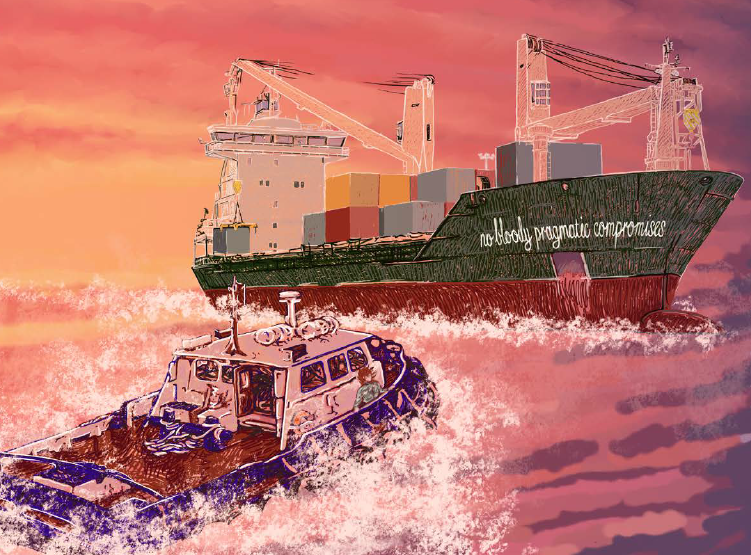
One theory for the relative weakness of the working class is that young workers lack the collectivism of prior generations. Dylan Brewerton-Harper’s interview with Janice McGarry, the first female shipbuilding apprentice, calls back to a time when injustice and discrimination was met with a strong and sustained challenge from the unions. Henry Maitles and Brian Boyd argue that while democratic rights and citizenship are part of the curriculum, they are falling by the wayside. Kieran Murphy discusses the inescapable prevalence of what Marxists call alienation, and Ngan Nguyen’s story of a refugee’s journey reminds us of all those in Scotland who have travelled or worked ‘illegally’ and are treated as aliens by the state and the courts – but who, as Karren Morrison suggests, may be the trade unionists of the future. As Odyssey watchers heard ad infinitum, the sacred law of xenia required all strangers and travellers to be treated with hospitality, because they might be gods. Scottish unions would do well to treat all migrants with solidarity, for they might one day be stewards of the movement.
It is a movement also fighting on the environmental front, from the erosion of working class communities by the kinds of economic development that Peter McColl describes in Torry, to the fires ripping through our cities and countryside which the firefighters are underequipped to fight, as Phil Chetwynd and Ian McGregor explain.
In our latter pages, we turn our focus internationally. Chris Main dissects the Board of Peace’s dead-end plan for Gaza, while Jean Rafferty offers a window into the oppressive turn of the education curriculum in Afghanistan. And last but certainly not least, Tommy Sheppard pays tribute to satirist-par-excellence Paul Sneddon, a.k.a. Vladimir McTavish, whose wit and wisdom shone from the inside back page of our magazine for decades, and who sadly passed away this summer. In his spirit, while there is much work to be done, let’s do it with good humour and a glint in our eyes.