The future of cultural criticism in Scotland depends on new forms of support and the old question of funding, write the Variant Editorial Collective.
Variant is an independent cultural magazine based in Glasgow, focused on ‘crosscurrents in culture’ and coming firmly from the left. It was first published in 1984 by a group of energetic and disaffected working-class graduates from the Glasgow School of Art. Originally a post-punk situationist influenced zine, it transformed into a glossy magazine and then latterly a tabloid newspaper.
Volume 1 was published until 1994, when the arts council cut its funding. Variant returned in 1996 for a second volume under the editorship of William Clark and Leigh French. Leigh was later joined by Daniel Jewesbury and finally a wider editorial collective. With volume 2, Variant’s shift to a cheaper tabloid newspaper format allowed for printing of 10,000 copies per issue.
Variant differed from other forms of critical cultural journalism. Less interested in celebrity culture or affirmative reviews, and not tied to any political group, it instead sought to understand culture’s imbrication with the political and economic world within which it was situated. Variant was, and is, more interested in posing difficult questions than providing glib answers. Its distinctive cultural and political contributions lie in its resolute insistence on critique and reflexive praxis, its rigorous yet non–academic approach, and its rebuttal of a prevailing anti-intellectual culture in the UK.
Producing a print edition (mirrored online) was always important to Variant. A key aspect of its history throughout volume 2 is that it was free and widely distributed, allowing for chance encounters with in-depth cultural criticism beyond the targeting of familiar networks. The authors of this text are partly products of such serendipitous encounters.
Rooted historically in critical artistic practice, Variant never settled there and sought to establish in parallel a set of divergent but connected strands in cultural studies, education, urban theory, institutional critique, working-class culture, and much more besides. Regionally rooted in Glasgow, Variant evaded parochialism and expanded its view globally by publishing many texts dealing with diverse geographies such as Turkey, India, the Balkans, and of course Palestine. It was distributed widely in Britain, Ireland and Europe.
Under French, Variant became a site for an increasingly forensic scrutiny of arts funding bodies, cultural nationalism, and encroaching market logics within public arts and cultural institutions, establishing its reputation as an essential critical voice within and beyond the counter-cultural scene.
In 2010, the Scottish Arts Council and Film Scotland were combined into a new unholy body under the name of Creative Scotland. Variant’s critical scrutiny of the marketisation of the cultural sector was unsurprisingly disdained by cultural administrators. And so the transition to Creative Scotland marked another death-knell for Variant (Volume 2), which was again defunded in 2012.
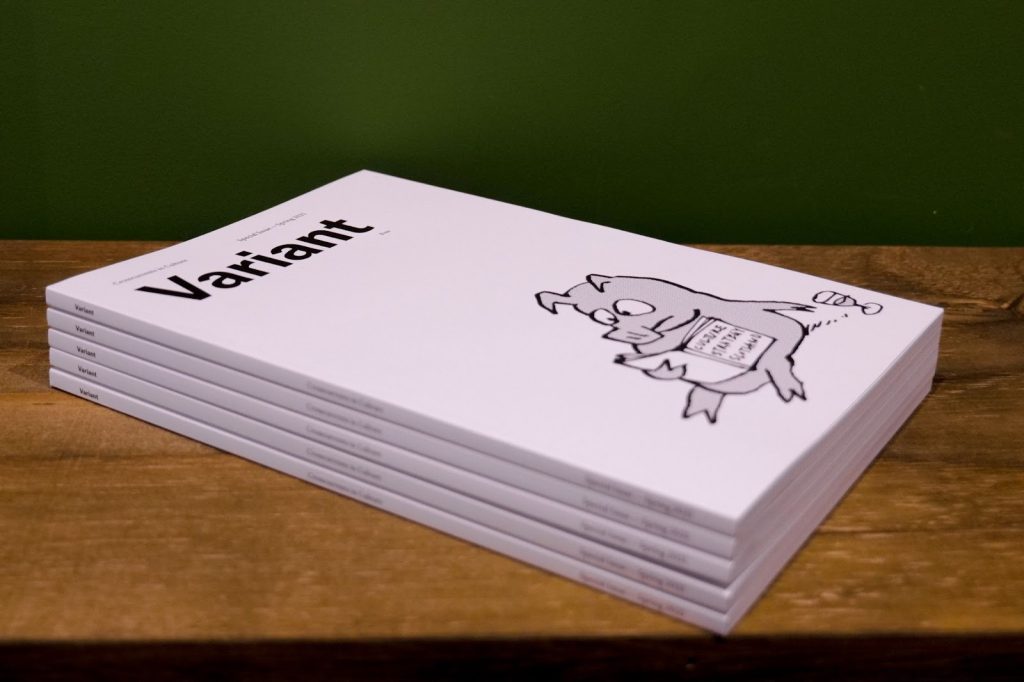
In the following years there were regular discussions about restarting Variant. Sadly, none of these conversations amounted to anything before the premature death of the main editor Leigh French in May, 2023. After Leigh’s death, various conversations took place on how best to mark the passing of our friend and comrade. The editorial group settled on a commemorative issue to engage with the spirit of the previous conversations about a new volume.
We put out an open call — the ‘we’ here being those of the editorial committee who could commit time to this project: John Beagles, Benjamin Fallon and Neil Gray. We were keen to see who was out there and what people might think necessary to say after Variant’s 13-year absence. We received an overwhelming response and ended up publishing a bumper issue of 32 contributions (previous issues featured between 6–10 articles). The work was undertaken free gratis (not a sustainable process but conceded to commemorate Leigh), with production costs aided by the emergence of cheap digital print services able to produce relatively affordable small runs.
The articles include discussions on radical housing culture in Glasgow, the position of Palestinian artists in Austria, cultural organisation in Scotland, class and literature, questions of form in relation to realism, the neoliberalisation of the arts and education sectors, serial publishing, and the relation between art, late fascism, and the working class. Standard article forms are accompanied by a series of artist pages and more experimental or poetic writing by artists. The range of contributions was typical of Variant’s broad approach to ‘culture’.
The future of Variant is an open question after forty years of publishing. We recognise the need for such media channels to engage with contemporary social and cultural reality in a serious critical reflexive manner, and the reception to the commemorative issue has been incredibly positive in this regard. However, the funding environment is not conducive to such work and new ways of thinking about how to support these necessary critical interventions will be required.
Variant is a magazine that addresses cultural issues in a social and political context.
The new issue and an archive of over 40 years of radical publishing from Glasgow is available here. https://variant.org.uk/.