‘A Play for Torry’ tells of how they paved paradise and put up an incinerator, a landfill site and not even a parking lot, writes Peter McColl.
It’s a warm summer evening, and in Aberdeen an evening like this is worth savouring. I’m walking through a wooded glade of deciduous and coniferous trees. Swallows and house martins swoop and hawk above my head, there is a gentle breeze on my face. It is a memory that lives with me.
From the nearby hill there is another memorable view. Memorable for very different reasons. To the left sits a newly imposed harbour, with industrial ships, then there is a sewage works and then as you scan the horizon a covered-over landfill site. Turn to the right and there is an incinerator with its chimney billowing. As you turn around there are houses now abandoned because they were built with a cheap form of concrete called RAAC that means they have been condemned.
I first encountered the idea of environmental justice more than twenty years ago. The idea that social injustice works by degrading the environment in which poorer people live and work. This view makes environmental injustice brutally clear. Poor housing, pollution, the destruction of natural spaces like the beach and now the park. Unimaginable in a rich community.
These two places are only a ten-minute walk from each other in Torry, one of the poorest parts of Scotland. Across the river are some of the richest parts of Aberdeen. The gap in life expectancy is more than ten years.
A Play for Torry tells the story of the area from the earliest records, spanning almost a millennium, through to the present. It shows how Torry became the dumping ground, metaphorically and literally, for Aberdeen’s most undesirable facilities and its rubbish. At times, the governing attitude seems to have been that one more blight would do little damage to a place already made to endure so much.
Developed in collaboration with the local community, the production is co-created with residents, artists and campaigners in Torry. Built from real voices and lived experience, it blends verbatim storytelling, ensemble performance, live music and an original score. The result is not just a piece of documentary theatre, but something more ambitious and more communal: part ceilidh, part protest, part love-letter to a place that has repeatedly been told to accept sacrifice in the name of somebody else’s progress.
Drawing on the tradition of the Theatre of the Oppressed, the production brings together professional actors and community members. Co-written by Mae Diansangu, Shane Strachan and Emer Morris, with direction from Emer Morris and Annabel Lunney, and original music from Coralie Usmani and Simon Gall, I saw it in the clubhouse of Nigg Bay Golf Club on a windy night in February. Outside, the weather was harsh. Inside, the room was warm and packed for the performance.
This is powerful because it isn’t a retelling of Torry’s history as a dry recount of injuries to the place. It is funny, moving, angry and defiant. The cast carry the audience through centuries of dispossession with humour, pace and feeling. You can feel the anger, but also the solidarity. The play refuses the idea that communities like Torry should appear only as victims. It presents them too as witnesses, organisers, singers, and fighters, fighters with humour.
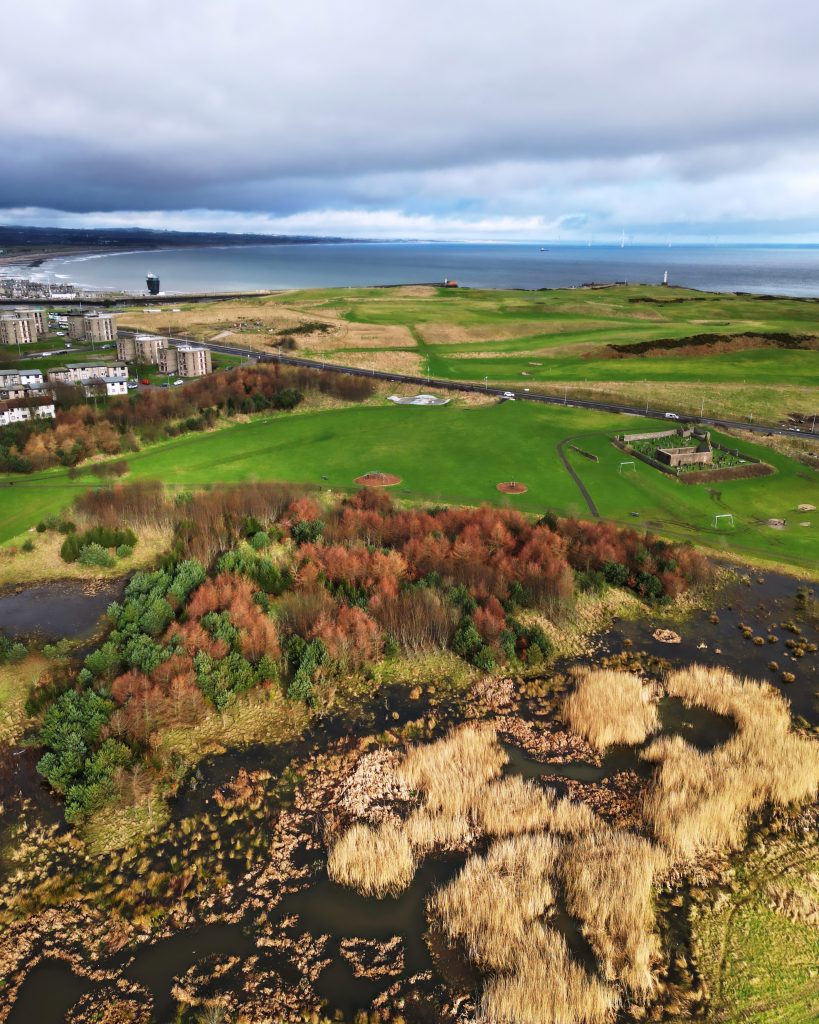
St Fittick’s Park, where I stood on that earlier summer evening, is now being torn up for an “energy transition zone”. The green of the trees is to be replaced by greenwash. Yet we are still not clear what the “energy transition zone” is actually for. The Bay of Nigg harbour beside the park has been justified in a succession of ways: as a base for extracting the last of the North Sea’s oil and gas, as a hub for offshore wind, even as a stopping point for cruise ships bringing visitors to Balmoral. The “energy transition zone” has acquired the same vagueness. Its purpose shifts, but the destruction remains constant.
The neighbouring industrial estates in Altens and Tullos are more than half empty, so why destroy a beautiful and much-loved park?
Some say it is to make the new harbour stack up commercially. Some say it is about capturing the profit to be made from replacing public green space with offices and light industrial units. Whatever the precise explanation, what is clear is that capital still has the power to appropriate a valued community resource from a place that has already endured more than enough.
Looming over this story is Ian Wood: oil baron, sometime billionaire and untiring enemy of Aberdeen’s green spaces until his death in July. Set against him was the wonderful and much-missed Renée Slater. In 2012, during an earlier attempt by Wood to seize another cherished public space, Union Terrace Gardens, she nominated a mannequin for the council under the name “Helena Torry, the voice of the silent majority”. It made the national news, reflecting the humour and resistance that were at the heart of both Renée and the campaign to save Union Terrace Gardens.
We were greeted by Helena on our way into the play. Union Terrace Gardens escaped Wood’s grasp. St Fittick’s Park has not been so lucky.
The production takes the audience on a journey from the arrival of St Fittick, who gave his name to the now-ruined church in the park, to the twenty-first century. The people of Torry lost their homes in the oil rush, their beach in the oil slump, and now their park in the age of renewables. The actors convey that history with verve, charm and force.
What A Play for Torry understands especially well is that this is not simply a local planning dispute. It is a question about the politics of transition itself. The production asks, directly, who the “Just Transition” is really for, and what it costs when decisions about climate and land are made without the people who live with the consequences. Rooted in Torry, it plainly resonates beyond Aberdeen, because the pattern is familiar across Scotland: industrial and coastal communities promised renewal, consulted late if at all, and expected once again to bear the burden.
There is a direct line from the destruction of old Torry to make way for oil infrastructure, through the siting of Aberdeen’s most undesirable facilities in the area, continuing with the construction of housing now deemed unfit and awaiting demolition, and ending with the removal of vital green space in the name of transition.
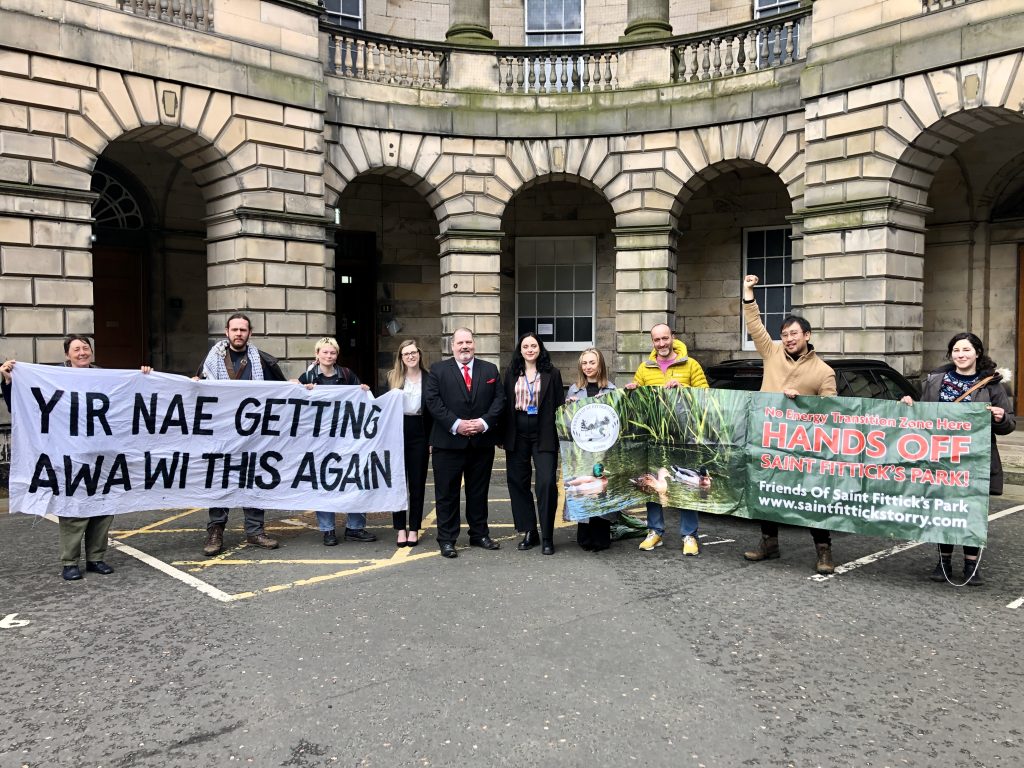
At its heart, the story of Torry is about corporate power: first in the age of oil, now at the end of the oil age, capturing the language of net zero and “transition”. A Play for Torry shows how communities are asked, again and again, to surrender health, memory and public space for a prosperity accumulated elsewhere. The destruction of the park has begun, but the public case for destroying it remains as thin as ever. That is what greenwash looks like when used against a community already treated as expendable.
The play succeeds because it combines politics with craft. It does not merely document injustice. It reflects a community’s struggle in language and song with humour and integrity.
Peter McColl is a writer and thinker. He was Rector of the University of Edinburgh 2012-15 and has a wide range of interests from data and technology to public participation in policy.