What are the experiences of those working to build unity between environmentalists and the labour movement? Matthew Crighton surveys a diverse range of activists, and shows how the alliance is more urgent than ever.
In 2015, Eurig Scandrett and I asked ‘Can green and red unite?’ in SLR issue 89 which we co-edited on the theme of Growing A Green Economy. We now have over a decade more experience and we know that climate campaigners and trade unionists find common ground and work together on many issues, if not all. On the left the importance of this question has become apparent to more people as the climate and nature crises have developed. In green movements and climate campaigns, at least some sections have realised that organised labour is a necessary ally not just a desirable one.
Perhaps now we can reflect on those experiences in order to plan ahead for a movement which unites environmentalists, trade unionists, movements for social justice and the left in general. We know we can co-operate, we now need to tackle the bigger question of ‘How can red and green unite to save our planet and change the world?’.
There are two unique things on which Scotland can draw here. One is the creation in 2016 of the Just Transition Partnership (JTP) by the STUC and five affiliated unions, Friends of the Earth Scotland, other environmental organisations and supportive think tanks. The other is the experience of decline of the offshore oil and gas industry and efforts to map a pathway forward for its workforce – the publication of the Our Power report by three environmental organisations which received the support of the relevant trade unions is perhaps a key milestone.
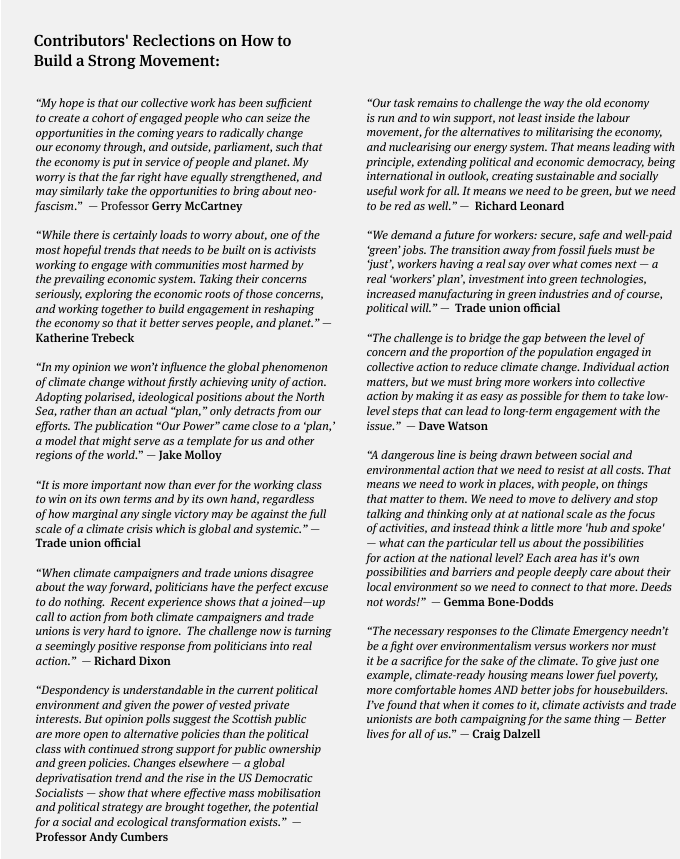
To capture a wide range of conclusions from key participants we invited short statements from the contributors to SLR 89 and from the people most involved in creating and sustaining the JTP and in related initiatives. Here’s the question:
From your experiences of working with trade unions and climate campaigners towards a strong enough movement to end the causes of climate change, what’s your main message to SLR readers looking to the future? What do you hope for or worry about?
Eleven years ago, most articles were mapping out the territory. Some were excavating from the past examples where workers had been engaged on environmental issues rather than with environmental organisations. Eurig’s article on environmental justice shows that some environmentalists have supported working class communities but not that they had engaged with workers organisations.
The responses today show a changed landscape in which each draws on the diverse practical experiences of the contributors. There are differences of approach but taken together it starts to look coherent. I’ve taken what I think is a core message from each and put them together:
- Climate activists and trade unionists are both campaigning for the same thing — better lives for all of us.
- A call to action from both climate campaigners and trade unions is very hard for politicians to ignore.
- Adopting polarised, ideological positions, rather than an actual “plan,” only detracts from our efforts.
- It’s important for the working class to win on its own terms and by its own hands.
- The transition away from fossil fuels must be ‘just’, workers having a real say over what comes next.
- Bring more workers into collective action by making it as easy as possible for them to take low-level steps that can lead to long-term engagement.
- We need to work in places, with people, on things that matter to them.
- Engage with communities most harmed by the prevailing economic system.
- Where effective mass mobilisation and political strategy are brought together, the potential for a social and ecological transformation exists.
- Challenge the way the old economy is run and to win support for the alternatives — we need to be green, but we need to be red as well.
It’s not a rigorous approach but it illustrates some consensus over the direction of travel for a combined movement for climate justice. And not just on climate.
In previous decades, ‘environmental issues’ would have been read to cover a much wider set of problems. We have to tell our allies that climate change is only one of the environmental limits which are being breached – there’s a nature crisis too, which stems from multiple ways in which our economic system is attacking the capac ity of our environment to sustain our civilisations. What we have learnt in addressing the challenge of decarbonising our economy we now have to apply to these issues to – to a just transition to an economy which protects nature in order to protect ourselves