The Union Theatre Company delivers a thought-provoking debut in their production of Shall Roger Casement Hang? at the Hill Street Theatre, Edinburgh, finds Allie Kerper.
The brand-new Union Theatre Company could not have picked a more appropriate time to revive Peter Arnott’s 2016 play Shall Roger Casement Hang?, originally written for the centenary of the Easter Rising and in the wake of Scotland’s 2014 Independence Referendum. The decision to stage the play in the week leading up to Edinburgh Pride was presumably deliberate; however, the preceding week’s Belfast pogroms and sentencing of four Palestine Action activists as terrorists were as much a part of the play’s ominous backdrop as the noose that loomed over the set for the play’s duration.
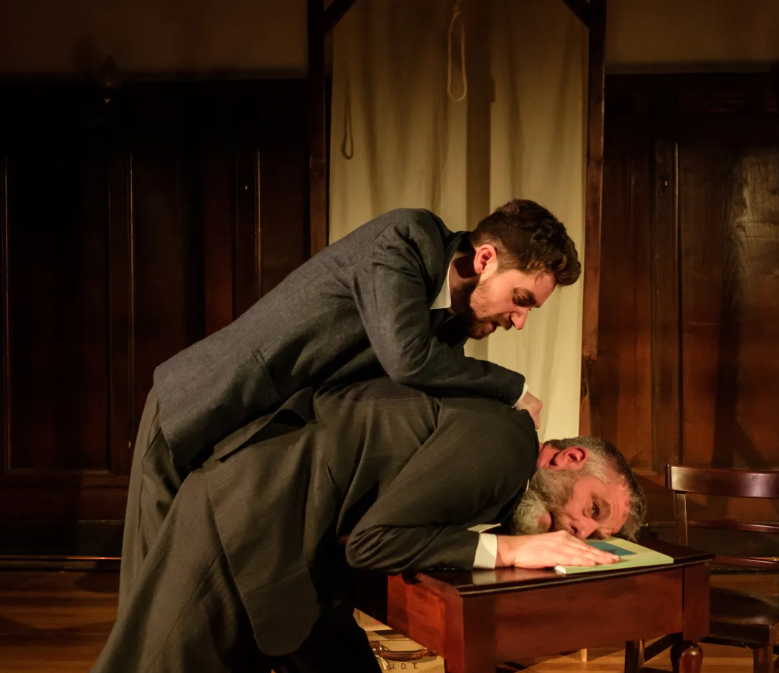
Shall Roger Casement Hang? dramatizes a critical moment from the real life of a controversial and contradictory figure: an anti-imperialist hero of the British Empire, and a Protestant-raised Irish Nationalist who both aided and tried to cancel the Rising. Roger Casement was renowned in his day for exposing Belgium’s human rights atrocities in the Congo. He later became involved in the Irish Nationalist cause and, in 1916, was arrested trying to smuggle German guns to the Irish Volunteers. Casement was convicted of treason and executed. During the trial, Casement’s diaries detailing his sexual encounters with men were discovered and widely publicised, turning public opinion against him.
From the vast and complex story of Casement’s life, Arnott’s play depicts just two days: his police questioning the day before and the day of the Rising. In the first act, Casement (played by Paul Arendt) is questioned by the fictional Scottish Captain Reginald Hall (Adrian Moore). The dialogue loops and repeats, which slows the action but emphasises the dynamic: while Hall tries to offer Casement a way out of trouble, Casement, nervous and unwell, doubles down on his convictions without wanting to jeopardise his comrades, unsure of what Hall already knows. The interrogation is intercut with flashbacks to Casement’s arrest and attempt to send word to the Volunteers through a priest. In these scenes, Moore plays both the arresting officer and the priest, conveying the sense that the different faces of authority ultimately share the same interests.
If anyone in the audience had forgotten about the noose at the back of the set during Act I, a projection between acts reminds them what is really at stake. Images of people, ranging from Congolese victims of nineteenth century empire to modern Trans Pride marchers, are projected onto the back wall of the stage. The noose occasionally frames the face of an individual, creating a foreboding mood into which Act II roars with fury. The Rising has begun, the diaries have been discovered, and there is no more mercy for Roger Casement. With nowhere left to hide, Casement proudly defends what he stands for, in all its imperfection and moral compromise.
One of the play’s most striking moments is when Casement infers that Hall too is queer. Rather than simply a twist in which the homophobe is secretly gay, we see something more: an invitation of mentorship and solidarity, mirroring the way in which Casement wishes for Ireland’s independence movement to inspire the people of Scotland. Of course, Hall cannot accept Casement’s truth/challenge/vision, and the question in the play’s title is answered as it was in history.
The play asks many questions, explicit and otherwise. When Casement asks Hall, ‘What does freedom mean to you?’, we also wonder, what do guilt and innocence mean, and to whom are they afforded? In Hall’s Scottishness and loyalty to imperial sensibilities, we are prompted to ask, what would an independent Scotland stand for? The answers to these questions are troubled by the text, the production, and the political context of the performance.
Just days before the play’s opening night, the first of the Filton 25 defendants were sentenced as terrorists, without the jury having been informed prior to conviction. What do innocence and guilt mean, and to whom are they afforded? On the play’s closing night, a man targeted Muslims in a series of violent attacks across Edinburgh. What does freedom mean to you, and what would an independent Scotland stand for?
Arnott’s play feels eerily prescient, as does the Union Theatre Company’s choice to stage it for their debut production. Per their website, the company aims to produce ‘challenging, engaging and thoughtful theatre’, and they are off to a phenomenal start with Shall Roger Casement Hang? The production ran just five nights, and the first included a Q&A with Arnott after the show. Arnott discussed the context in which he wrote the play, details about Casement’s life, how his own fascination with Casement came about, and the reasons and inspirations behind certain writing choices.
Arnott spoke of ‘recovering the present tense in history’ – how the characters in the play don’t know what will happen, even though the playwright and audience do. Casement may have known that (most of) Ireland would one day be independent, but he could not have known that (according to Arnott) the reinterment of his bones in Dublin would one day be thought to have incited the Troubles, or that the long shadow of this period would include (allegedly, at time of writing) Loyalist paramilitaries committing anti-Muslim pogroms in Belfast more a century after the Rising. Nor could Casement have known about the mass struggles for – and partial successes toward – queer liberation that would give rise to things like Pride Month and the celebration of historical queer figures.
At a time when history feels alarmingly present, radical theatre can remind us what questions we should be asking ourselves, and not to settle for the pretence of neat answers. The Union Theatre Company opened their run to a nearly sold-out venue; hopefully, this thoughtful, troubling, human production has garnered them the support they need to carry on asking such questions. They promise to be an important addition to Edinburgh’s year-round performing arts ecosystem, and local theatre fans should keep an eye out for their next production.
Allie Kerper is a poet, editor and trade union activist based in Edinburgh.