Jukka Seppälä finds that Lesley Riddoch’s nationalist image of Finland owes more to fantasy than facts.
The Nordic countries have been well-marketed in Scotland. For elements of the independence movement and indeed the Scottish Government, they embody the kind of social democratic policies and values that Scotland should choose over the London-centric UK.1 Many Scottish fans of the Nordics will have seen earlier instalments of Lesley Riddoch’s ‘Nordic Horizons’ series. The latest documentary in Riddoch’s series, Finland: The Happiest Country That Almost Didn’t Exist, is a great case study of the strengths and limits of Scotland’s self-identification as an aspirational Nordic welfare state. The documentary provides an inspiring but limited view of Finnish social democracy, sticking to the level of specific policies, whilst ignoring the economic and cultural crises facing Finland which should make any leftist wary of Nordic utopianism.
While I admire Riddoch’s keen eye for Finland’s common-sense policies, she leaves out much that is relevant to analysing the state of Finnish society. The most striking omission is Finland’s recent policy record, especially under the current Thatcherite right-wing government. Instead of a capitalist country experiencing class war and the normalisation of xenophobia by its governing parties,2 Riddoch portrays a seamless, frictionless nation. Another elephant in the room is the increasing Atlanticism of the Finnish elites after the country joined NATO in 2023.3 Riddoch’s perspective echoes the nation-branding PR of Finnish public diplomacy.4 Given the compromises inherent to ‘being Nordic’, the independence movement should perhaps rethink how, and why, it learns from the Nordics.
How Riddoch’s documentary exposes the limits of Nordicism
There are grounds for Nordicist awe. In many respects Finland is a very well-functioning society. I have seen how smoothly Finland’s larger urban centres seem to function in comparison to parts of Scotland and the wider UK. However, Riddoch’s enthusiasm focuses on highly specific facts and snapshots of Finnish life. This includes praising Finland’s national preparedness in anticipation of an invasion and marvelling at the coexistence on an island of open prison convicts with residents, which supposedly demonstrates the country’s high level of social trust.
Whilst it is reasonable to appreciate such details in isolation, the documentary frames these facts in a manner that largely obscures the role of friction and class politics in shaping Finnish history. Take the following quote for example:
“So this is Finland, the happiest country despite the most difficult history. The best place to be a child with excellent education and low child poverty. A land of ice breakers, saunas, cooperatives, and bunkers in case of invasion. A country run by its neighbours for centuries that’s created its own common-sense approach to solving social problems. A different way of running a country in the face of all adversity. If anyone can teach resilience and determination, surely it’s the unsinkable Finns.”
This framing of Finland as a unified country with high levels of trust and higher levels of happiness seems more instrumental than instructive. Its function is to provide a proxy for a particular vision of Scottish independence. With a brief detour discussing Finland’s early history of civil war and struggle against the Soviets during the second World War, Riddoch portrays a unified society that has transcended class inequalities by strengthening itself, against difficult odds, in pursuit of common-sense policies. The film’s subtext is that if Scotland also achieved independence (and was nationally ‘unified’) it could also unleash its national character towards the end goal of an imagined Nordic state without much class contradiction or structural racism.
In contrast to a nationalist argument emphasising the unity of classes, Finnish leftists have often argued that socialist political parties and organised labour are largely to thank for many of the social democratic aspects of Finland we still celebrate.5 Labour unions aren’t mentioned in the documentary, even though they are key to the Finnish success story. At their peak most Finnish workers belonged to unions, which largely accounts for the better working conditions they were able to negotiate in the Finnish social-corporatist model.6 Since the 1990s, however, Finland has gradually come to a point where a majority of its workers are deunionised. This has coincided with the growing strength of capital over labour.
At worst, the foundational nationalist assumption of Riddoch’s documentary is part of a lineage of classless nation-branding discourses about the Nordics. Unlike interpretations of Finnish history that recognise class struggle, the Nationalist story is perhaps more sellable to foreign audiences because it centres around that politically safe and marketable word: happiness. This simplistic narrative builds on Finland’s high score in the questionably named World Happiness report.7 It comes with the added assumption that the measured contentedness of citizens is the ultimate criteria by which to judge a political system. It is a rather uncomfortable assumption given the grave injustices perpetrated by many of the higher-ranking countries, including Israel (8th happiest) against Gaza.
Another problem with this nationalist framing is its lack of explanatory power. At the very beginning of the documentary, the high praise of Finland’s education system and of the population’s longevity are attributed to Finland’s quasi-mythical national character, sisu. Sisu is a Finnish term for determination and perseverance against impossible odds and formidable trials, from the cold climate to war. As a Finn I never gave this word much serious thought, as it mostly reminds me of the patriotic lingo of Independence Day speeches. This myth doesn’t have much to do with actual politics or life in modern post-industrial society. I doubt its role as a key material factor driving history.
Finland’s policy successes
But beyond the limits of this sisu-centric story of Finland’s success, what about the documentary’s empirical value? Riddoch’s policy analysis gets a lot right. Facts rightfully celebrated by Riddoch include the fact that Finland has the world’s largest number of co-operatives, which Riddoch says is “why Finland also tops the world charts for food security.” She also aptly points out that, “While Scotland is dominated by private landowners and developers, Helsinki City Council still owns 66% of its land so can plan for the long term.” I also appreciate the love shown to Helsinki’s central library, its diversity of free services, and the fact that Finns are among Europe’s top public library users.
There is also the much-praised Finland’s Housing First policy, and the continued focus on building affordable housing. However, whilst homelessness is still low compared to Scotland, it has risen for the first time since 1987 during the current right-wing government.8
On the other hand, the documentary’s claims about Finland’s education system (“the envy of the world”), are much more out of date. Indeed, the current domestic narrative about the Finnish education system is almost the opposite. The country was previously proud of its top-level PISA rankings, but its free state education system has plunged in PISA rankings for literacy and maths for more than a decade. The alarming decline of the education system and the relative lack of resources is a hot topic among teachers.9
Finland’s Rightwards Turn
The facts in Riddoch’s documentary largely point to a technologically advanced, progressive and egalitarian state, which has somehow achieved all of this without exploitation but through sheer determination and common sense. Such a story should raise an eyebrow. Indeed, in many ways Finland’s current trajectory offers a cautionary tale about what happens when states embrace austerity and neoliberalism, under pressure from international monetary institutions and capital’s incessant hunger for profits and so-called productivity. Similarly to the rest of Europe, Finland has seen a normalisation and mainstreaming of radical right parties, and the general acceptance of racist and xenophobic discourses by government ministers. Rather than offering an egalitarian alternative to little England, Finland is a state where anti-immigrant politics are running rampant and far-right street movements exemplify a general mainstreaming of racism, which obviously reflects deeper colonial and racial structures embedded in Finnish society.
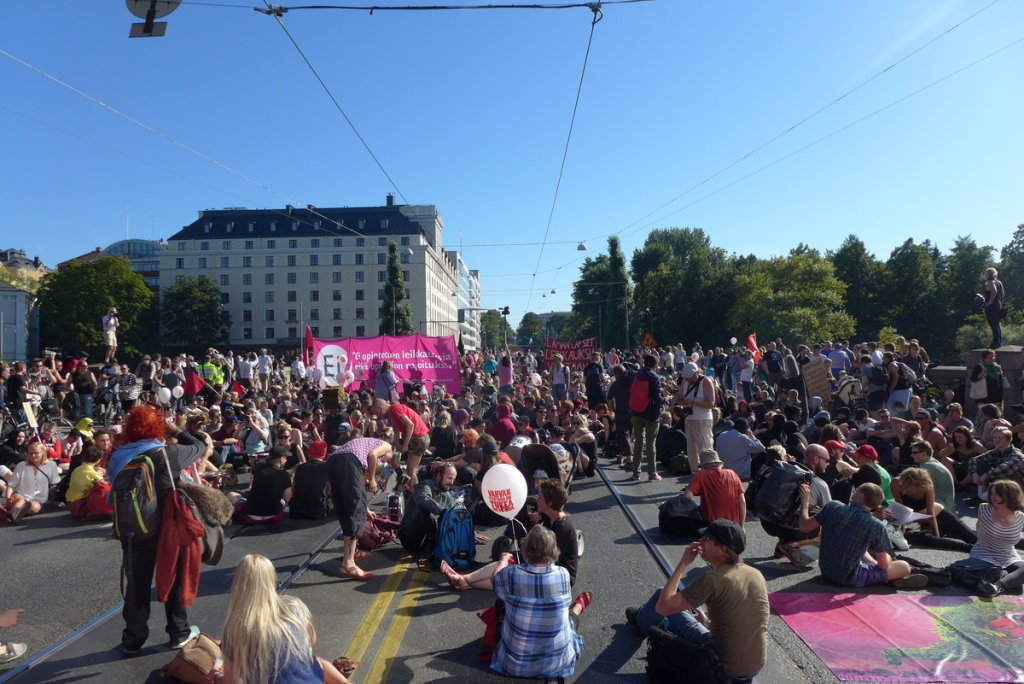
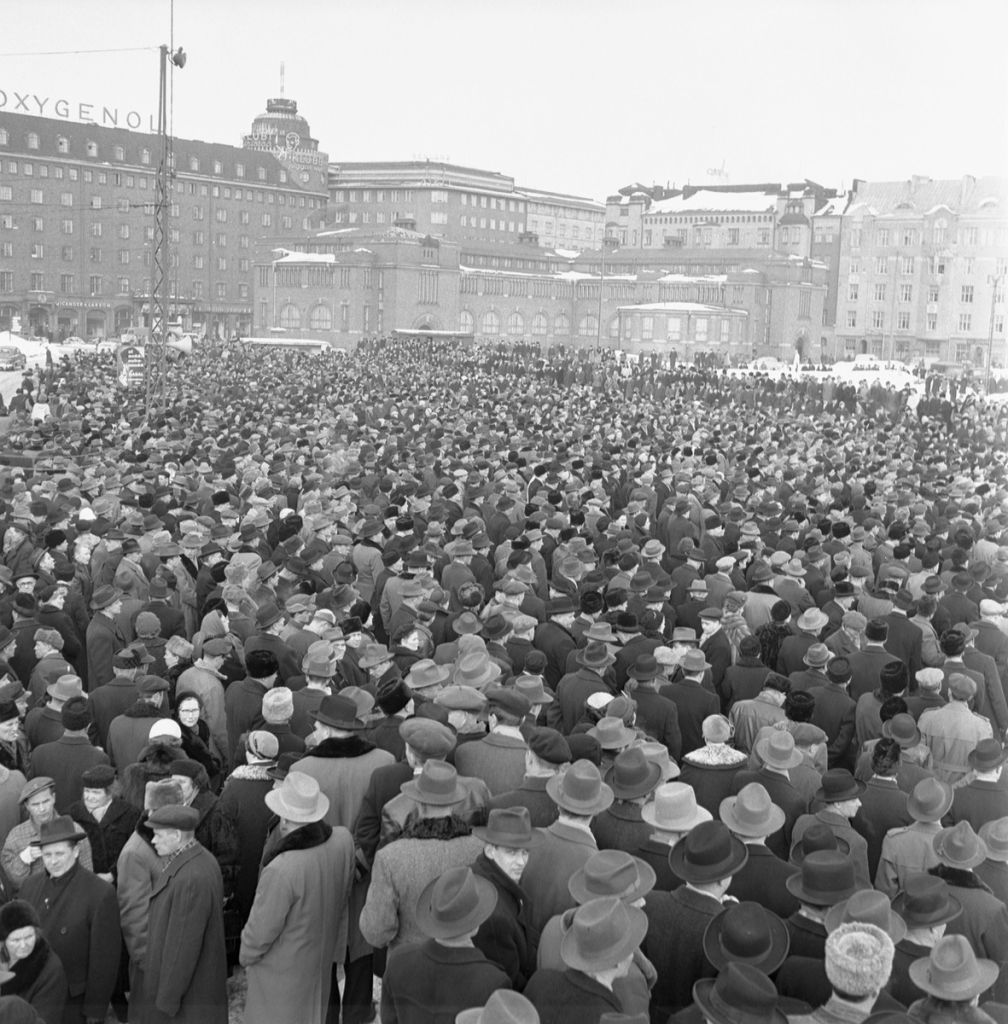
The right-wing turn of Finland has ushered in unprecedented government austerity, including but not limited to cuts to welfare benefits,10 healthcare and culture.11 Finland is also hardly a utopia for the disadvantaged. Finland boasts the highest unemployment rate in all of Europe at the time of writing. Beneath the image of homogenous social cohesion, Finland is a society of ethnic tension, migrant labour powered economies and modern-day slavery. It is a society with a health and care sector in a crisis not dissimilar to Britain’s. This is a society where the left is on the backfoot, defending the welfare state, or what is left of it, against erosion.
Another cautionary tale is geopolitical. Neoliberal Finland is a country whose elites have moved from military non-alliance not just to being more (rightly) prepared against real and perceived Russian state threats, but also to being more firmly Atlanticist, a position that ties Finland to imperialism in ways that is scarcely recognised by Nordic Utopians abroad. Indeed, the Left Alliance’s leader has argued that Finland’s fate is becoming so tied to the United States that it undermines its commitment to international law, and the avoidance of nuclear proliferation.12 This is scarcely an ‘independent’ existence: Finland’s reliance on the US has coincided with an increasing number of defence deals with Israel and American military bases in the country.13 What the Scottish independence movement is to make of this side of Nordic geopolitics is rarely raised.
There is also a notable lack of critical discourse regarding Finnish political elites. Take for example the global liberal establishment’s favourite progressive darling, former PM Sanna Marin, now working for the Tony Blair institute,14 which was tied to the neo-colonial ‘Trump Riviera’ Plan for postwar Gaza.15 Or Finland’s current president Alexander Stubb, the Europhile who has also been known as the ‘Trump Whisperer’, and signed an $6.1 billion icebreaker deal with a Trump regime known for its imperial intentions towards Greenland.16 Whilst Finland is Nordic and European by foreign policy identity,17 this identity does not exist in isolation from vassalage to American foreign policy interests. Fans of the Nordics should be clear about their stances on the aspects of the Nordic geopolitical grouping they want an independent Scotland to align with.
Notwithstanding the unanswered questions, there is little doubt that, for many people, it is a ‘lottery victory’ to be born in Finland (as the Finnish saying goes), and that Scots would benefit from the various policies Riddoch champions.18 In a time of monsters however, we cannot afford Eurocentric naval gazing and only focus on any country’s domestic achievements regardless of their imperial and environmental costs.
Who should Scotland learn from?
When learning from other countries, we should always ask the critical question of what not to learn from them. All societies have their faults. We should inquire deeper and question whether the familiar reference points are helpful for internationalists or anyone concerned with ‘progress’ (if one professes to believe in such notions). It is understandable why the independence movement continues to study the Nordics. In a post-Brexit little Britain of increasing xenophobia, it is hard not to champion a turn outwards towards Europe. But perhaps our map of the world should extend far beyond this. I would propose some rethinking regarding how an independent Scotland could orient itself geopolitically. This is key, as there is scarcely a ‘Nordic’ escape route from currently-existing capitalism, especially if one desires a more egalitarian, polycentric world system. To learn from the Nordics and their allegedly more social democratic systems, we must first acknowledge the cost, contradictions, and limits of such systems. We can start by recognising that there are good Finnish policies which we could adopt at home. Understanding these can help build consciousness of what the British state has failed to provide, as Riddoch so lucidly argues. But let’s soon move beyond state-promoted nationalistic interpretations of these countries’ histories in favour of narratives that put working class struggle at the centre of the story.
Jukka Seppälä is a Finnish politics researcher and information worker based in Scotland.
- The Scottish Government (2024) Building a New Scotland: An Independent Scotland’s Place in the World. Available at: https://www.gov.scot/publications/building-new-scotland-independent-scotlands-place-world/pages/10/ (Accessed: 19 May 2026). ↩︎
- Kyyrönen, O. (2024) Finland’s Government is Robin Hood in Reverse. Jacobin. Available at: https://jacobin.com/2024/11/finland-finns-austerity-authoritarian-neoliberalism ↩︎
- Särkkä, I. (2023) Nordic, European, or Atlanticist? Finland’s state identity during the post-Cold War period. Nordic Review of International Studies, 2, pp. 64–71. ↩︎
- For an example of a prominent book that argues that Nordic countries have a superior social model, see Partanen, A. The Nordic Theory of Everything. In terms of the branding of Finland as the embodiment of ‘happiness’, this is also heavily promoted by the Finnish Government owned VisitFinland. This is reminiscent of similar efforts elsewhere, exemplified by bestseller books such as the Danish ‘Hygge’, which commodifies ‘the Danish secret to Happy Living’ ↩︎
- Ahponen, Tatu (2020) Class Struggle Built the Finnish Welfare State. Jacobin. Available at:
https://jacobin.com/2020/01/finland-socialism-capitalism-welfare-state-strikes ↩︎ - Böckerman, P., Kallin, S., Juuti et al. (2025) Miksi järjestäytymisaste laskee ja mitä siitä seuraa?
Labore. Available at: https://labore.fi/t&y/miksi-jarjestaytymisaste-laskee-ja-mita-siita-seuraa/ ↩︎ - Rather than focusing on ’happiness’ the annual study measures the extent to which Finns are content with their lives. Even so, the Finnish happiness hype perversely glosses over the fact that Finland also ranks globally high for depression. See: Poggemann, J. (2022) Depression in the “World’s Happiest Country”: Notions of Social Exclusion in Finland. Åbo Akademi. Available at: https://blogs.abo.fi/socialexclusion/2022/09/26/depression-in-the-worlds-happiest-country-notions-of-social-exclusion-in-finland/ ↩︎
- Geraghty, L. (2025) Why homelessness is rising in Finland – and what Britain can learn. Big Issue. Available at: https://www.bigissue.com/news/housing/finland-homelessness-rising/ ↩︎
- Hosseini, S. (2026) Peruskoulun voi pelastaa. Suomen Kuvalehti. Available at: https://suomenkuvalehti.fi/kulttuuri/arvio-nyt-opettajat-kertovat-miksi-pisa-tulokset-ovat-romahtaneet/?shared=1354197-6ba9e4ea-1 ↩︎
- SAK (2025) Finnish Government decisions pushing people further into poverty. SAK. Available at: https://www.sak.fi/en/topics/news/finnish-government-decisions-pushing-people-further-into-poverty/ ↩︎
- Watson, M. (2024) Finnish Right-Wingers Are Defunding Culture. Jacobin. Available at: https://jacobin.com/2024/12/finland-right-defund-arts-culture ↩︎
- Koskela, M. (2026) Minja Koskela: Hallituksen hyssyttelyselonteko ei pysty myöntämään tosiasiaa: Yhdysvaltoihin ei voi enää luottaa. STT Info. Available at: https://www.sttinfo.fi/tiedote/72015371/minja-koskela-hallituksen-hyssyttelyselonteko-ei-pysty-myontamaan-tosiasiaa-yhdysvaltoihin-ei-voi-enaa-luottaa?publisherId=69821237&lang=fi ↩︎
- Ahronheim,A. (2026) Finland hosts large Israeli defense delegation for two-day seminar. The Jerusalem Post. Available at: https://www.jpost.com/defense-and-tech/article-896225 ↩︎
- Tony Blair Institute for Global Change (2023) Sanna Marin, former Finnish prime minister, joins the Tony Blair Institute. Available at: https://institute.global/insights/news/sanna-marin-former-finnish-prime-minister-joins-the-tony-blair-institute ↩︎
- Quinn, B. (2025) Tony Blair thinktank worked with project developing ‘Trump Riviera’ Gaza plan. The Guardian. Available at: https://www.theguardian.com/politics/2025/jul/07/tony-blair-thinktank-worked-with-project-developing-trump-riviera-gaza-plan ↩︎
- Bernd, D. (2026) Icebreakers and golf spark Trump and Finnish leader’s unlikely friendship. BBC News. Available at: https://www.bbc.co.uk/news/articles/c4g7nl35nz2o ↩︎
- Särkkä, I. (2023) Nordic, European, or Atlanticist? Finland’s state identity during the post-Cold War period. Nordic Review of International Studies, 2, pp. 64–71. ↩︎
- A ‘lottery victory’ is an adaptation of a quote originating from Cecil Rhodes, showing how ‘Nordicness’ has never been far removed from broader ‘Western’ imperial tendencies, and pointing to the unconscious influence of the British Empire on Nordic cultures. “You are an Englishman, and have subsequently drawn the greatest prize in the lottery of life” (said by Rhodes to Lord Grey. Michell, Lewis (1910). The Life and Times of the Right Honourable Cecil John Rhodes 1853-1902, Volume 2. New York and London: Mitchell Kennerly. p. 178.)
↩︎