When Forth Valley Unison won a spectacular victory over Serco, there was to be no honeymoon. Straight after their success, anti-migrant protests flared in Falkirk, with UNISON members on both sides of the divide. Cailean Gallagher and Stephen Smellietalked to Karren Morrison and Charlie McCarthy about the highs, lows, and lessons of an exceptional year.
As far as Karren and Charlie know, Serco was never beaten by industrial action before some of Scotland’s lowest-paid NHS staff resisted its attempt to restructure their pay. When the multinational announced its plan to shift workers from weekly-paid to monthly-paid contracts, “people were terrified”, Karren recalls. “We had people crying, they were really upset, and then very, very, very angry.”
What was the issue with these plans? “If you understand low pay, you know how difficult it is to budget. People who are not low paid don’t really see what the issue is with monthly pay, because they don’t understand poverty. A lot of people in low pay budget to the penny and need the income weekly. And if you need to buy something quickly, you might do an overtime shift, but you only get that money fast if you are paid weekly.”
Not only were Serco imposing the change on people who did not want it. They also proposed to give workers a loan, making them indebted to the company. Some might manage to pay off the loan from future income, but for others that debt would linger.
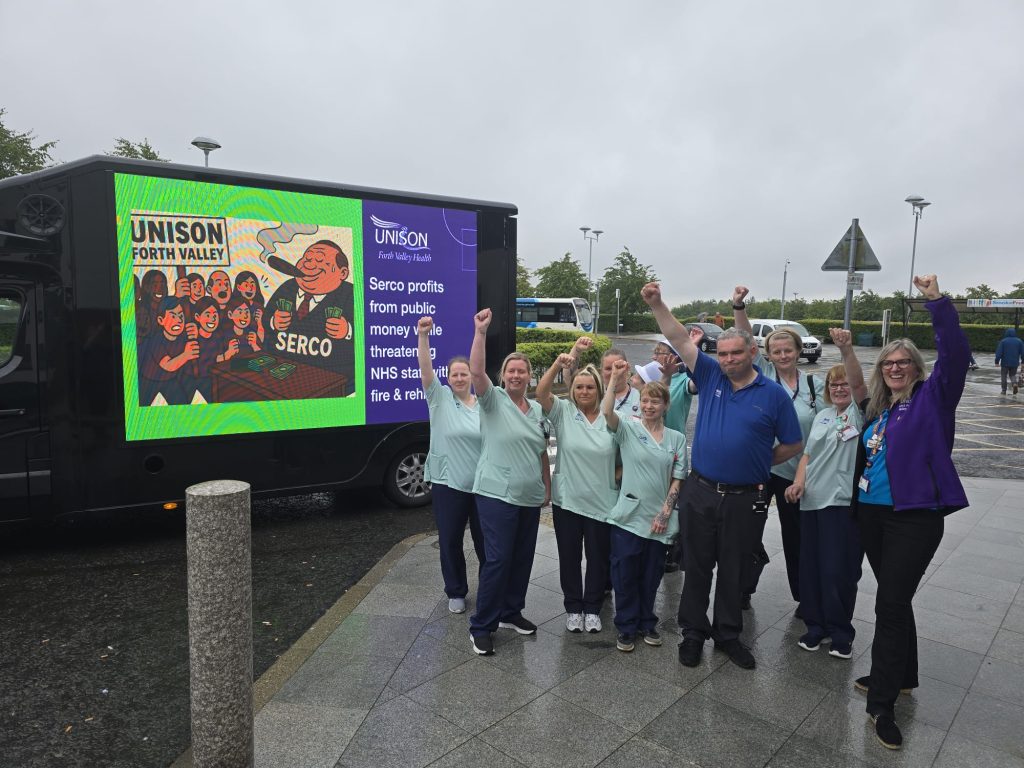
Serco’s people were flummoxed and frustrated by the refusal to accept the change: “people in ivory towers”, Charlie said, “who had no idea what it’s like to live on the bread line”. Karren recalls how “one of the lassies, an HR head in London, actually lost it”.
“She was like, ‘I just don’t understand. I just don’t understand. We’ve imposed this on all our workforces and it’s only Forth Valley where this is an issue. I just don’t understand the problem.’ I remember saying to her, ‘do you know what, it really worries me that you don’t understand what the problem is here, because we know what it is’, I said, ‘and I’m really concerned about that’. So she shut up.”
But still HR refused to listen to the workforce. “They did consultation”, Karren said, “which meant they told people what they were going to do. Their workforce were telling them that this was not a good idea. And they just kept ploughing on and on and on.”
The scene was set for a struggle that united hundreds of NHS Forth Valley workers.
Scales in Our Favour
From Indonesia to England, Serco has imposed its “unicorns and bunny rabbits, or what we call fire and rehire”, to shift workers into monthly pay and debt, and threaten to use scab labour to replace those workers who object. Why was Scotland different?
Scottish legislation has something to do with it, by making it more difficult for private companies to use anti-union tactics or alter contracts at will. The requirement for disclosure and PGVs before recruits start work makes it much harder to hire scabs or replace workers. Meanwhile, the Two-Tier agreement means staff working for private providers contracted to the NHS are entitled to terms and conditions no less favourable than directly employed staff. In England, Serco contracts do not have to offer NHS rates. In the Scottish NHS, Serco could not fire and rehire the workers with impunity. In a Scottish NHS environment, workers have a bit more power than south of the border.
Meanwhile, Serco would potentially breach their contract and face enormous fines if a strike damaged their ability to deliver their contracted service. For that reason, a strike might even have led to getting rid of Serco because they would have breached contract. As it turned out, workers’ action hit their target before a strike was needed. The reason for this success? “Imagination and fun, I think that sums it up”, said Charlie, describing the series of stunts that empowered and emboldened the workers for the fight. A new Serco manager had already been imposing things that workers didn’t like, so by the time workers met “everybody was raging: they were weak, and we came on pretty strong.”
The Struggle Against Serco
There hadn’t been an NHS strike since the pensions dispute, and the determination to prevent one was also powerful for the union. And the members were all on-site, in the acute hospital, face to face. There were boots on the ground, facility time, and joint union working.
“Everybody wanted to get involved. And we also had the best people ever you want to be on strike, and that is low paid part time female workers. They are warriors. They are absolute warriors. Sometimes we were ******* them off because we weren’t going fast enough for them. We had that in our favour.”
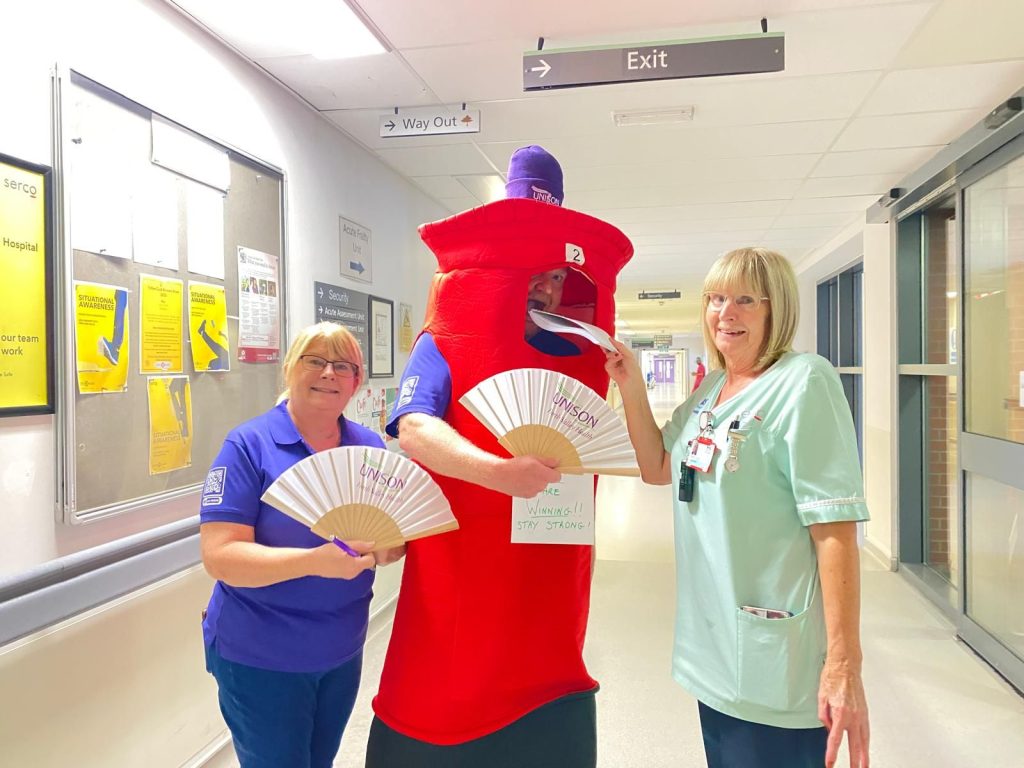
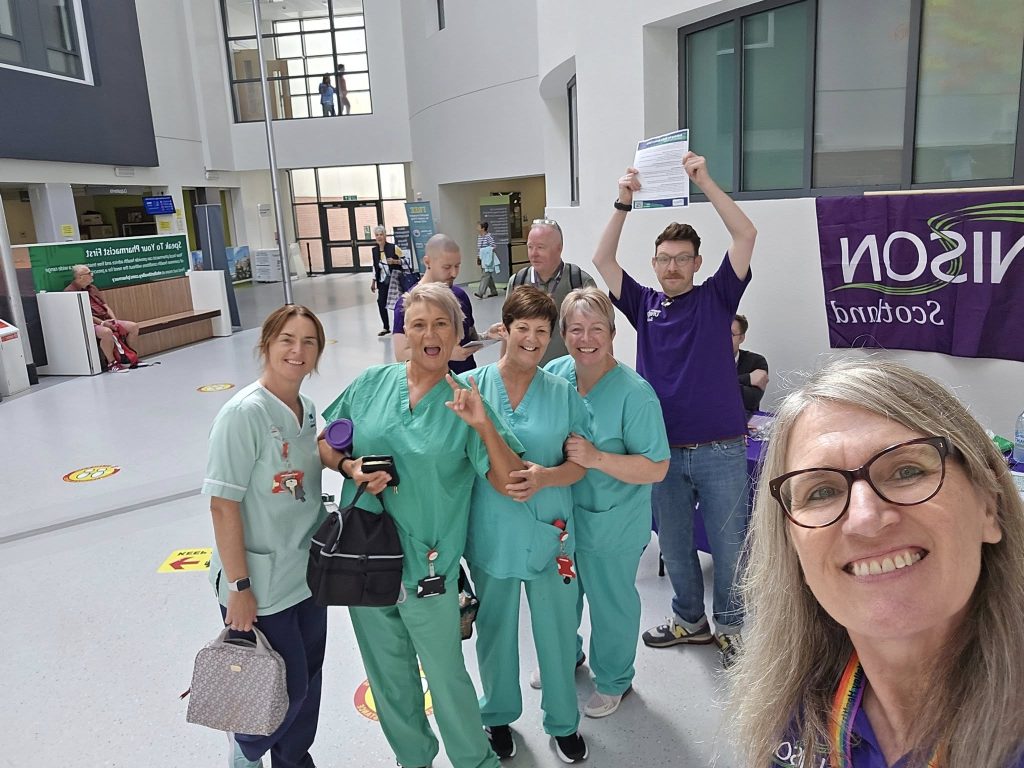
There were weaknesses too – “it’s a 24/7 service, we were bloody knackered” – but the scales were favourably balanced and the team “was just phenomenal.” One stunt involved a postbox occupied by an anonymous union branch chair. Another involved placard-making in the atrium. Members in the rest of the branch got engaged, signing big boards, and even people who were not union-minded were heard saying they had signed the petition. Politicians got involved, and the wider community were emailing MPs and MSPs. A favourite stunt involved tarring Serco with the slogan ‘led by donkeys’.
Karren: “No idea became too ridiculous. Except for Charlie’s when he actually looked into getting a real donkey.”
Charlie: “So, I was going to get a donkey and I was going to put devil’s horns on it and get the staff to follow it.”
Karren: “And I put my foot down because I had visions of it rampaging through the hospital. But I think if we’d asked members to get naked and run round the hospital grounds, they would have just been like, all right, let’s do it, because they were so engaged and everybody wanted to be part of it.”
And all this energy and engagement among the 690 affected staff culminated in an industrial action ballot, with an 82% turnout of members and a spectacular 99% for a strike among a ballooning membership. “Between GMB and ourselves, we effectively unionised the whole workforce from that campaign. I think there was hardly anybody that was [not in a] trade union by the end of it.”
The victory was not immediate:
“first of all, they didn’t even speak to us, which was really weird. They were speaking to Unison in London, and the Chief Executive, and the First Minister, but I said: ‘We’re the elected representatives of the people here. You can speak to whoever you want. We’re the only people that can resolve this dispute.’ It was very strange. As if they didn’t even understand how trade unions work. At the beginning we thought maybe we’d negotiate, you know, about money and stuff like that. By the end of it, we were like, we’re no budging on this. Because we had them at that point. And I think they knew that. And eventually they backed down.”
Is there a chance that the victory could lead Serco to exit the contract and to bring the work back in-house? While that is the hope, the problem is that the contract still has 14 years to run, and buying Serco out is too expensive, so they would have to leave. But the branch will keep fighting – they are making a film, putting pressure on the contract, trying to persuade them to walk away. “They don’t want to be in this contract. It’s such a pain in the neck for them”, Karren concludes. The struggle against Serco continues.
A Different Kind of Protest
But meanwhile a different form of protest was spreading in the Falkirk streets. The same August that the union won its campaign, the first protest sprung up outside the Cladhan Hotel. This hotel, like others used by the UK government to accommodate asylum seekers, became a focal point for far right and anti-migrant protest.
The branch officers were still on a high from winning as these charged and violent protests became more frequent and intense. Charlie remembers:
“I think we were entitled to expect a honeymoon period of members seeing how effective their union had been and a growing belief in trade unionism. And we never got that at all. You know, within days it was effectively stolen from us, and we were put on the back foot straight away.”
At the first counter-protest that Karren and Charlie went to, one of the former UNISON reps was on the other side of the road. While UNISON was not there formally, Karren said that they were “clear as a branch that this [counter-protesting] was the right thing to do”. But soon after, people were coming to the UNISON office angry about the union being at the Cladhan protests.
This was the same people that we had just spent the last however many months [campaigning with]. They know us, they trust us. We’ve just had this win and they’re coming in and telling us, what are you doing? Why are you spending our money on this [counterprotesting at the Cladhan]? … I was horrified.
“A bit of me felt in those few weeks that we’d failed. We’d failed as trade union to help people understand what we do and what we stand for. Because people were saying, why is a trade union getting involved in politics? … And I’m sitting thinking, ‘Oh my God, we’ve got members who don’t think that trade unions get involved in politics’. That’s our failure. That’s not their failure.”
On some reckoning, these protests in August amounted to the biggest far-right gathering in Scotland’s history. Charlie remembers looking at the people on one side and the other, assessing who could defend the hotel, because “the police were well outnumbered, they had totally underestimated this, … [T]here were at least five professional fascists. … I still don’t understand why they never attacked the hotel. I’m really surprised, and really thankful, for whatever stopped them doing that.” For Karren, “terrifying physical violence was one thing”, but more terrifying was that people in the protest were “people in my community, folk that I know, our members that I’ve had conversations with.”
The situation raised challenges for the branch and its approach to tackling the issues in the workplace. Speaking to people one-to-one was easier than deciding what to do as a branch, especially with it being targeted because of its stance. The branch invited other sister-branches to sign a statement. One union agreed, and another refused, but UNISON remained the target after its officers put their head above the parapet. UNISON’S building in Falkirk had its window smashed twice.
Members of hospital staff have also targeted UNISON inside staff areas. “We’ve had stuff stuck on our doors, stop the boat stickers, and folk vandalising our stuff,” Karren explained.
“We’ve had a lot of stuff online. I have been threatened, and they know who I am. But there’s a lot of people who’ve had a lot worse than me. When I say we are under attack over this, this is what I think trade unions need to understand: … It’s in the first playbook of the far right, isn’t it? You attack trade unions. That’s what you do. And you drive a wedge between the people that we represent and have been representing, and the trade unions.”
What didn’t happen, however, was a decline in membership in response to this firm stance. “I think that is what trade unions are worried about”, Karren wagers.
Union Power Beyond the Workplace
In recent months, union organisations and the STUC have held events to confront this challenge in the unions. For Karren, while such events are vital, there is more to do. “I want training on how to manage these conversations that me and Charlie were having. I wanted the STUC to promote counter-protest. I want people to put their name to it as a trade unionist. I wanted training about how to handle the digital stuff, because it’s really tricky if you don’t know what you’re doing. I want some kind of evidence base on how I respond to trolls.”
There is, for Karren and Charlie, a fundamental issue about how far unions focus exclusively on workplace issues, and how far to build beyond the workplace. As these events unfolded, plans were developing to establish a Trade Unions in Communities Centre. Gary Clarke, a retired Communications and Workers Union branch secretary, was the driving force behind it, and he and others did most of the work to get it going.
“What we realised at the time”, Karren said, “what came out of it for me, was that we do spend a lot of time on workplace stuff. We’ve lost that bit of trade unions being in the community, being involved in stuff. And that’s the bit we needed to get back to, because that’s how we are trying to get our community back. It’s no use shouting you’re a racist over the street. … So we looked at getting involved with Trade Unions in the Community, to help people to engage with local groups, charities, whatever, to bring trade unions together, help people understand what trade unions are, and do that education piece in our community. We will try and do something different.”
On 28th February, Unison Forth Valley opened up a Trade Unions in Communities Centre, adapting a model pioneered in Lothian at the TUIC centre in Craigmillar.
Karren Morrison is the Branch Secretary of UNISON Forth Valley Health Branch.
Charlie McCarthy is Chair of Unison Forth Valley Health Branch.
We continue this conversation in the next issue where Karren and Charlie discuss in depth what they see as the next steps for the union movement in Scotland, and why Trade Unions in Communities are a vital part of this solution.