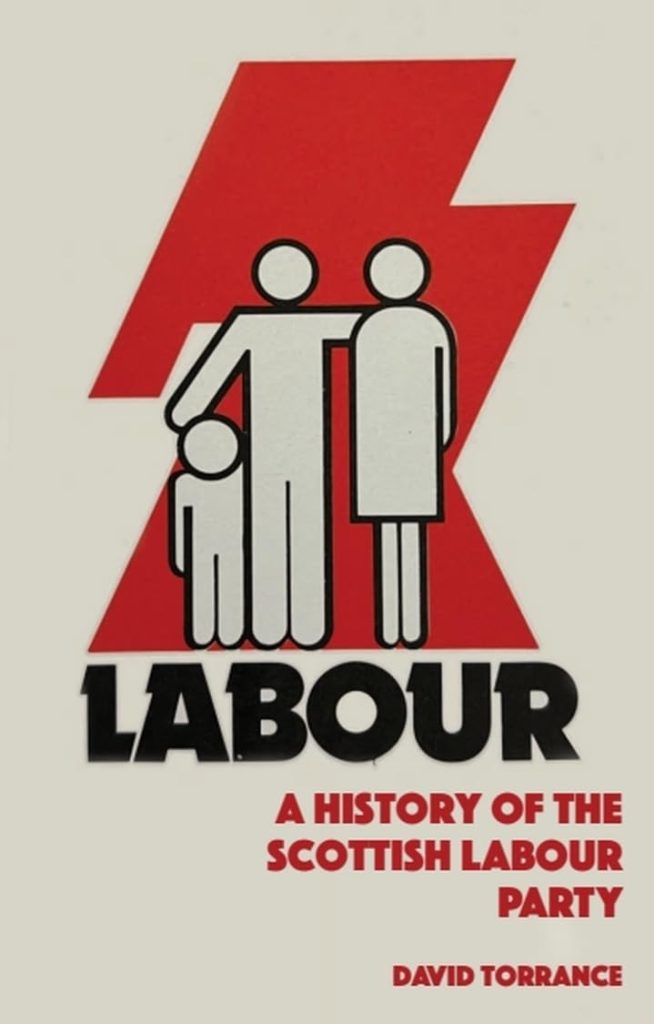
A History of the Scottish Labour Party, by David Torrance (Edinburgh University Press, 2026) reminds us that Labour’s woes in Scotland run deep through its history, finds Finn Smyth.
With the British Labour Party ejecting its first prime minister for a decade, installing Andy Burnham as the seventh in as many years, we have to wonder whether the stability and growth of Britain’s twentieth century ‘age of affluence’ has permanently dissolved. Will the Labour Party, which first matured in confidence and character by the middle of the twentieth century, ever regain its sense of self and purpose? Labour’s uncertainty today is all the more disconcerting because its symbols and language, despite New Labour’s spin-makeover, still partly invoke a time when its politicians confidently claimed to represent the majority in Britain, and spoke of full employment, socialist planning and the mixed economy. Could nostalgia for Labour’s past, when the welfare state was novel and young, be justified if it reminds us what used to be accomplished with political will and vast Westminster majorities?
Historians warn against nostalgia, of course. And the history of the Labour Party is at times too nostalgic, among its politicians, in the academy, and in the media. A rose-tinted BBC documentary from five years ago longingly recalled Blair’s 1997 triumph and the long economic expansion presided over by New Labour before 2008. More broadly, historians regret the erosion of the postwar civic culture which fostered popular consent for Attlee’s and Wilson’s muscular control over the economy. We are reminded that the last time income tax was raised was in 1975, before the cultural and demographic transformation of Britain under Thatcher – termed the ‘decline of the public’ by David Marquand – made further contributions to the state politically unthinkable.
The real danger of nostalgia is overlooking how contingent and contested the past always was. Close examination of Labour’s history reveals how uncertain its future often seemed, from its 19th century invention to its 21st century paralysis. Such a considered examination has recently been provided by David Torrance, in his new history of the Scottish Labour Party and its relationship with the wider British Party. Nowhere in Labour historiography is nostalgia more likely than Scotland. There, fond memories of Keir Hardie’s original Labour Representation Committee, Red Clydeside, and Labour’s electoral dominance from 1964 to 2010 have made the SNP’s unprecedented fifth consecutive Holyrood victory all the more unbearable for some. But as Torrance documents, Labour struggled to ground itself in Scotland for years. Despite the Party’s origins in Scotland, its momentum quickly steered to England and its politics to Westminster. The Independent Labour Party was far more vibrant and active than Labour branches in Scotland during the first decades of the twentieth century. It veered to Labour’s left under James Maxton, until its disaffiliation in 1931.
Torrance’s granular study tracks the intellectual confusion, internal divisions, and cash-starved organising which often defined Labour’s trajectory in Scotland. This finds its best case study in the battle for home rule and its modern conception, devolution. Despite the progressive potential and rhetorical value of home rule for a leftwing party critical of Westminster’s London myopia, Labour repeatedly foundered. We are pointed to Ramsay Macdonald’s dithering on home rule during Labour’s first government, and to Richard Crossman’s polite, English contempt for the posturing of Willie Ross. After 1979, momentum for devolution grew as Scotland consistently rejected Thatcherism, returning the ‘fighting fifty’ to the Commons in 1987. But, again, Torrance points out the cracks. Neil Kinnock and Donald Dewar dampened Labour’s potential appeal to Scottish nationalists, who were resentful of a Tory government with only ten MPs north of the border. Divided amongst themselves, Labour’s leadership drew the line against Poll Tax non-payment despite widespread support in Scotland.
In the concluding chapters, Torrance reflects on the ironic undoing of the Labour Party in Scotland by the realisation of its own devolution policy. The great paradox of Scottish devolution has been to enhance nationalism’s appeal, rather than to blunt its edge as some Labour thinkers hoped. Reflection demonstrates that Labour was never coherent about nationalism, in Scotland or Britain, and today is no exception. Devolution has reoriented the SNP around Holyrood, at Labour’s expense, who have been left to repeat arguments about the union’s relevance for Scotland. While Labour has regained power in Westminster, it has proven unable to maintain legitimacy in both parliaments since its ousting from Holyrood in 2007. This is perhaps a fitting contradiction when the tumultuous history of Scottish Labour is considered in the round.
The first dedicated single volume history of the Labour Party in Scotland since Ian Donnachie, Christopher Harvie and Ian Hood published Forward! Labour Politics in Scotland in 1989, Torrance’s chronicle traces the Party’s evolution in response to the major events of the twentieth century, from the Great Wars and the 1930s slump to the Suez crisis and the IMF bailout, and beyond. Its ambition is also its limitation. With so much to work through in 270 pages, Torrance gives himself little space to reflect in depth on key episodes in the Party’s history. As a result, major debates are briefly mentioned and many questions left open.
One missing question, for example, regards the role Labour played in Scotland and Britain in destroying the Liberals. How far did the Liberals’ collapse because of internal divisions, or Labour’s own drive and appeal, despite the Party’s uncertain and clumsy beginnings? Another underexplored area is the role of socialist ideas in defining Labour’s shape and eventual fortunes in Scotland. Torrance argues that while the Party was distinguished by the large number of intellectual traditions vying for influence among its leaders and organisers, it never committed itself to a dominant school of thought beyond persistent dedication to parliamentary politics and the rejection of revolutionary doctrine. More work needs to be done to understand the genealogies of leftwing thought in Scotland in the twentieth century, tracing the interactions between ethical and Christian socialism, for example, or connections between Fabianism and Keynesianism.
While Torrance provides a brilliant exposition of the disagreements and interactions between the Labour Party in Scotland and the central Party in England, another overlooked theme worth investigating is the relationship between Scottish Labour and the European left. Donald Dewar’s and Tam Dalyell’s staunch Europeanism would suggest there was nothing parochial about the Labour Party, at least in the late twentieth century. What’s more, the Scottish left occupied a uniquely early, though understudied, vantage point within the European New Left. As Neil Davidson showed, Gramsci was brought to the British left in the middle of the twentieth century through the explorations of Hamish Henderson and Tom Nairn. These excavations seem particularly relevant for Scotland today, where for several years the SNP has looked optimistically towards the EU as a vehicle for its own nationalist project.
The inertia of modern Labour – and its demise in Scotland – is not historically unprecedented. As Torrance shows, the Party always pulled in different directions, its greatest achievements far more insecure at their inception than we might like to recall. Given its resounding collapse, only time can tell if it will even be possible to write a second volume of Labour’s history in Scotland. In 1983 the French political scientist Jacques Leruez memorably called Scotland ‘a nation without a state’. Thanks to Labour, the Scottish nation which produced the Party, now has elements of its own state. But by creating the modern Scottish political arena, the Party engineered its own exit. It is far from clear, then, if Labour will ever seem relevant or play a major political role in Scotland again.
Finn Smyth is a researcher at the University of Oxford, focusing on the political economy of the British state. He previously worked as a communications officer for Progressive International.