After years of waiting, Scotland is close to launching sectoral bargaining in care. Peter Hunter explains why there must be no more delay.
On Wednesday 18th March, Scottish Ministers announced the implementation of National Sectoral Bargaining for Adult Social Care workers. Negotiations will commence in 2026 for implementation in 2027/28.1 This was a landmark moment for low paid workers and a major strategic bargaining and organising success for trade unions. It was also a major moment for the Fair Work Convention and Scottish Government and a credit to the employer organisations who see Fair Work as the only route out of the enduring care crisis.
Those headlines are all important and true. However, the deal is not ‘signed and sealed’. Agreement on the constitution for the negotiating body is within touching distance, but as with all major deals, nothing is agreed until everything is agreed. All the smart money says the deal will be done, but why take a risk with the public announcement? Why jump the gun?
In 2015, Scottish Ministers ordered new Calmac Ferries from Ferguson Marine. In 2017 they staged a fake launch using the hull of a possible boat with painted-on windows and plywood funnels. Nine years later, it is still not clear how robust those boats are.
It is not the end of the world, but the Government announcement on sectoral bargaining has a whiff of Calmac about it. A truly joint body would share the timing and content of any announcement on sectoral bargaining. Work is required to ensure the ‘good ship’ Fair Work is finally ready to sail.
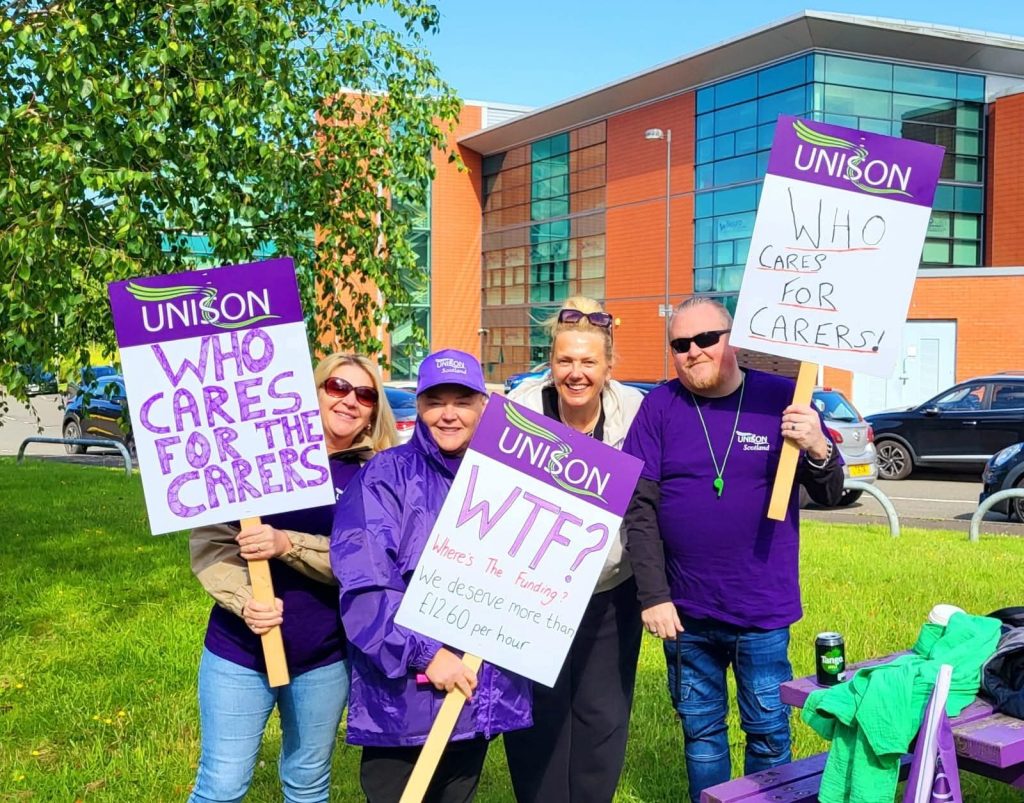
Built in Grangemouth
The origin story for Sectoral bargaining in Care dates back to the 2013 dispute at INEOS and the bold vision of the Scottish Government that Scotland could find a better way. Jim Mather led the ‘Working Together Review’ from which the Fair Work Convention was born. In 2019 the Convention’s first major report was Fair Work in Care.2 Converting the vision into hard practical gains is proving difficult.
Unions, employers and Government all agreed with the 2019 finding that “the level of wages for frontline support staff in social care is drastically low despite the work being complex and demanding”. Seven years later we can only say that implementation has been tortuously slow. While sectoral bargaining was a leading recommendation, the bedrock of the report was a sector body that would conduct sector bargaining but also lead a wider process of change. Sectoral bargaining is the voyage, not the destination, but if the Joint Council can be finalised we have the vessel to sail in.
Initial Progress
Although there was no need for further research and consensus building, the pandemic demonstrated the fragility of the sector and the desperate need for change. As the Covid inquires will prove, infected workers were too poor to take sick leave when infected with the virus. There were countless avoidable infections and deaths as the direct link between unfair work and failed care was cruelly exposed.
Despite the crisis, the initial work during the pandemic was relatively positive. Pay was benchmarked with the bottom end of NHS pay, and a sick pay scheme was hastily improvised to reduce avoidable infections and deaths. The plan for 2023/24 was to consolidate those interim gains by agreeing permanent pay and conditions for the sector as a whole. Since then, the link with NHS pay has withered and the £40m “earmarked” for terms and conditions was diverted to pre-election tax cuts.3 The good ship Fair Work was taking in water before it left the slipway.
The announcement made in March 2026 remains historic, but it felt a little like political salvage work before the Scottish elections. Now that dust has settled, the new body must make rapid progress and, crucially, display a deeper commitment to the fundamental principle of effective joint working.
Plain Common Sense
The standard explanation for delay between 2019 and 2026 is that sectoral bargaining is innovative and legally complex. That simply is not true. Sectoral Bargaining is common across Europe, and in fact it also had a long history in the UK prior to the abolition of Wages Councils in 1993. Sectoral agreements on pay and conditions cannot be described as innovative. On the question of complexity, there are only two moving parts in the engine room.
1) A bargaining process to agree minimum sector standards for pay and conditions.
2) A mechanism to apply those requirements to the sector as a whole.
Fully funded agreements might be tricky to negotiate, but creating the constitution for a bargaining forum is easy. It should not have taken seven years. Even now, that process is incomplete. Comparisons with Calmac will only fade when the constitution for the negotiating body is formally agreed.
It is fair to say that implementation by Government is impeded by the inadequacy of the devolution settlement. Scottish Ministers can only apply new sector standards to care that has been commissioned through the supply chain funded by Government. That covers most but not all of the care provided in the sector. This limitation in scope has been obvious since 2019 and does not explain the delay.
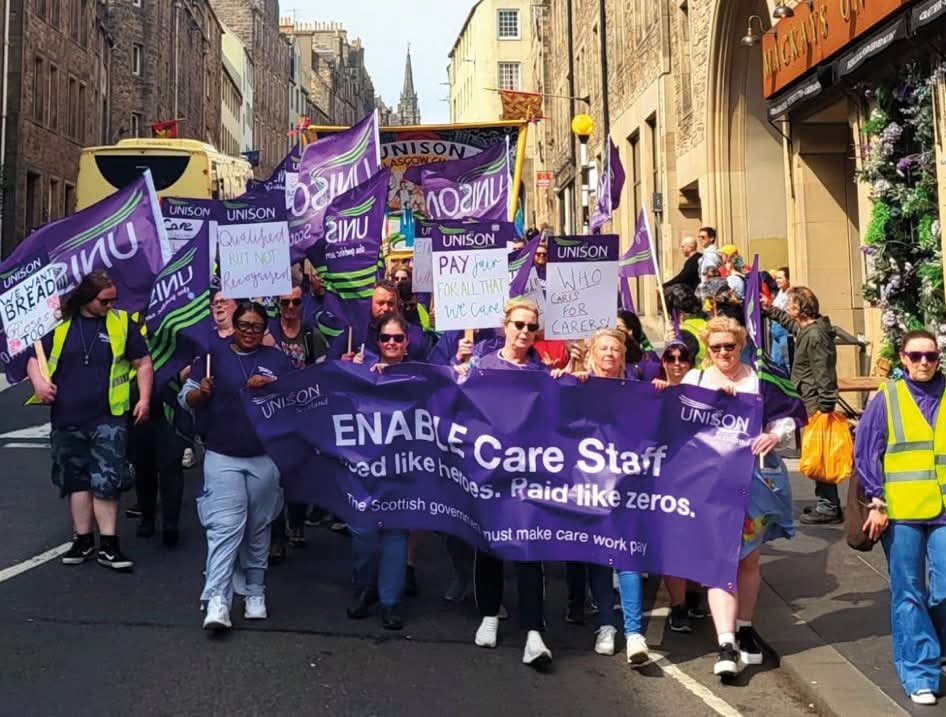
The explanation for the delayed move to sectoral bargaining is quite simple. Service users and care workers see the indispensable economic value of social care. Government and commissioners do not. Service users and care workers simply are not a political and financial priority. That needs to change. Fair funding for care needs to be embedded in every budget planning process and backed with serious political capital.
This change in Government priorities will not come easily. The momentary awakening of the pandemic and ‘clap for carers’ has passed. After the applause, the sector has slipped back down the political agenda. The national commitment to the demonstrable delivery of Fair Work has lost momentum and, locally, councils are diverting care funds to other priorities through service cuts and extensive rationing. The £20m cuts and privatisation programme in Aberdeenshire is just one example of a wider trend of local attacks on workers’ rights and withdrawal of vital care services.4 The Scottish Joint Council for Social Care will have its work cut out if the vicious attacks on vital services are to be halted.
The only way is up
Despite these delays, all the signs are that Scotland will lead the UK in the structural shift to sectoral bargaining for care. The importance of being ‘first’ is a strategic and industrial point. Any political advantage for the Government is ancillary.
There are two bargaining options on the table: the Scottish model with roots in the Fair Work Convention report, and the new powers under the UK Employment Rights Act (ERA) 2025. It is vital that the Scottish system is in place before the ERA model. Scotland has a different and vastly superior approach to the constitution and operation of the negotiating body. Only the Scottish model has the potential to drive wider transformation of the sector.
The ERA creates separate Adult Social Care Negotiating Bodies (ASCNBs) for the three British nations. Under the English model for the ASCNB:
· The negotiating body is made up of Government appointees.
· The negotiating body then recommends pay and conditions to Government.
· Government can accept or reject the proposals
· Where no sector recommendations are acceptable to Government, the minister has the power to enforce minimum standards.
It has to be a fundamental right of workers (and employers) to elect, instruct and if necessary remove their negotiating representatives. This is a legal and democratic principle, and the creation of that wider democratic infrastructure also creates local, regional and national forums to address wider issues including workforce planning, skills development, ethical commissioning, protection of displaced visa holders and more.
The English model is not collective bargaining. It will not build the depth and quality of joint relations envisaged for Scotland. The unintended benefit of seven years’ delay has been a closer understanding, unity and commitment to action between employers and trade unions. These embryonic joint relations were born from frustration with Government delay and opposition to funding cuts. They now extend to a deeper shared understanding of a wide range of sector issues. Our model is not inherently better by virtue of geography or national identity. We simply have a better plan.
ERA Amendment
Scotland is committed to accountable ‘bargaining’ in the conventional sense. The ERA model is more akin to a pay review body. So, what happens to this new Scottish body when the UK pay bodies arrive? Will the new Scottish Joint Council be scrapped after 12 months? No: Scottish Minsters appear to have secured devolved control over the bargaining process as a vital ‘carve out’ from the UK provisions under the ERA.5 The current understanding is that the parties will negotiate and agree Scottish sector reforms through a distinctly Scottish bargaining process, while also benefiting from common enforcement measures that apply UK-wide.
The Ministers’ announcement that Scottish workers may or may not get enforcement rights under the ERA came as a total shock to those drafting the new sectoral bargaining arrangements. There is a broad political consensus in Scotland that employment law should be devolved so that Fair Work rights can be improved. Using devolved powers to opt out of UK protections would be an act of political folly and it falls to our new MSPs to ensure that point is clarified at the earliest opportunity
Scottish Ministers deserve full credit for their insight and effort on this point. It is strategically important that Scotland’s distinctive approach to authentic bargaining is established immediately, prior to wider ERA implementation, and retained as a forum for deeper sector change by discussion and agreement.
The ethos of social care is unique in the Scottish economy. The wage-work bargain is fundamentally different, as are the barriers that perpetuate unfair work in care. Only authentic democratic voices, for both workers and employers, can create a sector body with the expertise, standing and power to transform the sector and deliver Fair Work in the fullest sense.
Peter Hunter is the UNISON Regional Manager for the North of Scotland.