Mike Arnott pays tribute to the Scots who, ninety years ago this year, joined the greatest international democratic army the world has ever known.
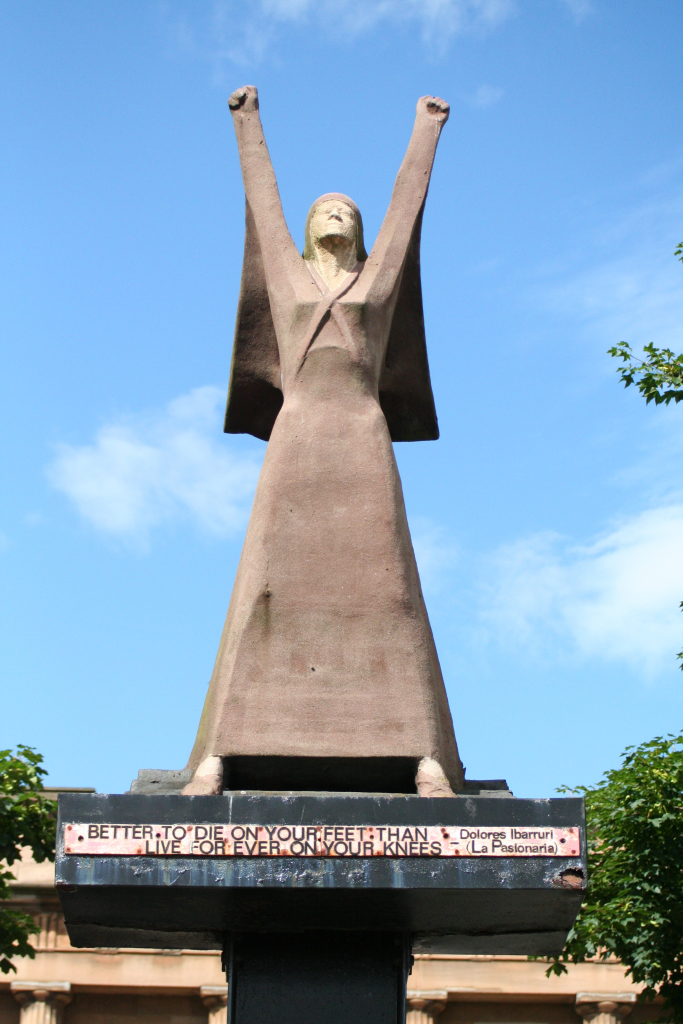
17th July this year will be the 90th anniversary of the 1936 military coup which led to the Spanish Civil War, sometimes called the Spanish Anti-Fascist War. It began in colonial Morocco, spread to mainland Spain the following day, and marked the culmination of months of planning among right wing generals, sympathetic political leaders and landowners. It quickly drew the allegiance of the Catholic Church hierarchy.
All this was in response to the election, that February, of a progressive Popular Front government, elected by a broad alliance of republicans, progressive liberals, socialists, communists and anarchists. Their programme signified a return to the democratising programme of the 1931-33 republican government, elected following the restoration of parliamentary democracy after the fall of the dictatorship of Primo de Rivera and the flight into exile of the royal family.
For a country with a largely rural economy, dominated at every level by men, by the church, and economically by landowners, the February 1936 government’s programme of land reform, secularising education, aspects of gender equality including female suffrage, and regional autonomy represented an assault on every facet of traditional Spain. By May 1936, armed groups representing elements of both left and right were attacking members of the other side in the streets. Conservative politicians and their client press were able to stir up fears about stability and openly called for the government’s overthrow, encouraging plans for the coup being developed by leading figures in the military, including General Francisco Franco who would later become its leading figure.
The nationalist coup was immediately supported by military units in places like Morocco, Pamplona, Burgos, Zaragoza, Valladolid, Cádiz, Córdoba and Seville. However, rebelling units in important cities such as Madrid, Barcelona, Valencia, Bilbao and Malaga were unable to capture their objectives, primarily due to workers’ and citizens’ militias taking to barricades and fighting the insurgents in the streets. In rural areas, adjacent villages sometimes declared for opposing sides. Spain’s navy stayed mainly loyal to the Government. These were heady days, captured vividly in black and white archive photographs and on film, showing cars and lorries, some with quickly improvised armour, crammed with clenched fist-saluting militia, heading out from the loyalist cities to take on the insurgency in surrounding areas.
On 19th July, British pilot Cecil Bebb had flown Franco from the Canary Islands to Spanish Morocco in a chartered plane from Croydon Airport. Hitler and Mussolini agreed to help the nationalists, particularly with the important airlift of the experienced Army of Africa over to the Spanish mainland. From Seville they began their advance, during which they overthrew the recent communalisation of rural land, massacred opponents such as at Badajoz, took control of South West Spain, and eventually arrived at the outskirts of Madrid in November.
For the ‘democracies’, Britain, followed by France, demonstrated their attitude by their eagerness for a Non-Intervention Agreement, which was signed within three weeks of the outbreak of hostilities. Their desire to appease fascism, rather than defend Spanish democracy, saw the Madrid government denied the right to even purchase weapons to defend itself. Though Germany, Italy and Portugal signed the Agreement, they had no qualms about supporting their fascist allies in Spain. Italian submarines and German planes attacked international merchant shipping bringing supplies to the Republic. The Soviets, for their part, signed and provided important military and material aid to the Government side, but this became less sustainable as the conflict progressed. In the final analysis, the impact of non-intervention on the Republican forces, as opposed to the nationalist side, proved the crucial factor in the eventual outcome of the war.
The conflict on land soon became more internationalised. Some of the first to take up arms, alongside their Catalan hosts, were overseas competitors in Barcelona in July for the Workers’ Olympiad, being held in opposition to the Berlin Olympics. The first from Britain to fall in action was a Surrey artist and Communist Party member, Felicia Brown, also in Barcelona ahead of the coup. She volunteered to join the PSUC (Catalan communist) militia called the Karl Marx that was heading for Aragon. She was killed on 22nd August, attempting to sabotage a nationalist train. Surrey Unison unveiled a memorial to her last year, outside its offices in Reigate.
Those Who Didn’t Wait
The first of the International Brigades, the XIth (eleventh), was formed in October 1936. Their recruitment was organised by the Communist Parties of the individual participating countries, under the co-ordination of the Comintern in Moscow. The 16th (British) Battalion of the XVth International Brigade, wasn’t formed until just after Christmas 1936, although numerous Scots had already been fighting with German and French battalions within the XIth. Their introduction at the battle for Madrid, on 9th November, had helped to halt the fascist advance on the capital, which only fell at the end of the war, thirty months later.
Glasgow’s George Square saw two significant departures. The first was in September, when the Scottish Ambulance Unit, under the adroit leadership of Fernanda Jacobson, left in a fleet of buses, lorries and ambulances. Then in December, led by Peter Kerrigan, three busloads of military volunteers from across Scotland left the Square for the channel ports.
By the end of the war, some 35,000 International Brigade volunteers, from over 50 countries, had fought with the Spanish Republic. Over 500 of these were from Scotland and a quarter of these still lie in Spanish soil, on the battlefields of Jarama, Brunete, Teruel, Belchite, Caspe, Gandesa and on the Ebro River.
This year, the International Brigade Memorial Trust, AABI in Spain, ACER in France, KSFR in Germany and our other international sister organisations, along with local commemorative groups, will begin to mark 90th anniversaries of the major events of the Civil War. Here in Scotland, the annual North Lanarkshire commemoration will take place in Motherwell on Sunday 26th July with Fife’s in Kirkcaldy on 26th September. The IBMT will hold our 2026 AGM in Glasgow on 10th October, with the annual commemoration at La Pasionaria taking place that morning. The anniversary of Jarama will coincide with Dundee’s annual commemoration in Albert Square on 13th February next year. The next weekend a sizeable Scottish contingent will be in Spain to mark the 39 Scots who fell at Jarama, at an annual ceremony in Tarancón, and to participate in AABI’s annual Jarama March on the battlefield itself.
In the last fifteen years, a number of places have begun to hold an annual commemoration at their local International Brigade memorials including at Dundee, Motherwell, Kirkcaldy, Irvine and Glasgow. Events also take place in Aberdeen, Renton and Edinburgh. If you have a local memorial, why not use the ninetieth anniversary as a focus for launching an annual commemoration? To keep tabs on events coming up, check the IBMT website, or the Scotland and the Spanish Civil War Facebook page. Join the IBMT and affiliate your trade union branch.
In our current political situation, it is more than appropriate to remember and to celebrate the role played by the men and women who left these shores to confront fascism in Spain. Many had already fought the Blackshirts on their own streets. Our streets.
You Are History
In his last words to his mother, Patsy McEwan, a 25 year old Dundee YCL member, said: “If I don’t go and fight fascism, I’ll just have to wait and fight it here”. He was one of 19 from the city who didn’t return.
In her words to the departing International Brigaders in Barcelona in October 1938, La Pasionaria said: “You can go proudly. You are history. You are legend. You are the heroic example of democracy’s solidarity and universality. We shall not forget you.”
When the British Battalion arrived home at Victoria Station that December, a press report said their welcome represented “British democracy spontaneously expressing its abhorrence of Fascism and its appreciation of bravery. They had made history, by forming part of the greatest international democratic army the world has ever known.”
Their example speaks to us today. Their legacy shouts more loudly across the years than at any modern time. Because it is a living legacy, not of memorials or sepia images, but of anti-fascist action.
Mike Arnott is the Scotland Secretary of the International Brigade Memorial Trust.