Katy Highet explains how Women against the Far Right are using united front tactics to challenge racism and sexism in Scotland
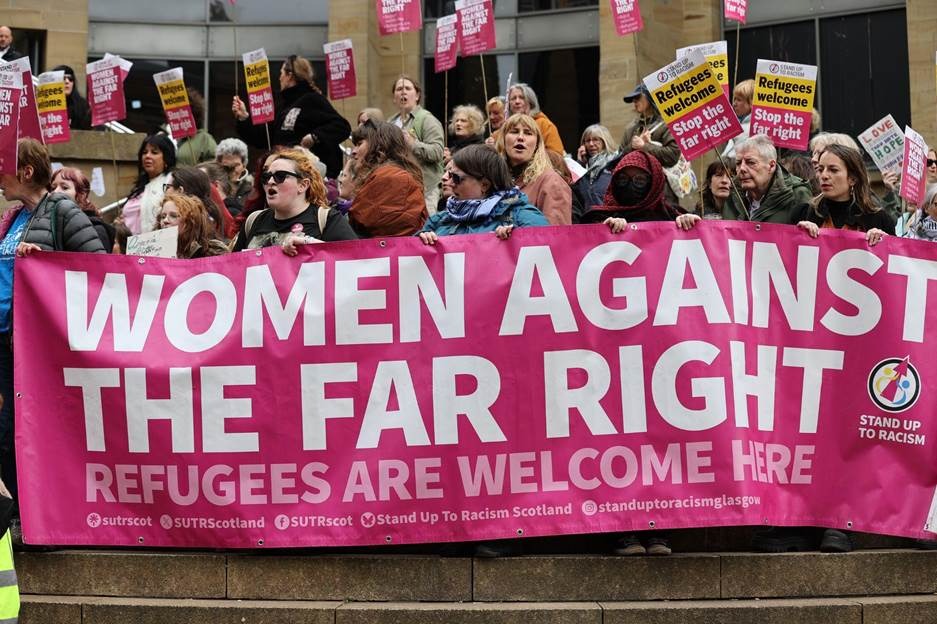
On Saturday 11th April, hundreds of women occupied Buchanan Street steps in Glasgow, in a powerful display of defiance. Several weeks earlier, an Edinburgh-based far-right organiser had called for a rally of “angry Scottish men” to take over the city. Holding the space for several hours, the women-led counter-protest overwhelmed a measly crowd of fifty, predominantly men. From the steps, representatives from anti-racist groups, refugee support organisations, trade unions and the women’s rights sector called for women across Scotland to refuse the weaponisation of violence against women to stoke up division, racism and Islamophobia.
This mass mobilisation was organised by Women against the Far Right Scotland, a Stand up to Racism initiative launched in October 2025 in response to far-right exploitation of women’s safety to demonise refugees. Since the first public meeting, which sold over 400 tickets, the campaign has touched a nerve. Over 3000 people signed our open letter, including Nicola Sturgeon, actor Elaine C Smith, and TV presenter Jean Johansson. Six months on, the momentum continues, sustained through a grassroots organizing model that has tapped into a wider mood of anger, frustration and defiance.
Misogyny is a systemic, pervasive reality, but blaming refugees does nothing to make women safer. The far-right’s hyperfocus on cases of assault by migrants ignores the fact that the biggest danger to women lies in our own homes. One in four women in the UK will experience domestic abuse in their lifetimes. Even the UK Government describes the situation as a ‘national emergency’. Those who claim to protect us by attacking migrants are themselves often perpetrators of violence against women (including Glasgow’s John Watt, organiser of the far-right ‘Unity Rally’ and convicted domestic abuser). Decades of austerity have seen services for women subjected to devastating cuts by current and previous Scottish and UK governments. Now Reform UK are threatening essential legal protections for women, as well as our bodily autonomy. Women across the country are understandably furious at a system that abuses and endangers us, and at far-right attempts to exploit our fears for racist agendas. The campaign is channeling this anger, mobilising many who had not been organised. Unsurprisingly, the campaign is resonating with young women for whom incel culture is a deeply troubling school-yard reality. One placard at the Rage against Reform UK protest in Glasgow read: “Farage vs. 1 very angry 17YO girl”.
Much of the campaign’s success lies in its united front tactic of building unity in action around shared goals. The steering committee comprises activists across party lines and from various women’s rights organisations, charities, civil society groups, and trade unions, and relies on robust processes of debate and decision-making. It is through these democratic structures that we adopted, from the outset, our trans-inclusive stance, as well as the position that, while women-led, our events are open to all genders. Within the united front there are inevitably tensions, particularly around elections, with some organisations being less able (or willing) to openly campaign against Reform UK due to electoral laws. But what we share is a commitment to anti-fascism, and an acknowledgement that the threat to women is too great not to unite.
The campaign’s dynamism also brings risks. Women in the spotlight have endured a torrent of harassment, vile abuse and death threats from far-right men, both online and in person. This has raised questions about police engagement, particularly given the justifiable lack of trust that women have in the police. It has prompted important discussions as to how a mass mobilisation of women can provide robust solidarity and care. We are also coming under attack from the ‘gender critical’ movement. Given the alliances between certain gender critical groups and right-wing movements, our campaign will remain vocal in welcoming our trans sisters. We refuse to let gender critical groups represent the women’s movement in Scotland.
The election results mark the next challenge for the campaign. Women have consistently been failed by successive governments, but Reform UK’s successes will endanger and impoverish women, migrants, and workers even further. We prepare to fight back confident that we have the numbers on our side. The unity demos organised across Scotland prior to the May elections saw thousands of anti-racists take to the streets to demonstrate true community solidarity. Comparatively smaller but equally crucial demonstrations took place where anti-racist organising is less historically rooted, including in Kilmarnock, Paisley, Dunfermline and Livingstone. As Talat Yaqoob, co-convener of Women against the Far Right Scotland, said at the April counter-protest: “we can see clearly at our rallies that there are so many more anti-racists in Scotland. The far-right worked for weeks to organise and only managed a handful, but their views are getting reach and platform beyond their numbers, and we have to fight that”.
We have women across the country, from the highlands and islands to coastal villages, contacting us for support in setting up their own local branches. Women against the Far Right will be spending the next few months on the road, growing our bases across the country and building in new areas. It is a tall task, but we are confident that we will find support from the many, many women who are sick and tired of being used as political footballs by people who are themselves a direct threat to our liberation.
Katy Highet is co-convener of the Women against the Far Right Scotland campaign.
Follow the campaign on instagram @womenagainstfarrightscotland or email sutrscot@gmail.com to join the whatsapp group or set up a WAFRS branch in your area.