In her first in-depth interview after leaving office, Shona Robison speaks to the Editor, Cailean Gallagher, about the SNP’s aspirations, ambitions and risk of over-commitment in the newly elected parliament.
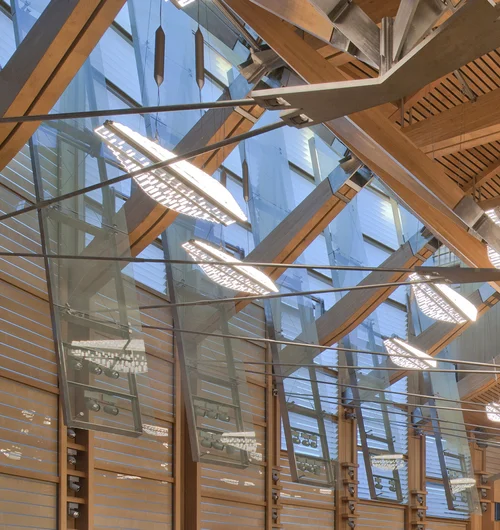
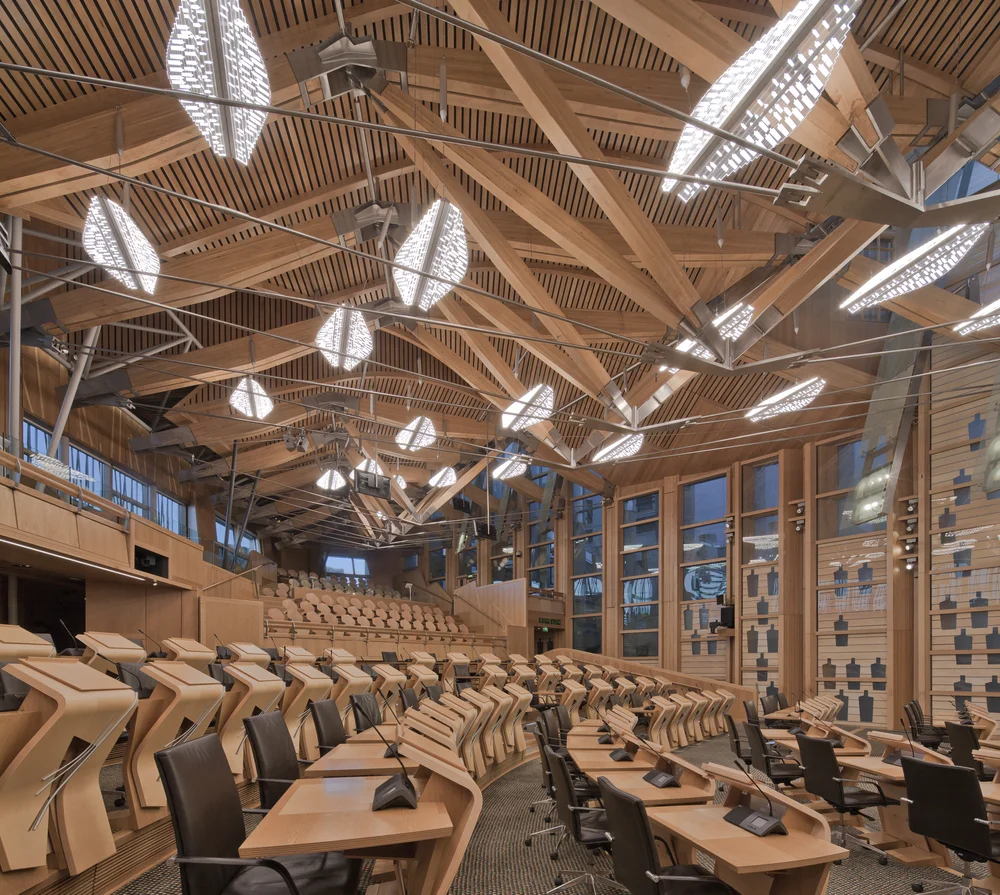
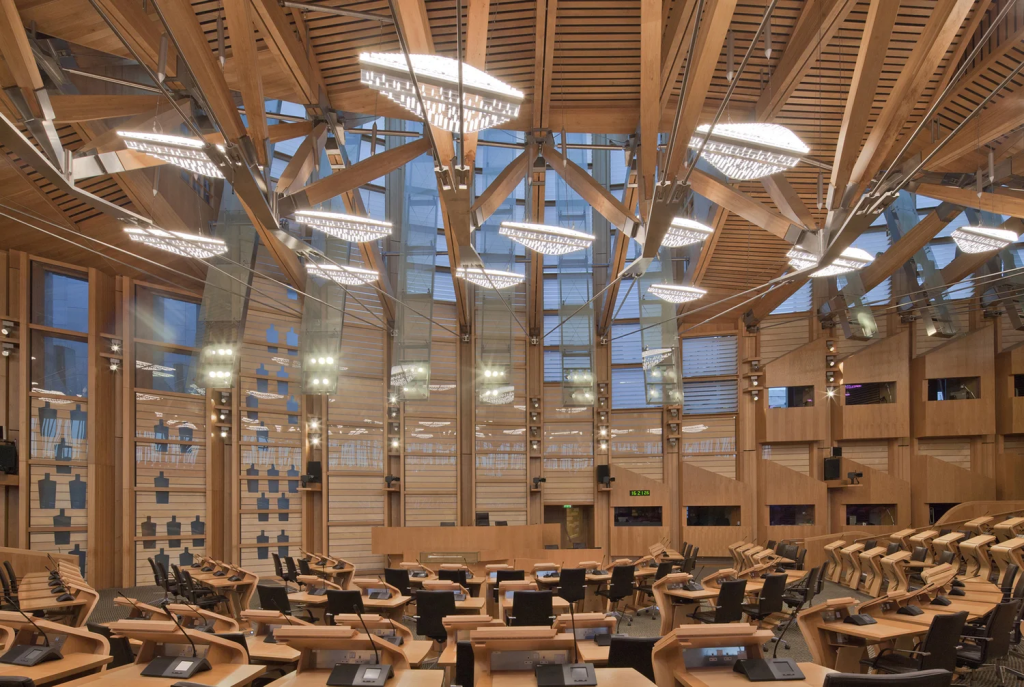
“Light of the day, shine in” wrote Edwin Morgan for the opening ceremony of the Parliament building. He was delighted by the “commerce between brightness and shadow”, with its 1,000-square-meter glass wall that lets the light stream in, while strategically positioned leaf-shaped towers shade the chamber from direct sunlight. As one of nine MSPs who served continuously from 1999 to 2026, Shona Robison knows our parliament better than most: its light and shade, its powers and limits.
We spoke four days after voters elected a bigger pro-independence parliamentary majority than ever, and gave the Tories and Reform fewer seats combined than the Tories alone had before. What is the former Finance Secretary’s greatest hope for this new parliament? Not one policy or bill, she said, but an aspiration that parties step beyond their own self-interest and ditch the fractiousness of the last session. “You have the SNP, and all these other parties, pretty much in the same place, and it’s whether they want to do things differently.” That, Robison hopes, would allow us to advance the frontiers of “radical public health policies and the transformation of public services”, and to address “big meaty issues”: the future of social care, the declining rate of population growth, energy investment, and council tax reform.
Power Ascribed, Power Denied
Robison outlined the SNP’s vision for all these areas which, she said, is “grounded in the centre-left”. But reform on any of these fronts is limited both by the powers of the parliament and by the way its powers are presented by the other parties. While an optimistic vision of consensus has been part of Scottish political imagination at least since 2007, another tendency of Scottish politics has been to blur the edges of devolution and cast doubt on the limits of what parliament can and cannot do.
A parliamentarian no longer, sitting at home with two cats in the background and Dundee sunshine streaming in, Robison returned more than once in our discussion to a frustration that seems to have been sharpened and clarified since she left office:
“There is something I’ve thought about a fair bit recently, that quite often the media and opposition parties talk about the government in Scotland as if it has all the powers of an independent nation. Why are you not doing this and why are you not doing that? And, you know, bluntly, if it could be done within the powers that we have, it would have already been done. But you come up against the blockages there [in parliament] and of an increasingly hostile UK government when it comes to trying to get things done.”
Tax is one example. With responsibility for revenue, Robison had a close-up view of the tax system’s complexities. “We have used the income tax powers pretty much to the maximum. I would call that progressive. It’s the UK government tax system that is not progressive. The idea that someone earning forty-something thousand pounds should be in the same tax bracket as somebody on nearly a hundred thousand pounds is just inherently unfair. So we raise taxes, but through the complexity of the fiscal framework, you actually end up not raising as much as you would otherwise.”
But what about the challenge that government and parliament have failed to use the powers they have to reform local tax or introduce wealth tax? “You know”, Robison explained, “we’ve been attempting to look at ways forward in the land value taxation space. The Scottish Land Commission is looking at it, but it is far from simple and requires a proper valuation of the land mass in terms of who owns what. That’s going to take some time. That doesn’t mean it shouldn’t happen. It definitely should. But you’ve got to have all of the infrastructure and the building blocks in place, which would then lend itself for us to look at different taxation systems. Council tax needs reformed, clearly, but try getting an agreement as to what replaces it without a majority. Everybody agrees it’s flawed, but there are about ten different answers.”
“And then you’ve got the wealth tax. It’s worth noting that when they were drawing up the Scotland Act, they put clever blockages in. For example, when I got the building safety levy agreement with the UK government – a very straightforward power that they had already given themselves – I had to jump through hoops to get their agreement. Any new tax has to have the UK government’s agreement. So clearly a wealth tax is not going to be straightforward by any manner or means.
“So I do think that sometimes – and Green colleagues, I think, sometimes fall into this trap – other parties make things sound very simple. Why don’t we just do this and why don’t we just do that? If it was simple, it would have already been done. The fact is that it’s not simple, whether it’s negotiating with the UK government or just having the infrastructure and data that’s required to shift the balance of taxation. I’m a big supporter of all of that, but it is far from straightforward under the devolved powers.”
It is easy to forget, Robison said, that the last time the Scottish and UK Governments worked in genuine cooperation was under David Cameron. So might the blockages and hostility from Westminster start to change after the recent election results?
“With the Celtic nations now all having nationalist governments, I think it could go one of two ways”, Robison suggested. “The UK Government could recognise their power is weakened and respond appropriately by talking genuinely about devolving further powers. Or, with its centralisation instinct from both ministers and civil servants, it might try to further marginalise devolved governments.”
Within these limits, then, Robison expresses pride in the SNP government’s work to address the cost of living around heating bills, childcare improvements, and above all the child payment, “putting money in pockets of families who really need it”. “But you know, to really do serious stuff in a cost of living space requires further powers. Otherwise, you’re just removing money from one block and moving it to another.”
A Divide in the Movement?
It certainly rings true that the public overestimates the powers of the Scottish Parliament, and it would be interesting to see the focus groups or polling data that backs up the claim. If it is right, then of course it is partly a result of opposition parties’ strategies to attack the SNP by suggesting they are failing to act. But the public perception is also in part the result of the SNP’s desire to present an image of itself as an ambitious government that can meet every challenge with competence and strength. “Everyone sees what you appear to be”, wrote Machiavelli, but “few experience what you really are.” Only those in power bump up against its edges.
So has the SNP got the balance right, between deploying every limited power it has, while demonstrating the limits of devolution? “I think the SNP has managed to do both, which is remarkable in itself”, Robison affirmed. Indeed, in its governing years the SNP seems to have overcome its old disagreement on this question. ‘Gradualists’ tended to want to use limited powers of government to full effect, demonstrating Scotland’s capacity to govern itself well. ‘Fundamentalists’ preferred to demonstrate Scotland’s powerlessness without independence, pursuing the goal of ‘independence – nothing less’, and warning of the risk of getting stuck in devolution. This divide did not always fall along left-right lines, but fundamentalists tended to seek more radical change than the gradualists, who operated closer to the centre-ground. Does the debate within the SNP and its different traditions still fall along these lines?
“I think less so these days”, Robison replied, predictably keen not to air old party faultlines. She pointed instead to the SNP’s remarkable unity, more than a quarter-century after devolution: “I think the party falls centre left and that is its instinctive kind of position. When an issue comes up, I know straight away what the SNP’s position is going to be: not far left, but centre left. Whether it’s on domestic affairs or international affairs, I would say 99% of the party is aligned there. There are people further to the left and there are probably people further to the centre. But I wouldn’t say there was anyone particularly on the right, not these days anyway. The party has taken in a whole new generation of folk, particularly post the indyref, and that has grounded the party in the centre left. There are no longer those kinds of debates of, you know, those principles. I think we’re quite comfortable in our skin as a party.”
One area of historic difference between centre-left and further-left nationalists has been the question of foreign investment and Scotland’s exposure to neoliberalism and global markets. The question directly concerns the limits of Scotland’s current and future powers. Should Scotland adopt a new economic model favouring inward investment and state intervention, involving a strong and active government in its economic management. Or should it facilitate private capital and use government to try and mitigate the harms and inequalities when the wheels of profit are spinning?
For Robison, the centre-left position involves the best of both worlds. “I’m a pragmatist. I want investment into Scotland, particularly in the key sectors where there’s growth and well-paid jobs. We have made a global name for ourselves in the renewables sector and in the food and drink sector, all of which is in severe peril from the current UK government obsession with nuclear power, but also, my God, from what might come along the tracks, with Reform UK explicitly saying they want to kill off the renewable sector. It’s mind blowing in its stupidity. I think you can have both FDI [foreign direct investment] in sectors that are key for Scotland, and you can marry that with strategic investments that are homegrown. A lot of the investment we’ve made into renewables through the Scottish National Investment Bank has been a catalyst for growth. Focusing on the infrastructure, making sure that you start that ball rolling, you then expect private investment to follow. So it’s not an either or.”
And yet, a moment later, Robison did edge towards a more radical alternative. Much greater levels of industrial intervention and control would, she said, be possible and desirable, were Scotland not so powerless. “We don’t have powers over corporation tax, we don’t have powers over most economic levers, actually. Hence you get situations arising like in Grangemouth or Mossmoran, where it is utterly frustrating that we’re not able to potentially pivot those towards new industries. Essentially, we are only able to provide some additional funding, try to extract money from the UK government, and try to start to build some new industries from the bottom.”
This starts to sound like a vision of a much more active and ambitious industrial strategy. And Robison continued to develop the picture when it came to the new industries: “The other worry I have is on the renewable side. It had always been envisaged that you would have the decline of oil and gas in terms of the North Sea Basin, and at the same time you would have the growth of renewables that would uptick and overtake and provide space for those skilled workers to move into. And because of all the prevarication around things like the linking of renewable electricity to gas prices, all of the things that just work against renewable energy, we’ve not seen the uptick be at a great enough pace to be able to absorb people. So you’ve got that loss of 1000 jobs in the North East every month from oil and gas and that is not good. These are well paid jobs that are going to impact on the income tax take.
So there are a lot of big items in the in-tray for all the new ministers that are taking over. And again, coming back to the limited powers, if we were designing an energy policy here in Scotland, we would centre it around renewables, not nuclear, and we would be really turbocharging it in a way that is then going to be able to harness and absorb all those skilled workers. And it is so frustrating that we’re seeing growth, yes, but a lot of investors are very nervous at the moment because of what might be coming down the line. And when they’re getting essentially being put on notice by Nigel Farage. That’s going to affect investment in the here and now.
The figure of Farage took us to an area where the Scottish Parliament and Government have done relatively little to test the limits of their power: migration and work. I asked about three sectors in particular in which workers, predominantly migrants, are systematically exploited: agriculture, care, and courier gig workers. Is there potential for more regulation of agricultural labour where you have up to eight people living in caravans? What is the prospect of platform regulation and a fair gig work agenda? Will the sectoral bargaining plans around social care be delivered?
“I think that could be an area for some cross-party agreement,” Robison suggested. “There is progress being made on national bargaining in the care sector, and there will be cross-party agreement on that at least from Labour, and the Greens.”
But Robison stressed that rules and regulatory change alone are no antidote to the obsessive crusade by major parties in England to cut off opportunities for people migrating into Scotland, to demonise migrants, and to deny asylum seekers rights to work.
I think there is a more fundamental issue for Scotland, that we need more people to come and live and work here because we’ve got an ageing population. And the really sad thing is that we were seeing predictions that population growth in Scotland was going to hit about 5.8 million because people were choosing to come to live and work here. And now because of the obsession of the UK government in cutting off all of these avenues for people to come, we’re now seeing the projection to be, I think, 5.4 million. How sad is that? It’s just such an act of self-harm.
So first of all, you know, why are we not allowing asylum seekers to work while their application is pending? You have some people who are extremely well skilled. So it makes more sense for the public purse, helps the economy, and helps them to have a better standard of living while they are waiting for their applications. I think that explained properly to the public, the public would absolutely get it.
I think with the best will in the world, yes, you can enhance terms and conditions. You could create better career pathways for people to go into care who could then go into the regulated professions from there. But you could probably employ every single school leaver in the care sector in the future, and it’s still not going to be enough. So we have to wake up and reach a more sensible set of immigration policies. I do think there are things we can and should do under devolution around fair work, around care, national bargaining and all of that, but we’re still going to hit against this fundamental truth that we need to grow our working age population and we are being hampered in doing so because of the obsession about numbers. The universities are being hit with the same thing. The easy hits of cutting back on international students because it gets the numbers down, at the very time that universities need income: it’s just continual acts of self-harm, a bit like Brexit itself.
Once again, Robison guided the conversation back to our major theme, the peril of overstating Scotland’s powers. “So, I think we have to be careful of not giving the impression to the public that the Holyrood can solve all of these issues when you’ve got these massive problems. And it is a tension, because you want the Parliament to be as bold and as ambitious as it can be. But I think sometimes we have been guilty as a party of stepping forward, [saying] “Yeah, we’ll roll our sleeves up and get on with it”. And then of course you find out you can’t, and you maybe raise expectations that something can be solved, when it can be helped, but not solved.” Overstating our power not only risks undermining independence, but stoking something worse.
Robison has long been at the heart of a parliamentary party that achieved hegemony by striking a competent and powerful poise. But in the post-parliamentary light of day, she has a warning for new ministers and the wider party: let’s not overstate our power, lest its limits are revealed, and disappointed people reach into darker places for reform. There is a radical edge to this message, sharpened by long experience of the limits of Scotland’s power, and long commitment to the struggle for sovereignty. “It’s about having the powers of independence to actually make change.”
This interview is published in the current issue which was distributed to subscribers on 5th June. The full issue is issue online next week. The second part of the interview will be published in the subsequent issue.
Shona Robison is the former MSP for Dundee City East and has held a number of Cabinet positions, mostly recently as Cabinet Secretary for Finance and Local Government.
Cailean Gallagher is the editor of the Scottish Left Review. He directs the Workers’ Observatory and lectures at the University of St Andrews.