It is hard to dispute that Scotland’s governments since devolution have been more left-wing than the UK’s. The Scottish Government’s condemnation of Israel’s genocide was recently followed by the First Minister’s objections to the use of Prestwick Airport by US bomber planes en route to Iran. Such interventions from a relatively centrist leadership are gestures, but good ones. The risk is that they encourage us to see Scotland as a left-wing place; a country pregnant with potential to be more socialist, less imperialist, and less susceptible to far-right sympathies than other North Atlantic nations. Sceptics are not completely misguided in criticising such left optimism for focusing on hypothetical ideals of an unreal future Scotland, rather than the material reality of the existing one.
But the left optimists are not necessarily more unrealistic than those we might call national realists, nor are they less grounded in the matters and experiences that make up Scotland today. Rather, they are much more imaginative. Constantly contrasting the Scotland that exists with an image of a better world takes real imagination. It is the Left that invites the country to imagine that the factories in Edinburgh cease producing parts for planes that bomb the homes of Palestinians, that wind and wave are no longer sold off once-and-for-all to offset some corporation’s thirst for cheap and dirty profits, that migrant workers are no longer persecuted on false grounds of public safety, and that digital life fosters radical communities rather than coaxing people into sipping cocktails of racist and reactionary poison. In the austere glare of reality, it takes imagination and determination to envision the ways that another Scotland can be possible.
A new future is always being created in the shell of the old and the Left always has a role in creating it. Our movements both helped produce and were the products of the past. Historians are wary of counterfactuals, but who knows how different Scotland would be were it not for organised labour? For a century and more our political and social life has been shaped by the labour movement and by the Left to an undeterminable degree. To fudge a line or two from our folk revival: ‘If it wisnae for the unions, where would we be?’
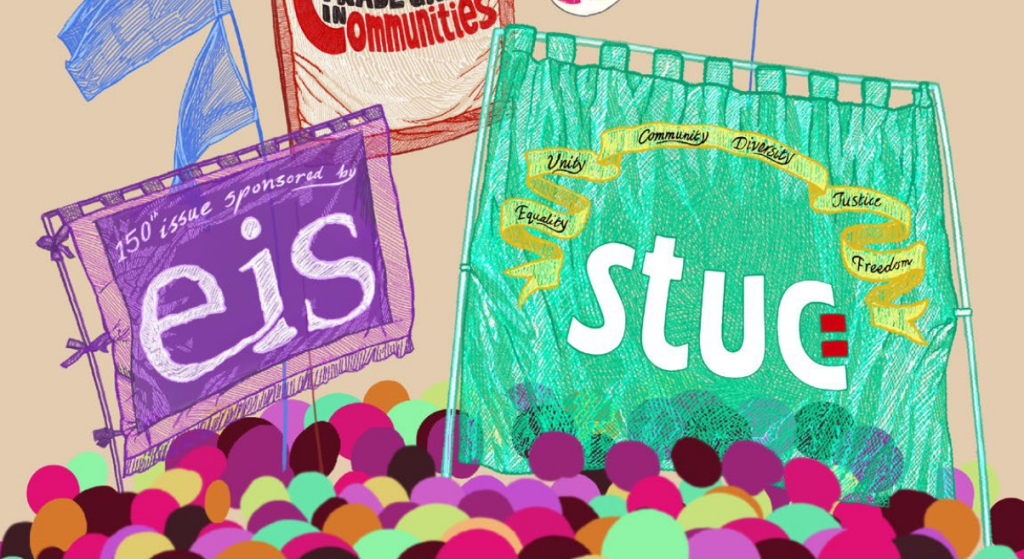
This creative work is done through organisations including two that feature on our 150th edition cover. We are proud that the Educational Institute of Scotland is sponsoring this issue. Since 1847, EIS, the oldest teachers’ union in the world, has fought both for teachers’ rights and conditions and for the best education of the country’s children. The STUC, meanwhile, has since 1897 annually convened Scotland’s unions to share their stories and successes, reimagine their vision for the country, and agree lines for the year ahead. This year each STUC delegate receives a copy of this edition courtesy of EIS.
In a new history of Scottish Labour, the historian David Torrance charts the early party’s rise against the backdrop of late-Victorian Scotland. Torrance suggests that socialist candidates in the Independent Labour Party were often out of kilter with the public, and he is sceptical how far the vision of the Left informed the values of the nation. Yet he shows how the individualism and imperialism of an older generation gave way to a new movement that harnessed working people’s will for control and change. Although he focuses on parliamentary politics, his account reveals that then, as today, many of the most impressive socialists put their energy not into the parliamentary cycle, but into education and organising, weaving deep-dyed fabric that survives the electoral wash.
In these pages, STUC General Secretary Roz Foyer urges us to treat the stories of past struggles as inspiration to write the script of Scotland’s future. This issue provides many illustrations of struggles in our time. Karren Morrison and Charlie McCarthy describe how Serco was steamrollered by a union coalition in Forth Valley NHS whose campaign was fuelled by imagination and fun. Rachel Crawford recounts the resilience and tactics of creative workers when their employer, video games company Rockstar, fired dozens of union members in October. Irene Graham tells how Sammy Morris’s legacy is changing the lives of many pensioners in one Unite Retired Members Branch. Greig McArthur describes the work to unionise the high voltage energy sector, while Jake Molloy shares how he went from winning better health and safety for offshore North Sea rig workers to contributing to Greenpeace’s Just Transition campaign. Looking to future struggles, Neel Sengupta describes the kind of education that unions need in this digital world, and the value of deep inquiry into working systems and conditions.
Meanwhile, beyond the shop, the Left is organising in solidarity with migrant workers who are targeted and persecuted. The darker side of Karren and Charlie’s story is the sudden change of scene from fighting Serco in the shop to fighting the far-right on the streets. Jim Slaven reflects on the legitimacy of working class anger that the Left should not confuse or conflate with hate. Christopher Silver’s review of Everybody to Kenmure Street explores how laying our bodies on the line can both achieve practical wins and strengthen heartening myths that help us amplify our image of a better Scotland.
Work to reimagine Scotland must always be accompanied with empowerment in the here-and-now. Kate Campbell of the SNP and Katy Clark of Scottish Labour share their priorities for the next parliament when it comes to tackling work injustice, from extending Fair Work beyond its narrow limits, to developing a Scottish strategy to rein in the exploitation that is rife in the expanding gig economy. Despite Scotland’s pretensions to being a fairer place to work than England, Udinyhiwe Unity describes the clunky and complicated Scottish system of support for migrant care workers who are arbitrarily displaced by Home Office enforcers. Xabier Villares details how deeply precarity can penetrate the psyche of those the public fails to see and fails to support. The solution lies in fostering solidarity across all boundaries and around every division.
While this issue takes Scotland as its focus, the onslaught on Iran is bringing shouts of anger to our streets. But as Margaret Elphinstone writes, these cries are nothing to the cries of parents and children, friends and comrades living under the rain of cruelty. As we hope and march for peace and justice, keep imagining a time when all the nations of the world are done raising hell on earth, and all the weary people of the world will rest.