The Danish model demonstrates how Scotland’s communities could co-own wind farms, writes Calum MacDonald.
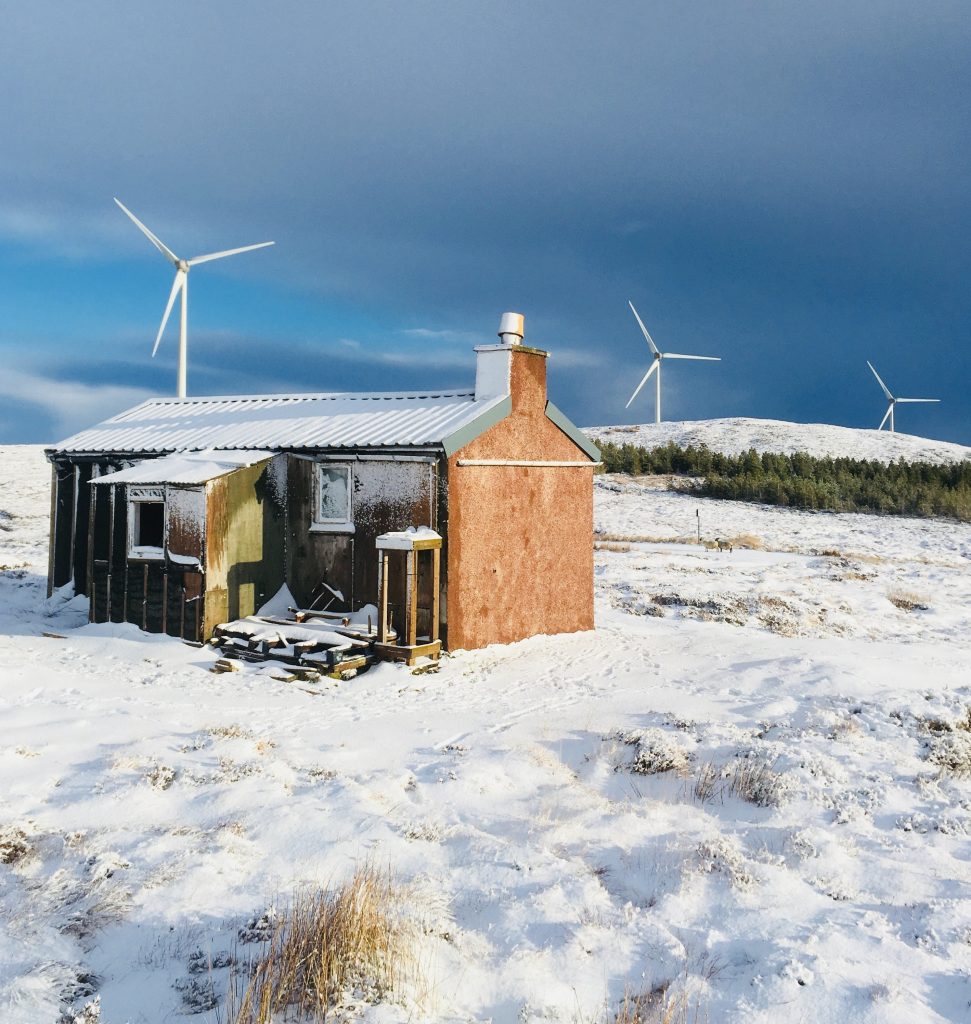
The harnessing of wind energy in Scotland over the past twenty years has been truly spectacular but, unfortunately, the economic benefit at both local and national level has failed to keep pace. There is a striking lack of Scottish presence not just in the manufacturing supply chain but also in the ownership and operation of the wind farms themselves. Even Scottish Power’s portfolio of wind farms is ultimately owned by its Spanish parent company, Iberdrola, and a 2025 report by Future Economy Scotland pointed out that only a quarter of Scotland’s offshore wind farms are owned by companies headquartered in the UK, far less in Scotland.
A striking example of this imbalance of ownership and benefit is the proposed super-cable, recently approved by Ofgem, designed to take 1,800MW of new green energy from wind farms in the Outer Hebrides to the national grid by 2030. Only 38MW – less than 2% – of all the power to be carried across the Minch will be generated by UK-owned companies. The remaining 98% will be owned by companies from France, Germany, Ireland, Norway and Canada. Given that existing wind farms on the islands generate an average profit of £100,000 a year per MW, that means that up to £180 Million a year in profit generated in the Hebrides could be flowing from the island to headquarters located overseas, while less than £4 Million a year is retained to benefit the local and Scottish economy.
An even more inexplicable example can be found in the use of the Scottish government’s own forests managed by Forestry and Land Scotland. This enormous land bank has been leased out for 1,300MW of wind farms over the past twenty years, yet hardly any of the turbines turning in the government’s own forests is Scottish owned and around a billion pounds of profit in the past decade alone has been allowed to trickle through Scotland’s fingers.
The Danish Model
It is not too late, however, to do things differently. A typical site lease for a Scottish wind farm lasts around 25 years, in keeping with the expected lifespan of the turbines. At the end of its lease, each wind farm is due to get ‘repowered’ with new and more efficient turbines. At that point, developers need to apply for new leases and new planning consents to match. In Scotland, the entire onshore industry will be going through this process over the next twenty years and this provides a golden opportunity for both the Scottish and the UK government to deliver a policy reset and finally bring a better balance between national economic benefit and international investment.
Other countries already do it differently and provide easily adaptable models for us to follow. In Denmark, for example, over 50% of onshore wind farms are locally and community-owned, including by local development trusts, by cooperatives and by municipal companies. Furthermore, all new wind developments by private companies are obliged to offer 20% part-ownership to the local host community. Far from deterring corporate enterprise or international investment, this sensible balance between public and private interest has enabled Denmark to build some of the most successful energy companies in the world, both in the supply chain and in wind farm development and ownership.
Can this be replicated in Scotland? The good news is that attitudes are at last beginning to change at government level. Whereas previous policy makers thought of community-owned energy as a nice but niche sector whose benefits were small-scale, it is now increasingly appreciated that, in terms of local economic impact, community owned wind farms can deliver far more than any corporate wind farm can do, regardless of size. A good example of this is the Beinn Ghrideag community wind farm in Lewis (of which I am a director) which has returned £10 million in profit to a local development trust in the past decade. By comparison, Whitelee, south of Glasgow, the largest corporate wind farm in the UK and fully sixty times bigger than Being Ghrideag, has returned just £9 million in community benefit payments over the period. In terms of sheer economic impact, then, it is clear that such models of community ownership can truly move the needle and that we need new policies to scale up this sector and make it central to Scotland’s – and Britain’s – energy future.
Signs of a Scottish Reset
This reset can be achieved without huge new public spending or complicated new parliamentary legislation. Politicians and policy makers can use the powers and budgets they already have to back the community model and grow it to its full potential.
Last year, for example, a coalition of community bodies, led by Community Energy Scotland, met with Gillian Martin, the Minister for Energy in the Scottish government, to press for a change of policy giving local communities the right of first refusal on wind farm sites in the national forest estate when their leases come up for renewal, instead of those sites simply being tendered on the open market. Last November, the government agreed that ten of their smallest sites will be offered first to local communities with a grace period of 15 months to come forward with development proposals that are acceptable to Forestry Land Scotland.
This represents a truly significant and welcome change of approach and it will mean that millions of pounds will eventually return to these local economies which would otherwise have been lost. It is still only a first step, of course, and we will continue to advocate that the whole forest estate should be opened up in the same way. There should be no cap on community ambition or potential.
At the same time, we have been pressing the new Labour government to make a similarly radical break from the laissez-faire, hands-off approach of previous UK administrations through a number of new policies. One of the proposals which the government is currently consulting on is for private developers to be required to pay a specified annual community benefit per MW rather than for such payments to be left to developer goodwill as at present. This would formalise current best practice but, of course, would still leave the vast bulk of profits going elsewhere. Therefore, we are also using the government’s consultation to press strongly for the adoption of the Danish policy, cited above, and to require corporate developers to offer local communities a 20% share in every new or ‘repowered’ wind farm. Over time, this would dramatically change the landscape of the green economy in the UK, making it many times more beneficial to frontline local communities as well to the whole economy of Scotland and the UK.
To purchase their offered share, of course, communities will need to get financial backing from commercial lenders, just as the existing community-owned wind farms must do to develop their own wholly-owned schemes. But with public bodies such as GB Energy and the National Wealth Fund standing behind these communities, commercial lending should not prove too difficult or expensive to raise. Indeed, banks I have talked to would be keen to invest at large scale in projects that would be so clearly community-friendly as well as climate-friendly.
These new policies have the potential to mark a radical break from past failure, delivering greater community empowerment, more social fairness and stronger local enterprise. The current openness of both Scottish and UK governments is encouraging but to get these reforms over the line we need the support of interested community activists, trade unions, local authorities and members of all political parties. The upcoming Scottish elections provides the ideal forum for these ideas to be debated, demanded and locked in to the political manifestos of all parties.
Calum A MacDonald is Chair of Community Energy Scotland and Founding Director of Point and Sandwick Trust. He was the MP for the Western Isles from 1987-2005.