Colin Porteous reflects on the work of Technical Services Agency and its damp-busting and flat-building achievements in 1980s Glasgow.
Fuel poverty and its associated problems reached critical prominence during the 1970s and 1980s. Cities such as Glasgow epitomised the prevalence of fuel poverty with large post-WW2 housing developments particularly vulnerable to immediate and health-threatening consequences, in particular internal surface dampness and black mould growth. For example, in 1975 a group of tenants based in Hutchesontown, Gorbals, initiated the Anti-Dampness Campaign in 1975.1 It was this together with the incremental formation of a network of similar tenant-led and community groups across Glasgow, plus some socially focussed academic input, that ultimately resulted in the founding in 1983 of a user-controlled, community aid organisation: Technical Services Agency.2
A Short History of the TSA
Known by its acronym, TSA was modelled on an earlier initiative in Liverpool, Community Technical Services Agency or COMTECHSA, founded in 1979 and initially led by architect Leslie Forsyth.3 COMTECHSA and TSA became part of a UK network of such groups under the aegis of the Association of Community Technical Aid Centres (ACTAC), as did also Community Technical Aid (CTA), Northern Ireland.4 Organisational structures for COMTECHSA and TSA were closely aligned. Both were non-profit distributing members cooperatives, effectively friendly societies, registered under the Industrial Societies Acts; CTA was a company limited by guarantee with charitable status. Funding was more disparate in terms of detail but similar generically. Comparing COMTECHSA with TSA, each had a publicly funded start-up phase, recognising that need lay in societal sectors without financial resources, but each was empowered to generate income from viable commercial services, to be reinvested to further longevity.
TSA’s steering group largely emanated from ASSIST, an academic housing action group within the University of Strathclyde. It initially received a seed grant from the Gulbenkian Foundation, followed in January 1984 by ‘Urban Aid’,5 a fund “established in 1969 by the then Labour Government to support, with Government finance, community projects in areas of greatest social need.” There was little question that TSA targeted resources on the basis of need, since 70% of TSA’s membership comprised tenants’ associations, action groups and residents’ associations based within the territories of Glasgow District Housing and Strathclyde Region.6 (There were nine other smaller categories, including community centres, Community Councils, disabled groups, tenants’ federations and housing co-ops.) The Urban Aid grant to TSA, however, was recognised as time-limited and likely to be curtailed beyond 1991.
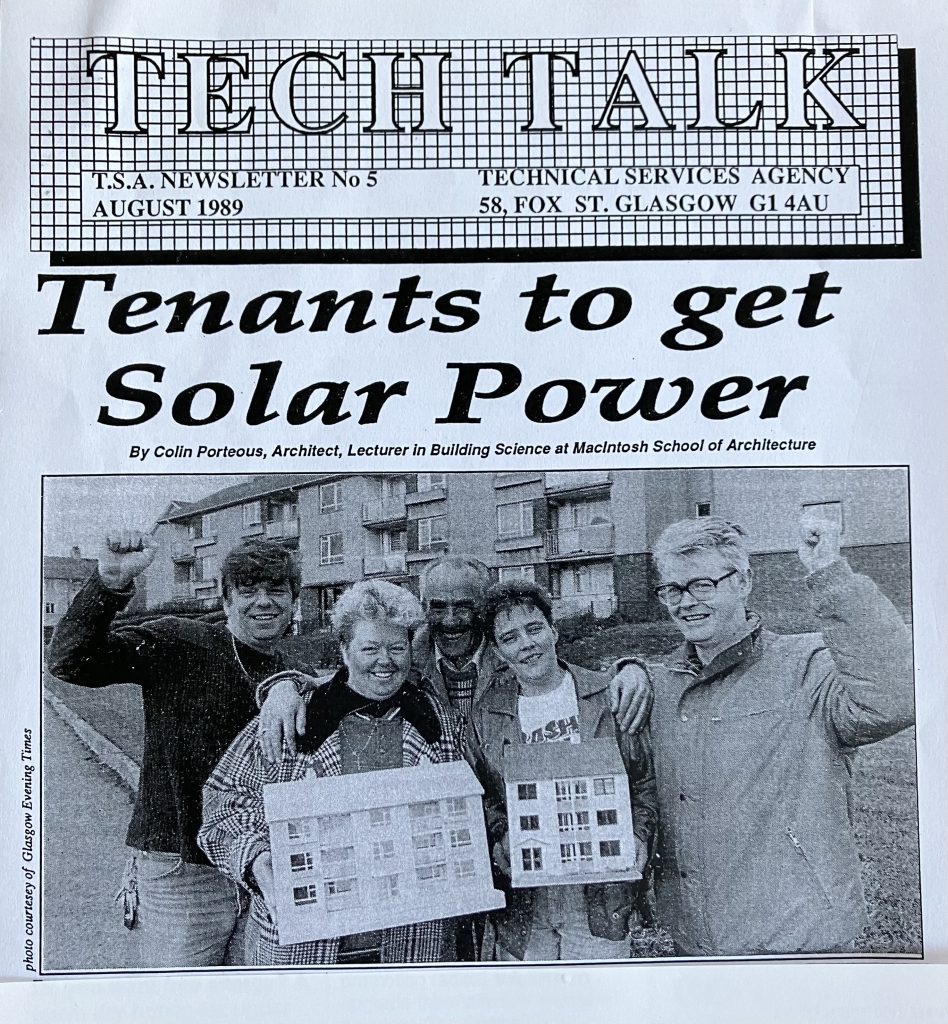
The grass-rootedness of TSA’s membership translated naturally into the user control of its management structure. The nominated shareholder for each member group was allocated a place at the Annual General Meeting, from where 20 were elected or re-elected onto the management committee for the following year. The present author, an architect with solar-thermal research experience, was TSA’s salaried Project Leader for the first two years of its existence from late 1984 to late 1986; and after moving to the Mackintosh School of Architecture was co-opted onto TSA’s management committee as the only representative not drawn from the membership pool as described. This position proved to be an enabling one in terms of the subsequent projects undertaken by TSA in concert with academia (see below). A Development Worker fulfilled a valuable scoping role, including liaising with other relevant voluntary sector organisations such as Heatwise and Energy Action Scotland. They also produced a newsletter, Tech Talk, summarising recent activities and distributed to TSA’s membership, as well as initiating conferences, reciprocal visits with COMTECHSA, etc. Another architect was appointed earlier in 1984 and several others followed after TSA became fully operational in late 1984, with its office in a newly refurbished shop-shell. An administration worker was also appointed and joined by an assistant.
With the 1991 Urban Aid curtailment in mind, TSA had by 1987 launched a sister company, Community Architecture Scotland Ltd (CAS), and moved to larger office premises. Additionally, since it had always been the intention to be able to provide legal as well as technical aid, a steering group was formed to that end and Legal Services Agency (LSA) was set up by 1989. LSA shared some board members with TSA, had a similar user-controlled managerial structure, and is still operational today.
Work, Spin-Offs and Impact
TSA’s first full operational year coincided with the publication of the Building Research Establishment’s BRE Domestic Energy Model,7 which provided a relatively simple calculation methodology enabling TSA to measure problems arising from fuel poverty – typically, lack of affordable ‘heatability’ – and to situate fuel poverty as the fundamental concern of many of its referrals from member groups. Heatability problems were sometimes aggravated by damp and other defects associated with water ingress. Causes of members’ issues were then carefully explained in face-to-face tutorials to their representatives. Such reports could then constitute potent campaigning tools for groups to obtain appropriate remedial action via their landlord.
Aside from such surveys and analytical reports, some members presented TSA with building projects. An early one was the refurbishment of a youth centre in Easterhouse, reputedly linked with pop-star Frankie Vaughan’s promotional visit in 1968. Whether apocryphal or not, the Easterhouse Project was set up in in 1969, and a Nissen hut, used thereafter as a youth centre, was rejuvenated by TSA in the latter half of the 1980s. TSA also designed buildings that went on to be constructed. Two 5-person maisonettes were constructed in a project initiated by Bernard Street Residents Association and partly funded by Glasgow District Council (GDC). An initial survey, report, and follow-up monitoring over 1985—86 were described and illustrated in a paper presented at a Royal Incorporation of Architects in Scotland event in September 1986.8
GDC’s direct labour unit then undertook the project, given the acronym DRI to denote Dampness Remedy Initiative, and involving commercial financial contributions to meet the shortfall of GDC funding. Their thermal performance was described in a TSA-published book of the early 1990s, and a video from the project was used as part of an Architecture School lecture series for many years.
Another venture combined an idea of TSA management with an offer by an active member group, Easthall Residents Association (ERA). TSA had provided two reports, the first concerning a fabric survey in 1985 and the second recording the results of cold-weather internal air and measurements in early spring 1986. Its ‘idea’ was for an interactive community competition aimed at upgrading a specific ERA block of six flats; ERA’s ‘offer’ was to host the event over a weekend. The event was named Heatfest, promoted by TSA alongside the Scottish Solar Energy Group (SSEG) and the West of Scotland Energy Working Group (WSEWG), and held from Friday 30th January 1987 to Sunday 1st February inclusive. The first day was a conference with eminent speakers such as the late Prof. Tom Markus, who had aired the issue of fuel poverty to the architectural community in 1979, and Dean Hawkes from the University of Cambridge.9 The second day comprised workshops; each team included two architectural members (practitioner and student), housing professionals and, notably, two tenants drawn from different TSA member groups. They brainstormed a briefing-pack for upgrading the flats, promoting the use of solar energy. On the third day one tenant and one professional from each group presented their solution, with Owen Lewis of University College Dublin chairing the closing Q&A session.10 Lewis had strong links to the then Commission of European Communities (CEC), and suggested that ERA and TSA should take the winning design idea forward to implementation as a European Solar Demonstration Project.
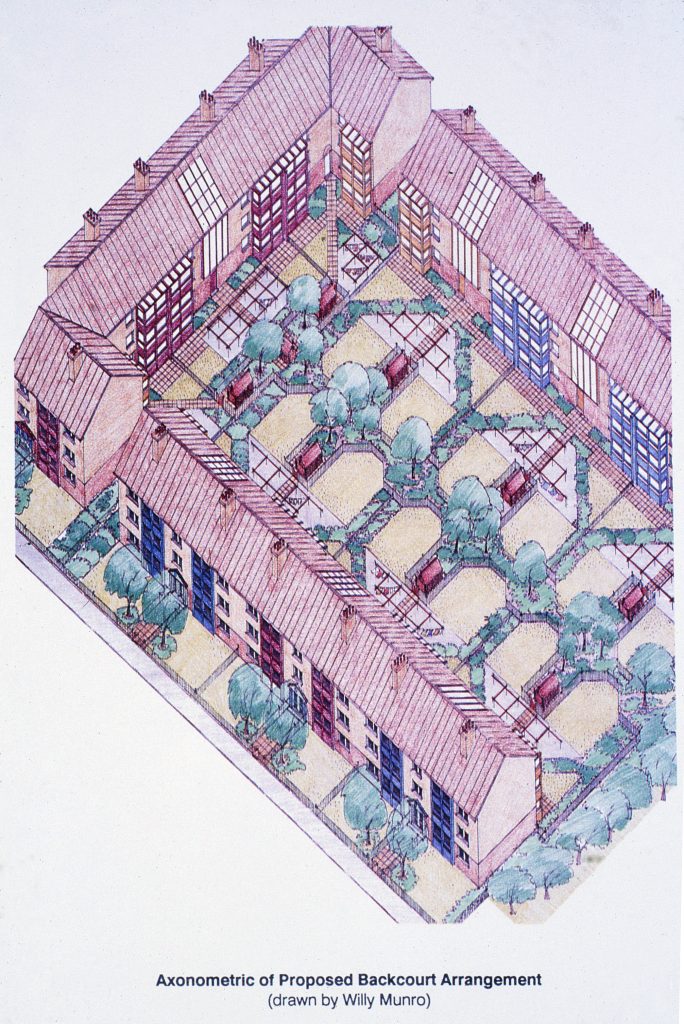
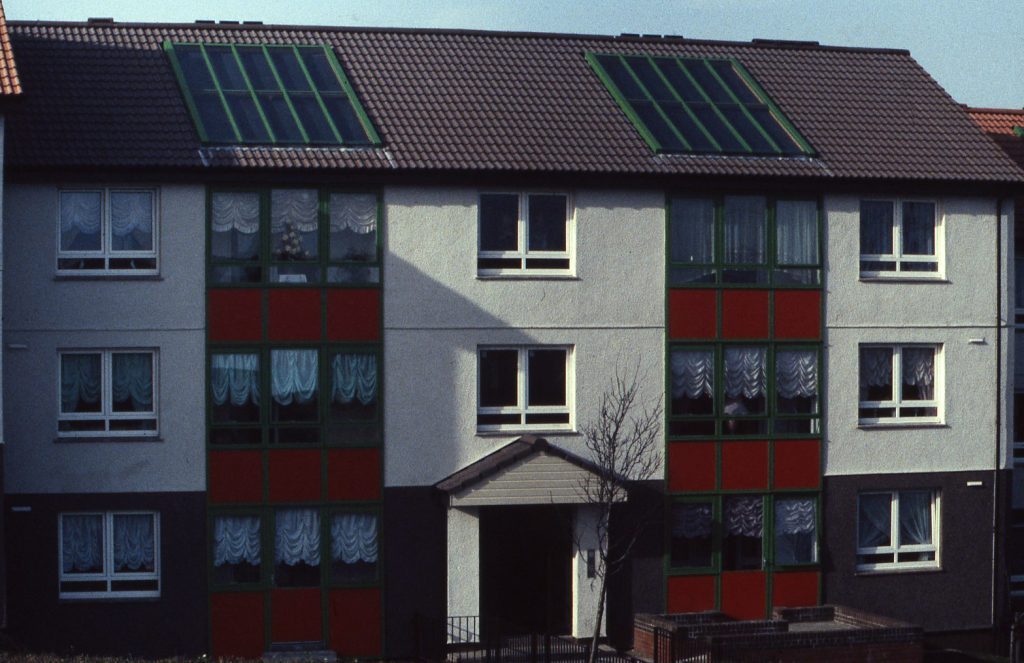
ERA was enthusiastic about such a challenge, although the CEC bureaucracy appeared daunting. It may be noted that most groups such as ERA had the support at that time of a community worker over and above that of TSA.11 In due course the submission was made by ERA, GDC, and TSA, resulting in the happy announcement in January 1989 that the CEC would support the Solar Demonstration Project to upgrade 36 flats in Easthall with an award of £380,000 to ERA.12 That was not the end of the story in terms of implementation, as although GDC had signed off as a Proposer, it had not envisaged success; consequently, ERA sought governmental persuasion (i.e. to ‘arm-twist’ GDC), as well as support from the wider TSA membership in Glasgow and Strathclyde and similar active groups elsewhere in Scotland.
In March 1989, ERA promoted the Scottish Anti-Dampness Conference at Alan Glen’s School, Glasgow. This included a workshop led by Dr. Sonja Hunt, with whom TSA had been working on health surveys in damp housing in Edinburgh and London. Moreover, Prof. Markus launched the National Right to Warmth Campaign.13 By 30th January 1990 GDC had confirmed “a suitable funding package”, enabling CAS as architect to move forward with technical drawings together with D M Doig & Smith as quantity surveyor.14 The building contract was dated 06.11.90, with ERA as Principal Contractor, GDC as second Contractor, TSA as third Contractor, and the Mackintosh School of Architecture (MSA) as academic sub-contractor.
By 1992 the heat monitoring system had been fully designed and installed by MSA. Data-logging commenced in September of that year and was completed by the end of May 1994 – i.e. for two entire heating seasons.15 Design and performance were initially disseminated at international solar conferences and in a 1997 journal.16 The CEC-funded demonstration had also been prefaced by Heatwise Glasgow funding a pilot ‘Jobs and Energy’ Project to upgrade the Heatfest block. Both the Heatwise pilot and the full CEC demonstration were underpinned by MSA’s calculation methodology, which had developed BREDEM as SODEM, denoting Solar Option Domestic Energy Model.17
The project as a whole, however had wider and longer-term impact than its numerical performance and architectural potential for replication. It had the impact of social empowerment. This manifested itself through more than one of ERA’s players. One member, Cathy McCormack, travelled widely during the 1990s on global health missions.18 Closer to home, she directed a community play, ‘The Dampbusters’, which toured as part of Glasgow’s City of Culture 1990, and reappeared in 2021 as part of an exhibition.19 She also instigated a health investigation of the CEC Demonstration,20 and leaves a 2024 legacy via the ‘Cathy McCormack Community Activism Fund’ inaugurated by Glasgow Community Energy. Former ERA Chairperson, Helen Martin, a close ally of McCormack, matured as a member of teaching staff at the University of Glasgow, and David Humble, ERA Secretary in 1996, toured the UK and parts of Europe to disseminate the project, with emphasis on beneficial social outcomes.21
Such impacts, taken together with TSA’s more routine work, raise the question as to why we have no similar service today? Unlike LSA, TSA’s business model did not weather the financial constraints of the 1990s without continuing public funding. Given today’s statistics on fuel poverty (31% in the 2022 Scottish House Condition Survey), and continuing concerns about indoor health, it would seem that there is a strong case to be made for a renewed CTAC, certainly in Glasgow and Strathclyde, and probably in other Scottish centres.
| Colin Porteous is a retired social architect, with a career split fairly evenly between practice, laterally community trouble-shooting, and academia at the ‘Mac’ (Mackintosh School of Architecture), including authoring articles and books. |
- Wright, V., 2018, ‘Housing problems … are political dynamite: Housing disputes in Glasgow c. 1971 to the present day’, Sociological Research Online, 26(4), pp 976-78. ↩︎
- Porteous, C., 1988, ‘Technical Services Agency (TSA), Glasgow’, Town Planning Review. Liverpool University Press, pp 18-29. ↩︎
- Forsyth, L., 1988, ‘The Community Technical Services Agency (COMTECHSA) Limited’, Town Planning Review. Liverpool University Press, pp 7-17. ↩︎
- Blackman, T., 1988, Community Technical Aid (Northern Ireland) Limited’, Town Planning Review. Liverpool University Press, pp 30-43. ↩︎
- Hamilton, W. H., 1984, ‘Urban Aid Programme (Scotland)’, Hansard, Vol. 63 cc1513-20. ↩︎
- Proceedings of 1987 International Housing Conference ↩︎
- Anderson, B. R. et al, 1985, ‘BREDEM – BRE Domestic Energy Model: background, philosophy and description’, BRE, DoE. ↩︎
- ↩︎
- Markus, T., 1979, ‘Fuel Poverty in Scottish Homes’, AJ Information Library, AJ 23rd May, pp 1077-1062. ↩︎
- Goulding, J. R., Lewis, J. O. & Steemers, T. C., 1986, ‘Energy in Architecture, The European Passive Solar Handbook’, Batsford for CEC, 239 pages. Owen Lewis was one of three editors of the 1986 ‘Energy in Architecture, The European Passive Solar Handbook’. ↩︎
- Note: the late Anne McGuire, Community Worker for Easthall Residents Association. ↩︎
- Porteous, C., 1989, ‘Tenants to get Solar Power’ Tech Talk, TSA Newsletter 5, pp 1-2. ↩︎
- Anon., 1989, ‘Scottish Anti-Dampness Conference’, Tech Talk, TSA Newsletter 5, p 8. ↩︎
- Anon., 1990, ‘Energy Demonstration Project No. SE-167/88-UK, Annexe 1, (see note under Item 7), see Glasgow School of Art Archive – Easthall Solar Demonstration Project ↩︎
- Porteous, C. D. A., 1984, ‘Passive Solar Retrofit of Thermally Substandard Housing at Easthall, Glasgow: Final Report – Results of the Monitoring Programme 1992-94’, CEC Demonstration Project No. SE-167/88-UK, see Glasgow School of Art Archive. ↩︎
- Porteous, C. D. A. & Ho H. M., 1992, ‘Solar Retrofit of Thermally Substandard Housing in Glasgow’, North Sun ’92 Solar Energy at High Latitudes, Trondheim, Norway, pp 138-144. Ho H. M. & Porteous, C. D. A., 1994, ‘First Year Results of the Solar Retrofit of Thermally Substandard Housing in Glasgow, United Kingdom’, North Sun ’94 Solar Energy at High Latitudes, Glasgow Scotland (ed. Kerr MacGregor and Colin Porteous), pp 317-322. Porteous, C. D. A. & Ho H. M., 1997, ‘Do Sunspaces Work in Scotland? Lessons Learnt from a CEC Solar Demonstration Project in Glasgow’, The International Journal of Ambient Energy, Vol. 16, No. 1, Jan., Ambient Press Ltd, Lutterworth, UK, pp 23-35. ↩︎
- Porteous, C. D. A., 1990, ‘ Performance Characteristics of Solar Buffer Zones for Scottish Housing’, PhD Thesis, University of Strathclyde, pp 2 and 4-16. ↩︎
- McCormack, C with Pallister M., 2009, ‘The Wee Yellow Butterfly’, Argyll Publishing. Note travels: 1992 Nicaragua (study tour), 1994 USA (UN), 1994-95 Demark (WHO), etc. ↩︎
- Herbstein, W., 2021, ‘Dampbusters’, 6 August – 4 September, Centre for Contemporary Arts, Glasgow. ↩︎
- Lloyd, E. L., McCormack, C., McKeever, M., & Syme, M., 2008, ‘The effect of Improving the thermal quality of cold housing on blood pressure and general health: a research note’,
Journal of Epidemiol Community Health, 62, pp 793-797. ↩︎ - Note that this Passive Solar Workshop tour, September 1996, was funded by NIFES. ↩︎