Helen Yaffe, Professor of Latin American Political Economy at the University of Glasgow, addresses the context and possible consequences of Maduro’s kidnapping.
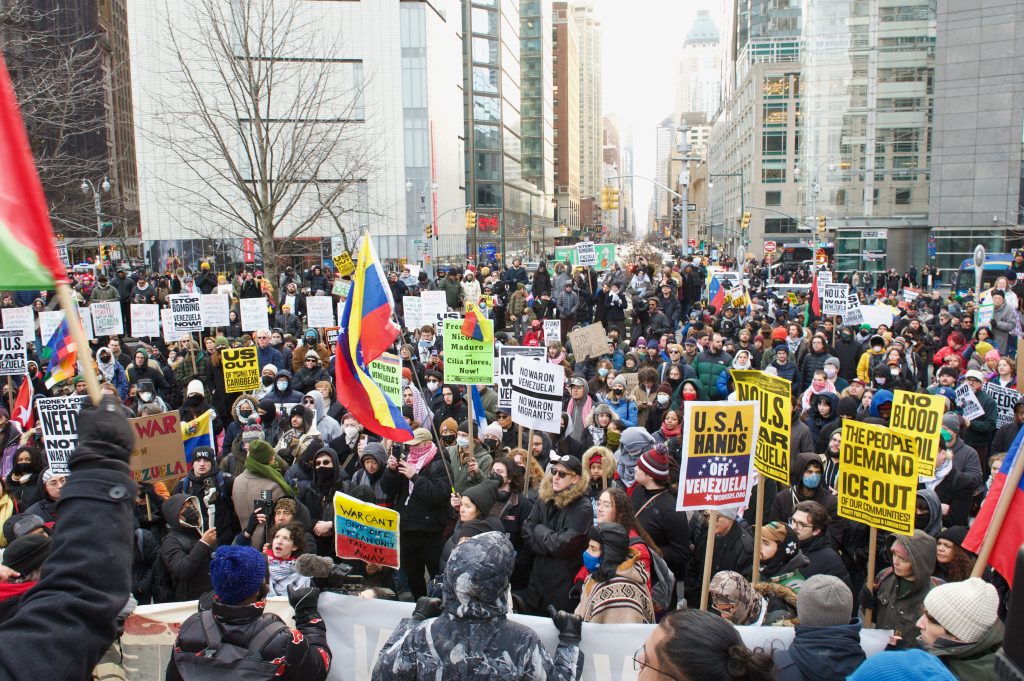

Venezuela enters 2026 under the onslaught of US military operations to enforce regime change against socialist president Nicolás Maduro and the Bolivarian Revolution he leads. This follows a quarter-century of US hostility, which has seen coup attempts and covert operations, economic warfare and lethal sanctions, the fomenting of domestic opposition, claims of electoral fraud and recognition of two self-proclaimed presidents. Drawing on a familiar playbook for manufacturing consent, a US fabricated narrative casts Maduro as head of a drugs cartel and Venezuela as a narco-state. Trump has even branded the country a foreign terrorist regime, accusing Maduro of flooding the United States with the synthetic opioid fentanyl and criminal migrants.
Behind this smokescreen lies US anxiety about access to oil and other strategic resources on which its prosperity depends, concern about China’s expanding global reach, competition from foreign powers in the Americas, and fear of socialism as a viable development alternative in the Western Hemisphere. The aggression against Venezuela is also an assault on socialist Cuba, which fourteen US administrations have failed to overthrow in 67 years. Trump’s first administration concluded that toppling the government in Caracas would hasten collapse in Havana, and vice versa. Now, with Secretary of State Marco Rubio, whose career has been built on hardline opposition to Cuban socialism, that strategy has moved to the fore.
The US military threat escalates, August to December 2025
In early August 2025, the US intensified pressure on Venezuela, first doubling its bounty on Maduro to $50 million, then deploying a massive naval and air armada to the Caribbean, close to Venezuela, including a nuclear submarine and 15,000 troops, under the guise of ‘Operation Southern Spear’ to target drug trafficking. Between 2 September and 29 December, US forces launched 30 lethal strikes on civilian vessels in the Caribbean Sea and Eastern Pacific Ocean, claiming to target Venezuelan narcotraffickers. These were extrajudicial killings; US authorities have neither identified the 107 victims nor presented evidence. Trinidadian and Colombian fisherman are among the dead.
On 10 and 20 December 2025, US troops seized large oil tankers in international waters, along with nearly four million barrels of Venezuelan crude, and Trump announced a naval blockade of US-sanctioned tankers entering or leaving Venezuela. Dramatic footage shows heavily armed US soldiers rappelling onto the decks from helicopters. The fate of their crews is unclear, but Trump has nonchalantly stated that the US will keep or sell Venezuela’s oil.
These actions violate international law, including prohibitions on extrajudicial killings, unlawful use of force, and interference with freedom of navigation, as pointed out in an emergency session of the UN Security Council by Venezuelan Ambassador Samuel Moncada, who denounced them as ‘the greatest extortion known in our history; a gigantic crime of aggression in progress, beyond all rational parameters, all legal logic, and all historical precedent.’ Moncada referenced Trump’s social media post a week earlier which boasted: ‘‘Venezuela is completely surrounded by the largest Armada ever assembled in the History of South America. It will only get bigger, and the shock to them will be like nothing they have ever seen before – Until such time as they return to the United States of America all of the Oil, Land, and other Assets that they previously stole from us …’. The claim that Venezuela has stolen oil from the United States is another lie.
On 29 December, Trump claimed that US forces had struck a Venezuelan dock used for loading drugs several days earlier. Caracas offered no official response, but Venezuelan sources instead pointed to an explosion in a private chicken-feed factory in the area and accused Trump of another fabrication. As psychological warfare intensifies, distinguishing fact from fiction will become increasingly difficult.
The kidnapping of Maduro on 3 January 2026
Then on the night of 2-3 January explosions rocked Caracas as 150 US aircraft, including fighter jets, helicopters and bombers, hit targets throughout Caracas, including antennas, military facilitates, ports and airports. 32 Cubans, who were there to protect Maduro, were killed in the attack. On Trump’s orders, the US military captured President Maduro and his wife. At a press conference later that day, Trump said Rubio, and Secretary of War, Pete Hegseth, were working with a team in Venezuela and would designate a new government. He claimed that Venezuelan Vice President Delcy Rodríguez had told Rubio, ‘we’ll do whatever you need’, adding that she didn’t really have a choice. Shortly afterwards, however, Rodríguez addressed the National Defence Council, broadcast live on state television, and denounced the US military attack and kidnapping of Maduro and his wife, demanded their immediate return, insisted that he remains the only legitimate president and declared that Venezuela would never be a colony again. It was a defiant response to Trump’s warning, in the same press conference, that Venezuela would be hit harder with a second round if they did not give the US what it demands. Meanwhile, Rubio added that Cuba’s government should be ‘concerned’ after its strike.
Venezuela’s Fake Weapon of Mass Destruction
US warmongers have blamed Venezuela for the US fentanyl epidemic, labelling the drug a ‘weapon of mass destruction’, despite the US State Department’s own March 2025 report identifying Mexico as the sole source of fentanyl entering the United States. After researching the so-called Cartel of the Suns, which Maduro is alleged to lead, Spanish lawyer and professor Fernando Casado concluded that it was ‘a fantasy that makes Narnia look real.’ Further discrediting Trump’s professed concern about narcotrafficking, in late November he pardoned Honduran ex-President, Juan Orlando Hernández, who was convicted in a US court the previous year and sentenced to 45 years for conspiring to smuggle over 400 tons of cocaine into the country.
Black Gold
Venezuela holds the world’s largest proven oil reserves. While it continues exporting crude to the United States, the share has plummeted, especially since the 2017 Trump administration sanctions targeting the oil sector and state-owned oil company PDVSA. China is now the primary recipient of Venezuelan crude. Trump’s November 2025 National Security Strategy declares: ‘Restoring American energy dominance (in oil, gas, coal, and nuclear) and reshoring the necessary key energy components is a top strategic priority’. US reserves have fallen and Trump seeks to build them up; falsely claiming that Venezuela’s oil was stolen from the United States, then seizing tankers, serves that end. Yet the oil aboard those vessels is Venezuelan property, legally sold and exported.
Venezuelan President Carlos Andrés Péreznationalised the country’s oil industry and created PDVSA in 1976. PDVSA operated with considerable autonomy, benefiting managers but not the broader population, 70% of whom lived in poverty by the 1990s. In early 1999, Hugo Chávez became President of Venezuela on an anti-neoliberal platform, launching the ‘Bolivarian Revolution’ and using oil revenue to fund social missions. Chávez reasserted state control over the oil industry, restructuring joint ventures with foreign firms in 2007 to secure majority state ownership. Oil revenues were used to fund development projects at home and abroad under cooperation agreements such as Petrocaribe, through which Venezuela supplied oil at concessionary rates to fourteen Caribbean nations. However, incremental US sanctions have severely curtailed Venezuela’s oil production and export capacity, adversely affecting its partners, especially Cuba.
Links with Cuba
In 2000, Chávez and Cuban President Fidel Castro signed their first cooperation agreement under which Cuban medics staffed Venezuela’s public healthcare system, trained Venezuelans as medics and treated Venezuelan patients on the island. From 2004, when the Venezuelan Medical Federation boycotted Barrio Adentro, a government mission to introduce free public healthcare to millions of poor Venezuelans, some 20,000 Cuban healthcare professionals arrived to fill the void. The Chávez government paid Cuba with Venezuelan oil at below world market prices. Based on the resource strengths and socioeconomic needs of each country, this ‘oil for doctors’ programme enabled Chávez to deliver the social benefits promised to Venezuela’s impoverished majority, the backbone of support for his Bolivarian Revolution, and catalysed Cuba’s recovery from the Special Period of economic crisis following the collapse of the Soviet bloc. The exchange launched medical services as Cuba’s main source of revenue, circumventing the decades-long US blockade, and bought Cubans respite from the blackouts and bus queues resulting from oil shortages. Hundreds of cooperative programmes followed, along with political support.
Venezuela and Cuba’s alternative regionalism
In December 2004, Venezuela and Cuba launched the Bolivarian Alliance for the Americas (ALBA) – its Spanish acronym means ‘dawn’ – a trade and development agreement later joined by a dozen Latin American and Caribbean states. ALBA championed welfare-based development, inspired by Cuba, and mutually beneficial cooperation as a deliberate alternative to the Free Trade Area of the Americas, a neoliberal treaty Washington sought to impose on the region. Despite the insignificance of the ALBA bloc in world trade, production, population or land mass, the project alarmed the US establishment.
In 2005 Chávez declared that Venezuela’s Bolivarian Revolution was building ‘socialism for the 21st century’. Other ALBA member presidents did likewise: Bolivia’s Evo Morales with his Movement Towards Socialism, Ecuador’s Rafael Correa via his Citizens’ Revolution; and Nicaragua’s Daniel Ortega with the return to a Sandinista government.
Having survived a coup attempt in 2002, Chávez succumbed to cancer on 5 March 2013, following two years of treatment, mostly in Cuba; he had won four presidential elections over 14 years, with between 54% and 63% of the votes. Vice President Nicolás Maduro stood in as acting president, subsequently winning three presidential elections with 50% to 68% of the vote, including the July 2024 elections which the opposition, and western governments, decried as fraudulent in a pre-prepared campaign.
Maduro has survived thirteen years of violent street protests, mercenary incursions, fraud allegations, and crippling sanctions that have been blamed for over 40,000 Venezuelan deaths in 2017-2018 alone, according to a Center for Economic and Policy Research report. He has steered an economic recovery since 2021, with GDP growth above 6% in 2025. Although domestic support for the Bolivarian Revolution has waned and sanctions have driven mass emigration, recent US pressure has rallied the popular masses to its defence, and to the streets; over eight million Venezuelans have voluntarily joined the Bolivarian militia. Meanwhile, Caracas has imported military hardware from Russian, Iran and China.
Extirpating socialism from the Western Hemisphere
Trump’s first administration revived Cold War rhetoric, propelled by hawks and neoliberal idealogues like Secretary of State Mike Pompeo and National Security Advisor John Bolton who, in 2002, falsely accused Cuba of developing biological weapons. In 2018, Bolton vilified Cuba as ‘the sordid cradle of communism in the Western Hemisphere’, branding Cuba, Venezuela and Nicaragua the ‘Troika of Tyranny’ while announcing fresh sanctions. The objective was to overthrow Maduro, ending oil exports to Cuba and triggering economic collapse and regime change on the island, leaving Nicaragua as an easy third target; thus, eradicating socialism from the western Hemisphere.
After the failed 2019 offensive to oust Maduro, US policymakers concluded that Cuba had been crucial to his survival. As Trump’s Secretary of State and acting National Security Adviser, Cuban American politician Marco Rubio is ideally placed to pursue his personal vendetta against Cuban socialism. For Rubio, toppling Maduro is a means of weakening the Cuban government. As Fidel Castro warned in April 1961 on the eve of the US-backed Bay of Pigs invasions, Cuba will never be forgiven for carrying out ‘a socialist revolution right under the nose of the United States!’
The Trump Corollary to the Monroe Doctrine
and the government, 4 January. Source: the author.
In late 2018, Trump resurrected the 1823 Monroe Doctrine. This foundational document of US foreign policy asserts its dominance over the Western Hemisphere to the exclusion of outside powers. It was reinforced by the 1904 Roosevelt Corollary which authorised US interventions in the Americas to advance US self-interest. The November 2005 National Security Strategy introduced a Trump Corollary: ‘to protect our homeland and our access to key geographies throughout the region. We will deny non-Hemispheric competitors the ability to position forces or other threatening capabilities, or to own or control strategically vital assets, in our Hemisphere. This “Trump Corollary” to the Monroe Doctrine is a common-sense and potent restoration of American power and priorities, consistent with American security interests.’ For all its bombast, the document reveals US anxieties about access to resources, eroding ‘soft power’, the status of the dollar as the world’s reserve currency, China’s international reach, and foreign rivals in the Americas.
The prospect of war is terrifying. Venezuelan forces cannot match US military might, but could bog it down in a protracted, bloody, Vietnam-style war. Such a conflict would destroy millions of lives, embroil the Latin American left, disrupt global oil markets and undermine the viability of anti-imperialist, anti-neoliberal governments in the future. That prospect should alarm us all.
Helen Yaffe is Professor of Latin American Political Economy at the University of Glasgow.