Kieran Murphy reviews Embracing Alienation: Why We Shouldn’t Try to Find Ourselves by Todd McGowan (Repeater Books, 2024).
Alienation, in Todd McGowan’s scheme, arises from an irreconcilable tension between one’s outward identity and inward subjectivity. Personal identity provides us a sturdy, rationalising frame by which we might offload subjectivity’s untidy complexity and flux – I’m a professor, a parent, a Scotsman, an activist, a good listener – but the array of titles by which we might orient ourselves in a wider social context never quite squares with the dynamism and subterranean mystery of inner life.
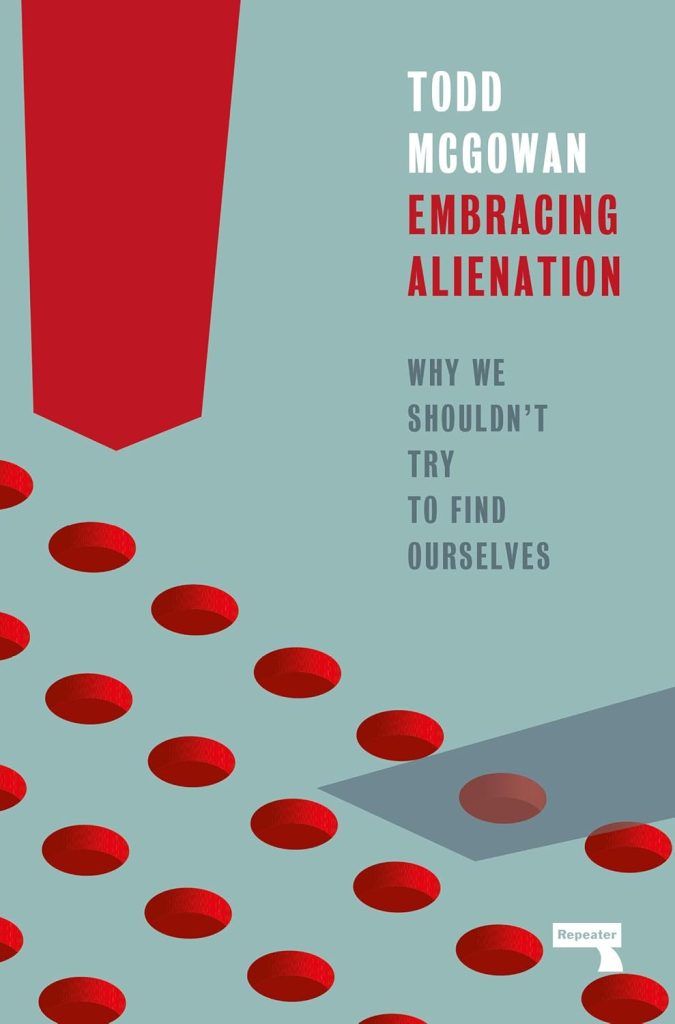
Regarding alienation as a tensile gap at once inborn and irreconcilable, McGowan argues, allows us to reconsider the dilemma of alienation not as a problem to pathologize or negate, but as a shared condition which unifies us all; we suffer more, after all, for the imagined wholeness we are perpetually failing to achieve than from alienation itself. This recognition, the tagline on the back boldly claims, could be the basis of our emancipation. Alienation, in this scheme, holds some homologies with just about every other expression of Lacanian lack – we can forget about any pretence to its ultimate resolution, as they would probably entail being dead.
McGowan’s most interesting argument within this particular framework of alienation is his proposed amendment to the orthodox-Marxist assumption that alienation originates largely from the complex of capitalist relations. Opposing an image of a mythic, nonalienated past, McGowan argues instead that the age of capitalism demarcates a sociohistorical turn at which alienation inherent in the subject is rendered inescapably visible, that it is the capitalist system’s capacity to uproot and provide a glut of potential vessels for gnawing lack that lays bare the latent alienation which always was. The true insidiousness of capitalism, where alienation is concerned, lies in the perpetual promise of transcending alienation, whether through avenues of accumulation, or through fetishizing a kind of life one ought to be living and isn’t. McGowan explores this particular vein more thoroughly in his 2016 work, Capitalism and Desire.
Embracing Alienation is a short work of ~150 pages. Were one to limit themselves to the intro, conclusion, and first chapter, they’d have read something resembling a slim, prescriptive self-help title, but the bulk of the book reads more like an archaeological excavation, tracing a lineage of alienation across centuries, making case studies of literature, philosophy, and popular culture, charting the social and psychic alterations the alienated subject sustains from one historical moment to the next.
Despite its broad survey of headier subject matter (Shakespeare, Marx, Descartes, Heidegger, Kant, Battlestar Gallactica), the work’s decidedly Zizekian bent, treating the social via the psychoanalytic (keep a look out for the lengthy exegesis of a Stalin joke), is accomplished in concise and comprehensible language that keeps the work accessible to a general reader. It’s Lacanian without the Lacanianisms, academic but not abstruse, and avoids obscurantism as a rule.
This brevity also invites didacticism; one notices virtually every subsection begins and ends in tight, assertive aphorisms, which might beg more incisive analysis than the work’s concise form permits. This is remedied somewhat by the work’s extensive use of endnotes, which allow for further exegesis on points not precisely concerned with a given chapter’s task-at-hand. Just as often, the endnotes function as a repository for non-consequential asides and personal anecdotes, which are nevertheless entertaining enough in their own right.
For a sceptic, the promise of embracing alienation as a basis for emancipation may seem just as utopian as the Marxist-idealist’s vision of harmonious and total non-alienation in a post-capitalist world. Perhaps McGowan’s promise is more measured and mature: emancipation for McGowan doesn’t equate to utopian futures or the illusion of perpetual fulfillment, it is rather a matter of aspiring toward a comparatively prosaic and banal station which, should one attain it, might be received in much the same fashion as an ideal recipient of Freudian analysis, which is to say, they find their hysterical misery transformed into common unhappiness.
Kieran Murphy is an American writer and visual artist.