Deer running wild on protected peatbogs is nothing new, and governments don’t read the riot act to stop them – until now. As The Ferret reported, the Scottish Government recently tested out powers that require landowners to control deer and prevent them running riot on special areas. Yet after a knuckle-rap, the reprimanded estate slurped up £467,000 of subsidies. This is land justice, SNP-style.
Obviously landowners will keep using all sorts of duplicity to secure hand-outs. Occasionally, now that the Land Reform Act 2025 is in the statute books, an edge of an estate will break off to become a crofter’s enclave, a grazing commons, or another kind of community asset. But land ownership is still concentrated to almost comical degrees. Land and the energy from it remain prized investments. As Arianne Burgess MSP writes in this issue, the law alters the terrain, it does not bring transformation.
There are more direct routes on the scramble to land justice than the law, and many precedents of radical direct action on the land. Yet Scotland’s land struggle is cautious and contained, partly a result of our history, not least the long de-peopling of the land itself. Life upon the land can salve the drudgery of daily toil, and lead a soldier to lay down their gun, as Lewis Grassic Gibbon captured cannily in Sunset Song (the beautiful 1971 production of which is on iPlayer just now). But land is not a daily stage for most of us, nor do we think too much about the power it holds. The Scottish struggle for socialism is geographically concentrated in the cities, and it is fractured by the urban/rural divide.
It is easy to forget, but there was a time when tactics of resistance flowed directly to and from countryside to cities. In the late nineteenth century, Glasgow was full of people who had come from the Highlands due to the clearances, became involved with the Land League, and then travelled north to support pockets of resistance to landowners. They knew of that northern corner of Skye, where groups of crofters who had been pushed from the land came together to orchestrate raids: denied the right to have their flocks on fields, they opened the gates and let the sheep run riot. The tactic spread, which is what the sheriffs and landowners feared most.
At city meetings during these upswells, people heard about the tactics of rent strikes and land raids that had passed through generations of islanders. Land Leaguers knew the power of steady, constant resistance, so that even when individual actions failed, the attrition, the constant activity, wore away at the enemy. This movement came to be referred to as the land war. It was an inspiration to workers in Glasgow involved in their own ceaseless industrial struggle. If conventional strikes failed (which they often did when folk from the land took striking workers’ places) dockers and shipbuilders turned to cleverer tactics, using sabotage to wear away at bosses and their profits. Edward McHugh was one of many who straddled the Land League and the victorious dockers sabotage of 1889. He and his fellow workers deployed a go-slow tactic, a form of sabotage, that they called the Ca Canny.
I share this history in an attempt to illustrate the value of the whole Left’s involvement in the land struggle. With most of Scotland deindustrialised, and much of its land cleared of people, the struggle for the land requires new ways of generating solidarity and strength. Much of the work of unions and the climate movement for a Just Transition addresses issues and areas of urban/rural crossover. For Scotland, the climate transition is about energy and land, about the de-industrialisation of the oil and gas economy and the development of a green economy that encompasses both countryside and cities.
This issue seeks to restate the significance of land and energy as a priority for the entire Scottish Left. Catherine MacPhee and Iona Macdonald offer personal political insights into the effects of economic exclusion beyond the central belt, from Skye to Aberdeen. Satwat Rehman provides a candid view of the state of the Just Transition agenda in relation to land. Calum MacDonald points to wind energy policies that could and should be taken up by the Scottish Government. Ariane Burgess maps out areas of the government and governance of land that require future reform. And Craig Stockwell warns about the risk of new dependencies, as extractive and often bloody industrial investment is favoured over efforts to distribute ownership and control of the land and the energy latent in it.
Our second section offers a sense of the seeds of resistance, the spread of tactics, and the work of common struggle that is building as the rural and the urban Left seek common aims. Kat Hunfeld reflects on the 2025 Land Moot that generated practical and tactical ways to build anti-capitalist work across the country. Ewan Morris and Scott Herrett, creators of A Play for Torry, turn our focus to the economic extraction and social erasure for which Just Transition can serve as cover. Tara Wight and Suhail Merchant introduce Hate Out of Farming, a campaign in a league with city campaigns also fighting fascism and the far-right. While the radical cultures of the North-East and the Highlands draw on language and traditions of their own, plenty of their seeds can cross all geographical divides.
Our third section addresses questions that stretch across the nation, as William Thomson explores a job guarantee that would provide relief and resources for those without work wherever they live. And Héctor Sierra’s discussion of Your Party speaks to the challenges of crafting socialist arguments that can mobilise working people right across the country. This section is followed with a prescient exploration of how Nicolás Maduro’s kidnapping in Venezuela will affect Cuba, a nation that stands as an example to socialists everywhere. Our final last article returns us to the land, as Moira MacFarlane talks to Mahmoud Zwahra about what makes land a haven and a source of strength for Palestinians.
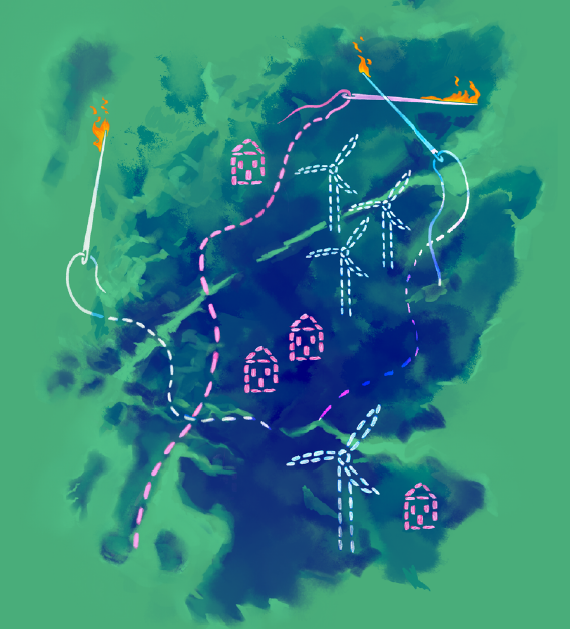
Certain threads run through this edition. In Scotland, as elsewhere, some will always sow violence under the guise of laws and property to take what they can from land, field or nation. Stripping and tearing, they leave devastation and misery in their wake. Morelle Smith’s poem and Cat Goss’s cover art describe this reality so devastatingly. But here and in every land, as well, there are many more with strength to work the ground of a better society and to end the day at home with freedom.