Dylan Brewerton-Harper talks to Janice McGarry about joining Glasgow’s shipyards, her trail-blazing career, and her battle with – and victory over – a sexist and harassing boss.
Following the historic Upper-Clyde Shipbuilders (UCS) work-in in 1971 and 1972, Govan Shipbuilders was formed, and in 1977 it was nationalised by the Labour government and subsumed into the newly-created conglomerate, British Shipbuilders. Hugh Murphy, in his 2020 history of the conglomerate, points out that this represented “one of the last of the major industrial nationalisations”. By 1984, under a new Thatcher government emboldened by a landslide election victory the year before, it represented “one of the first privatisations” and catalysed an “almost complete industrial collapse in merchant shipbuilding”.
In the summer of 1978, an 18-year-old Janice McGarry from Ruchazie in the East End of Glasgow had just finished her Highers and left school. She had secured a place to study engineering at the University of Strathclyde, and over a long summer waiting to begin her course she decided to look for a job. Through a mix of personal determination and timely coincidences, she made history by becoming the first woman to be given an apprenticeship in a British shipyard.
DBH
How did you get into the world of shipbuilding? What do you think led you to that point?
JC
It was absolutely a series of coincidences. The only shipyard connection in the family was one of my uncles who was a foreman before he became a manager in Yarrow’s shipbuilding, but he certainly wouldn’t have prompted me to go into the industry. I subsequently found out at my aunt’s funeral that she was one of the many women who went into the shipyards during the war and became an electrician.
I didn’t know what I wanted to do at school. Most of my pals were applying to join the bank, which didn’t really appeal to me. My mother was desperate for me to become a nurse, not a doctor, strangely enough. It was one of the teachers that suggested, since I was good at maths and physics, that I should think about engineering. I’d never heard of engineering up until that stage. My brother, he’d got a job as a draughtsman. And it seemed like quite a good job.
So I did techy drawing at school. When the headmaster was asked if I could do technical drawing, he said:
“We don’t have enough teachers to teach the boys. We’re certainly not going to start teaching the girls.”
But one of the teachers offered to teach me at lunchtime. So I used to go across to the classroom, and I did the year’s course and got an O level in technical drawing.
I applied for university and got a space on an engineering course at Strathclyde University. And then during that summer I was just wandering about, waiting for university to start. And I was getting a bit worried about being a poor student because I would get a minimum grant. I wandered past the careers guidance place one day and I went in and explained to them what I was doing, and that I was having second thoughts about going to university.
And they said, “Well, you’re probably looking for an apprenticeship. You’re too late to apply, but there are two here that are left.”
One was Govan Shipbuilders who were recruiting late that year because their training centre had burnt down and they had had to focus on that. So that was a big coincidence. And then the other one was to be a civil engineering consultant. I went for both interviews.
After much discussion, Govan Shipbuilders had to get approval from British Shipbuilders in Newcastle to actually offer me an apprenticeship, because it was the first time in any British shipyard that they’d offered an apprenticeship to a female. So in August of ’78, I started a four-year apprenticeship.
I was a mechanical technician apprentice destined for the engine drawing office. We did six months in the training centre drawing office, which was at Linthouse. And then we had to do six months in the craft training centre, which was working with the fitters, learning how to scrape a steam flange, how to do turning, how to do drilling, how to do filing—all those craft things that we had to know about. They did give us a shot at welding and things like that, but that was for the black squad. We were more refined than that.
The rest of the apprenticeship was basically eighteen months going around different sections in the yard on the tools working with the guys, and then eighteen months in the engine drawing office.
In 1975, Harold Wilson’s Labour government passed the Sex Discrimination Act – a groundbreaking piece of legislation that rendered unlawful “certain kinds of sex discrimination and discrimination on the ground of marriage”. It also established the Equal Opportunities Commission to “work toward the elimination of discrimination” and “promote quality of opportunity”. In 1979, only one year into her apprenticeship at Govan Shipbuilders, Janice found herself in need of the newly-formed Commission.
All the other apprentices had been on sea trials. Now it was my turn. Mr. Shilp was the chief draughtsman in the engine drawing office. And in those days, chief draughtsmen were next to God. You didn’t speak to them unless they spoke to you first. It was really very hierarchical.
It’s embedded in my brain that I went into his office and said:
“Afternoon, Mr. Shilp. Thank you very much for seeing me. I just wanted to chat with you and let you know that I’d be keen on going on sea trials and there’s sea trials coming up. I was hoping you would consider me for the recording party.”
His response: “Get out of my office. How dare you come in here and ask for such things? If I had my way, we would never have employed you at all. This is no place for a woman. Get out.”
It came as a bit of a surprise to me.
DBH
What was your response?
JC
I was really quite shocked because, well, I’d been apprentice of the year. And in my naive headspace, if you work hard and if you’re good at something, that will be recognised and therefore you will get some sort of promotion or recompense on the basis of your ability to do the job. You learn that that might not always be the case. But at that time, I was really quite shocked.
So I went back to the office. The other guys were there waiting to see what he said because I think they knew what the response might be. They came out with: “Yeah, we need to do something about this.” So of course we were unionised. I was seething mad. The more that guy came into my face and said, “You will not”, the more I dug in and said, “I will.”
And that kind of shaped our relationship for the next year. He used to come up to my desk and just shout at me and walk away. He would just get so frustrated by the fact that I didn’t fold over and say, “That’s okay.”
My union, God bless them, were always one for doing a pragmatic deal. And this guy had incensed me so much that there was going to be no bloody pragmatic deal. I was going on sea trials.
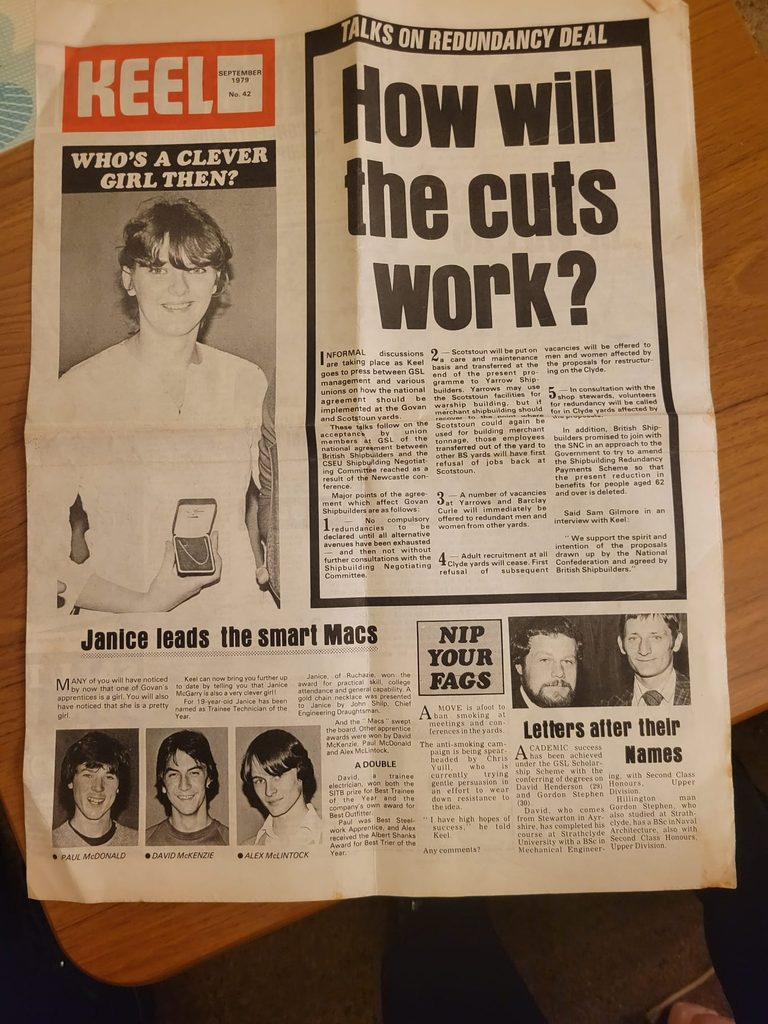
So the next day I phoned the Equal Opportunities Commission. I couldn’t phone from the office, so I had to walk along Govan Road at lunchtime, and look them up in one of the phone books that was in the phone box. And I phoned them, made an appointment and they met me in a café on Govan Road the next day. I explained the situation and the guy said they were happy to take my case on.
So I went back to the office that afternoon and told the shop steward what I’d done. He was quite upset with me, but he got over it. And yeah, I took on a kind of cause that I was not going to be pushed around just because I happened to be female. Certainly not by an old bigot like that. We took the case to an employment tribunal. It wasn’t a year, but it took a lot of months to get there. And meanwhile this man made my life hell.
To put it like an engineer, I must have had a rod of steel up my back to go into the shipyards in the first place. But as far as I was concerned, it was a means to an end because this was a good apprenticeship and then I could get sponsorship and go to university. I’d always wanted to go to university, engineering students could get sponsorship, and through the scholarship scheme in Govan, they would send two people a year. Out of 36,000 workers they sent two people a year and I decided I was going for that.
You had to serve your four-year apprenticeship before you could apply for that scheme. So I had to get through my apprenticeship first. But the more that man came after me, the more I just hardened up to him. I was not letting him push me about like that. I knew I had a solid case, but there was a clause in the Equal Opportunities Act that said that it didn’t apply on board ships. Immediately the company said: “Oh no, because ships have limited accommodation.” But my argument was that as the recording party on board ship, none of us got accommodation. We had all come off the ship at night. So we were on early in the morning, the ship would stop in the measured mile, and then they would take all the recording party off. There was no need of accommodation for the recording party. Therefore that clause did not apply.
DBH
So you were good at your role, and you’ve gone on to university and then had the career that you subsequently had. You had as much right to do that basic part of the apprenticeship as anyone else.
JC
That was exactly my argument. I was not asking for any more than my colleagues in the same training scheme.
So, the day before we were due to go to the tribunal, a deal was done between the union and company. And Mr. Shilp informed me of it by appearing at my desk saying:
“Clear your desk. Get out of here. You report to Jimmy in the engine design office tomorrow—or Monday.”
He kind of stamped his feet and off he went. And the guys from the union told me that a deal had been done, and they were hoping I would accept it because I was to go into the next sea trial and I’d be part of the recording party. But in the meantime I was being moved away from that office, away from that man, and I was being moved into the engine design office.
I took that as a good deal because, one, it got me away from that old git, and two, you could only apply for the engine design office two years after your apprenticeship. They were the designers; we were the draughtsmen. So that was a promotion as far as I was concerned.
And I went on the sea trial. Just the one. And I was seasick. I wouldn’t tell anybody because I was too frightened.
DBH
You fought for the equal right to be seasick. Just like all the men who would have been seasick.
JC
Yeah, exactly. It was pretty rough down those measured miles. And cargo ships don’t have any stabilisers. So I just stayed in the engine room and hoped nobody could see what was going on. I talk about that to people now because it was so blatant. It wasn’t hidden misogyny or anything. It was in your face. “You should never have been employed here.”, “This is no place for a woman.”
DBH
Which actually makes your case easier, in a sense.
JC
An absolute slam dunk. Personnel, I think, knew they didn’t have a leg to stand on. They were going to lose this case. So he was coming under pressure from the company to change his mind. But that was beyond him. And I think every time they had a meeting, he’d come out and shout at me instead. He’d come up beside me at my desk shouting: “I’ve had enough. I’ve had enough of you and your behaviour. I’m going to phone your parents.” To which I replied: “You do that. Because if you think I’m bad, wait till you get to my mum.”
Dylan Brewerton-Harper is a PhD student in sociology at the University of Glasgow studying photographic responses to deindustrialisation in Glasgow and Leipzig. He is affiliated with the research project ‘Deindustrialisation and the Politics of Our Time’ (DePOT) based out of Concordia University, Montreal.