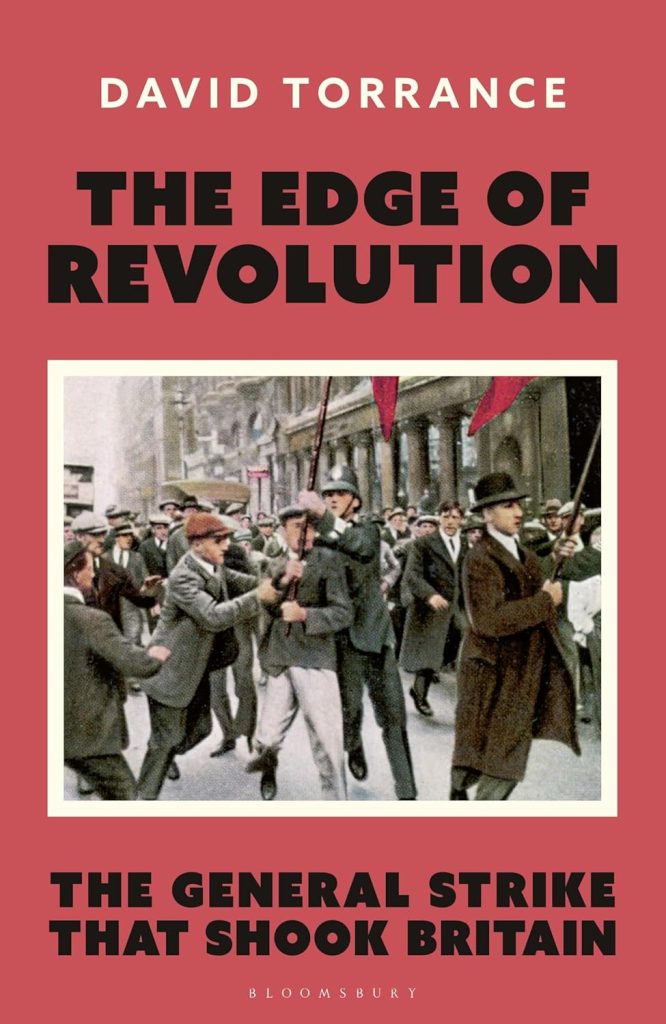
100 years since the General Strike, Amber Ward reviews books by David Torrance, The Edge of Revolution (Bloomsbury, 2026) and Callum Cant and Matthew Lee, The Future in Our Past: The General Strike, 1926/2026 (Verso, 2026).
What did you do in the General Strike? Stanley Baldwin went to the zoo. It was day six, workers across Britain were still out, and the Conservative Prime Minister just needed a break. His friend and cabinet member William Bridgeman took him there to ‘distract his mind’, and the change of scene seemed to do the trick. On the drive home the Prime Minister seemed lighter and pulled out a letter, written to him personally from the Prince of Wales. The Prince had tuned in to the Prime Minister’s emergency broadcast the night before and had some ‘almost affectionate’ words about his delivery. Quietly, the premier beamed.
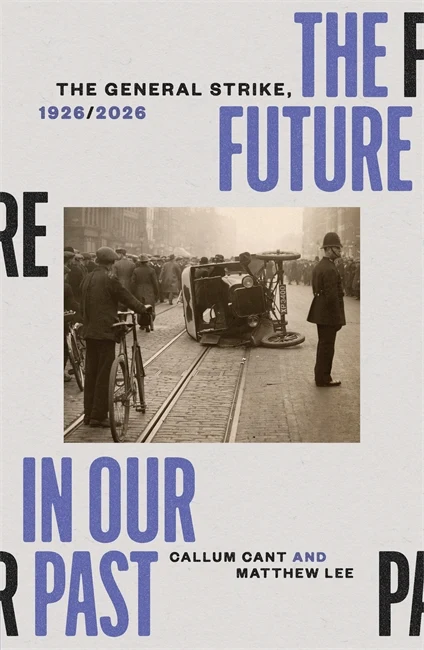
On its centenary, two books tell the story of the UK General Strike in meticulous detail through the eyes of people who were there. In May 1926, workers in key sectors across the four nations went on strike for nine consecutive days. Public transport ceased, mines emptied, and printers stopped printing the news. Docks stood still and there was a growing risk of food shortages. In The Future in Our Past, Callum Cant and Matthew Lee narrate the experiences of workers and organisers in South Wales, East London, and Swindon – in 1926 and 2026. In The Edge of Revolution, David Torrance gives an account from the perspectives of those who, he writes, have been ‘much maligned’ in this story: the politicians, coal owners, commentators, and ‘volunteers’ who kept things running. The two books narrate the strike from very different perspectives. Yet their shared attention to subjectivities – the weird ways in which people experienced things and wrote about them – make for two insightful accounts each in their own way.
The General Strike grew out of disputes in the coal industry. At the turn of the twentieth century Britain’s coal sector boomed. Huge numbers employed in textiles and traditional industries like weaving and fishing were all pulled to the mines for work. At this time, one in eleven working-age men worked in coal, and the sector employed large numbers of women and children too. Coal powered the nation’s homes, its industry, and its social infrastructure, but a good amount of the stuff we exported abroad. So when trade took a dip, Britain’s coal industry was hit especially hard. Both plummeted during the First World War. In 1915 the government part-nationalised the mines as an emergency measure, establishing a national wage.
In April 1921 the mines were returned to private hands, although there was less demand for British coal now that other nations had adapted to do without. But the coal owners still wanted their cut; they immediately threatened miners with significant wage reductions. The strong Miners Federation of Great Britain (MFGB), a national union, refused to accept the new terms. They called upon their partners in the Triple Industrial Alliance – the National Union of Railwaymen (NUR) and the National Transport Workers’ Federation (NTWF) – to walk out with the miners, but the two allies backed out on the day. The date of that ‘betrayal’, 15th April 1921, became known as ‘Black Friday’. Coal owners kept miners locked out their pits for three more months until they were forced to accept local wage cuts.
Black Friday was a sharp lesson in the need for communication and strategy across sections of Britain’s labour movement. But that movement held many visions of the future and radically different ideas on how to get there. After Black Friday, the General Council of the Trades Union Congress (TUC), the unions’ umbrella organisation in England and Wales, took on more of a coordinating role between the major unions. In Scotland there was the STUC, an independent body that worked closely with the TUC. The TUC General Council had thirty-two members, all union officials who ranged from communists to members of the new Labour Party. Meanwhile, more radical pressure groups were forming amongst the ordinary rank-and-file. These included the National Minority Movement (NMM) within the unions, and the National Unemployed Workers’ Movement (NUWM) outside them. Both were led by members of the Communist Party of Great Britain (CPGB) and were affiliated with the Third Communist International: the international body for revolutionary socialism led from Moscow. The Independent Labour Party (ILP), a broad-church socialist organisation, was especially strong in Scotland. In the mid-1920s it advocated a parliamentary route to deep social transformation.
In the year leading up to the General Strike the economy worsened. In April 1925 the new Conservative chancellor of the exchequer, Winston Churchill, returned Britain to the gold standard that it had left during the First World War. This pegged the pound to a fixed amount of gold – the same amount as before the war – which overvalued the pound in relation to the dollar, the world’s other major trading currency. British exports shot up in price on the global market. Coal bore the brunt again, so coal owners attempted to cut wages and increase hours further. The miners’ response, under the leader of A. J. Cook, was steadfast: ‘Not a penny off the pay, not a minute on the day’.
On 31st July 1925 miners won a government subsidy for their wages – this was ‘Red Friday’ – but only for nine months whilst there was an official investigation into how to stabilise the coal industry in the longer term. This task was assigned to the Liberal statesman Herbert Samuel who cut short his sojourn in Italy to work on it. In a letter to a friend, Samuel described the interruption as being ‘sent down my coal mine’. All this time the Baldwin government sought to ‘tighten up’ its emergency machinery, preparing for a potential confrontation with the miners when the subsidy expired in the spring. Outside of government, the Organisation for the Maintenance of Supplies (OMS) was created in 1925 to recruit volunteers to replace strikers in the event of a general strike. It was a magnet for members of the British Fascists, but officially they had to renounce their membership to be allowed in. The TUC, on the other hand, did nothing to prepare.
In March 1926 the Samuel Commission was complete. It rejected nationalisation, suggested points for reorganising the coal industry, and insisted upon an immediate reduction to miners’ wages. Negotiations ensued and miners refused to take a cut, so when the wage subsidy expired on May Day, the coal owners locked them out. The General Council of the TUC prepared to call all its members out on strike in support of the miners, but it strove to avoid doing so as far as it could. In the end it was the Baldwin government that called off negotiations, triggering the TUC to call a general strike. Printers at the Daily Mail had walked out spontaneously in a small wildcat strike – they refused to print a sensationalist anti-union editorial – and the government jumped on it, calling off negotiations on the basis that ‘press freedom’ was under threat.
The King declared a state of emergency under the Emergency Powers Act 1920, the first time it was used for a sustained period of time. The Act empowered the government to make ‘any regulations’ necessary in order to secure ‘the essentials of life to the community’. On 3rd May the TUC called all its members to strike in solidarity with the miners. Officials began arresting prominent members of the Communist Party of Great Britain (CPBG) in case things got out of hand. Britain’s first and only general strike commenced the following day.
Across Britain, local union branches elected delegates to trades councils, small committees that were ready to act in the event of a strike – or a greater political event. Trades councils had been established in the years before the General Strike; during it they transformed into strike committees and Councils of Action. In the village of Bedlinog in South Wales, the Council of Action coordinated a strong strike at Taff Merthyr colliery. Crucially the Council of Action also oversaw canteens and collectivised childcare, bringing domestic work out of individual homes and into the public sphere. Bedlinog was tightly organised but pretty quiet too, because police didn’t even bother trying to break anything up.

Elsewhere, the government’s emergency machinery lurched more visibly into action. Back in 1919, Lloyd George’s government had divided Britain into a system of twelve ‘divisions’ that could be administered by ‘Civil Commissioners’ in an emergency. There were ten divisions in England and one each in Scotland and Northern Ireland. Civil Commissioners were junior government ministers, each with a headquarters and an unelected staff of eight. During the General Strike, they were instructed to exercise ‘all powers of government’ and, where appropriate, to ‘act on initiative’. The Civil Commissioner for the South Midland Division, the 6th Earl Winterton, had a gloat about this in a letter to his friend, the new Viceroy of India. His ‘ultimate powers’, the Commissioner wrote, were ‘as comprehensive as those of any head of a Province in India’. In another letter he described how he had transformed an assistant into ‘a complete local Mussolini’. He even managed to visit his old school, Eton College, where he found the teachers and housemasters all out waiting for him, notebooks in hand, ready to receive his ‘instructions and advice’.
Things escalated in East London, where there were large pickets at the area’s important docklands. The military was deployed and eventually armoured cars arrived to escort food and essentials out from the ports. Across the docklands street battles broke out between strikers and police. Many of the latter were volunteer ‘Special Constables’ supplied by the Organisation for the Maintenance of Supplies (OMS) that was now working in close partnership with the Baldwin government. Navy submarines arrived to supply power to the docks and cold storage warehouses. Navy warships were stationed in the Thames. Each day, a local seventeen-year-old called Alfred Green would sneak onto the boats near the near the water’s edge to steal cigarettes.
In Swindon large numbers were employed by Great Western Railway in their workshops; the town boasted the largest branch of the Transport and General Workers Union (TGWU) in the Midlands region. When university student ‘volunteers’ arrived to try to drive the stationary trains, strikers applied grease to the tracks so the carriages could barely move. On 6th May the Commons debated whether the TUC calling everyone out in a ‘general’ strike was against the law. On 11th May at the High Court, Justice Astbury made the arbitrary judgement that it was.
On the evening of 12th May the TUC announced their ‘unconditional surrender’. The General Council hoped the government would accept new recommendations from Herbert Samuel that included extending the miners’ wage subsidy and protections for strikers when they returned to work. These were not guarantees, and Samuel had only written them down in a memorandum, but the TUC called off the strike anyway. The nation was informed instantly over the wireless. When the news reached the young Jennie Lee, daughter of an ILP miner and the future Labour Minister for the Arts, she and others in the Edinburgh strike committee ‘ended the day with a cursing competition’.
In Bedlinog, East London, and Swindon, strike committees and Councils of Action all rejected the TUC’s decision. The Taff Merthyr picket lasted for six more months; dock workers in militarised East London stayed out for several more days. In Swindon, when news arrived that the TUC had called off the strike, chairman of the strike committee Harry Hustings declared: ‘That is a lie!’ The town’s transport workers stayed out for an unofficial period. Miners everywhere continued their strike until November, when they were forced back on worse conditions than before.
The General Strike was a staggered, universal defeat. On this both books agree, but they offer differing interpretations of what the event actually was. For Torrance the General Strike was exactly that: an industrial dispute that ricocheted into a broad sympathy strike, skilfully manoeuvred by the moderates in all camps. This set the future tone for British industrial relations. Level-headedness: the real Utopia. In his acknowledgements, Torrance gives a nod to Great Man Theory, a philosophy that contends that ‘major events are shaped by exceptional individuals’. The book even opens with a five-page ‘Dramatis Personae’, an annotated list of major characters.
For Cant and Lee the General Strike was a missed opportunity, a state of pre-revolution in which the vanguard lurched forward, only to be betrayed by labour-aristocratic bureaucrats in the TUC, whom the Communist International had, at that time, told British communists in the CPGB to listen to. ‘There was a future in our past’, they write, ‘even if we don’t live in it today’. Interesting discussions with workers, organisers, and locals in South Wales, East London, and Swindon in 2026 also feature. The authors connect 1926 and 2026 to consider how that future could be opened up again. In this drama, an inflexible Leninism provides the cast, set, and dénouement.
Two very different accounts of the General Strike, both told compellingly through personal testimonies and experiences. Great men, great Theory, and all the deep or daft ways in which a historic event was felt. Postmodern pages bound together by long-nineteenth-century spines.
A century on, the General Strike has left us whatever lesson we like. It was the revolution we swerved, the one we fluffed, and the one we kept writing about. It was a great defeat, but for the next hundred years we kept whittling away – all of us – at tools for rethinking what truly constitutes revolutionary change. I’m being wide, but grant me this: did it really fail?
Amber Ward is a writer and researcher.