297 years ago, Jonathan Swift, whose Gulliver’s Travels put big people in their place, penned an essay called ‘A Modest Proposal’. It made the dark suggestion that since so many poor families were unable to feed their children, poor families’ children might be fed to the rich instead. Amidst a grim crisis of poverty and ill health, Swift satirised ruling class hostility and incredulity towards any attempt to improve welfare through increasing taxes on their luxury.
Swift’s satire mentions policies that might address the imbalance of wealth: taxing absentee capitalists, investing in domestic industry, refusing to “sell our country and consciences for nothing”. Yet he presents these as measures lying far outside the Overton window of his day: “let no one talk to me of these and the like expedients till he has at least some glimpse of hope, that there will ever be some hearty and sincere attempt to put them into practice.” It often feels like we are in a similarly hopeless age when the rich ride roughshod over the rest, and governments comply with the dogmatic assertion of a divine right to non-intervention.
That is why my ears pricked when I heard John Swinney describe his food price cap pledge.
“The food price cap proposal is in the grand scheme of things quite a modest proposal. It’s about identifying 20-50 food lines that would enable an individual, a family, to buy a nutritious shop. That addresses, in some way, the challenges that people face. If people can’t get access to nutritional food, then we will have a public health problem that will arise, and it will be the Government that’s got to try to address it.”
Swinney’s explanation was an answer to a question from The National editor Laura Webster about right wing media presentations of the price cap policy as communist or Soviet. I do not know how deeply John Swinney knows the work of Jonathan Swift, but there was more than a dash of satire in his reply: “if you were to go out on the street and ask people, ‘do you think John Swinney is a communist?’ you would not get many takers for the proposition”.
Indeed, the policy reminds us of both how moderate and modest are the efforts of the new government to change Scotland, and how fiercely the shopkeepers will resist any government intervention. (A few days after the election, Rachel Reeves announced a copycat plan, before u-turning in fear when the supermarkets started snarling.) It looks likely that Swinney’s government will cap the price of beans with one hand, while making some serious cuts with the other. The cost of living has just overtaken the NHS as the single biggest concern for Scots, and people who are angry that they cannot afford to live are being offered a promise that government will not ignore them, but Swinney’s mild market intervention is hardly an expedient that will give hope to the one-in-five parents whose work earns them poverty.
The hopelessness that many feel is likely to grow into greater disillusionment and rage. Some will seek to blame migrants and benefit claimants, which Starmer’s Labour government has made part of its pitch but which the SNP has steadfastly resisted the pressure to do. Yet modesty and morality are not material solutions. Radical social and economic intervention requires using all the powers of government and setting its powers against those who sell the country for their luxury and gain. Otherwise the right will keep forcing the target down, to demonise the poorest and most precarious and promote grim interventions that feed the rich.
So, are there any glimpses of hope in the policy direction of the nation? In her interview with the editor, former Cabinet Secretary for Finance Shona Robison points out that redistributive policies like the child payment keep families happier and healthier, yet she urges her party not to overestimate the Scottish Parliament’s powers and raise expectations that it cannot deliver on. Meanwhile, Jukka Seppälä urges the wider independence movement not to oversell the vision of Scotland as a Nordic-style nation, when states like Finland fall far short of the utopia that some nationalists imagine. Even within the limits of our power, however, the left has opportunities to drive policy towards a better place. Peter Hunter and Dan Holland describe what a better future looks like for care workers and for colleges. And Kendra Briken and Dustin Hafki describe a host of organisations both raising and realising people’s hopes for justice at work.
If the danger of hopelessness is rising hate, our second section confronts the reactionary right and documents the risky work of anti-fascist action. Nicole Treanor argues that while Reform’s success was underwhelming compared with their English victory, their mainstreaming is an existential risk to egalitarian elements of Scottish identity. Kirsty Highet explains how Women Against the Far Right are using both united front and mutual support strategies to confront far-right activists who are weaponizing women against migrants.
On the 90th anniversary of the Spanish Civil War, Mike Arnott describes the lorry trips, logistical challenges, and enduring legacy of the Scots who fought and died in Jarama and elsewhere, while Nik Gorecki marks another 90th anniversary describing the popular front approach of the Left Book Club, whose branches are a bulwark against the rising fascist tide.
The international struggle continues. Cal Rosie pays tribute to the Scottish contingent of the Global Sumud Flotilla who set off in April to confront the grotesque face of Zionism. They met with abuse and violence that led even European allies of Israel to baulk, though not to break off their channels of complicity. Israel, after all, needs all the support it can get. Phil Chetwynd explains how badly the Israeli economy is faring as a result of its genocidal war.
Israel’s berserk attack on Iran alongside its US allies has only harmed it more. Yet the damage done to Israel’s standing by the Iranian response does not make the Islamic Republic any less oppressive for those who are struggling for socialism and liberty within Iran. Sohrab Rezvani describes the efforts of the left in Rojhelat, the Kurdish region of Iran, to take advantage of its strategically significant position and build a civil and military path to revolution in the region.
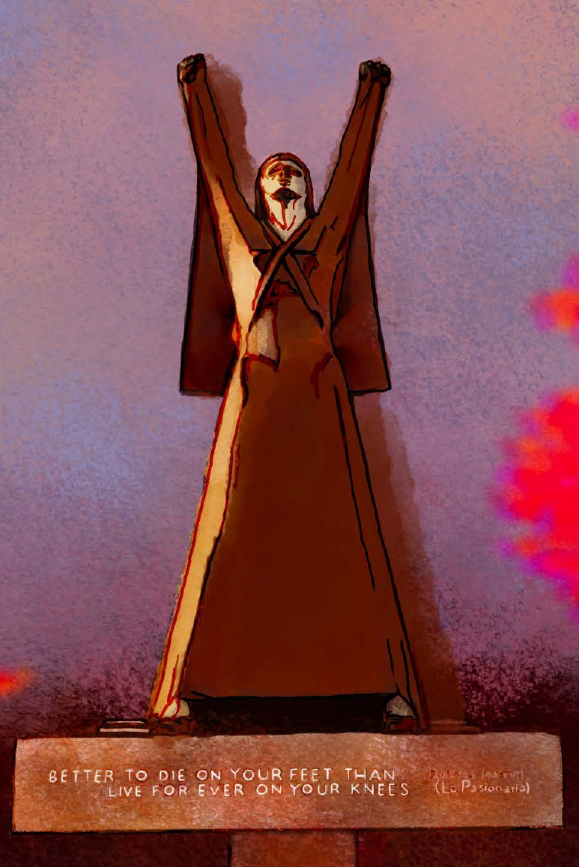
The Scottish struggle abroad and at home is immortalised in the statue of La Pasionara that was erected in 1980 on the banks of the Clyde, and provides the model for Cat Goss’s cover. Our last section is given over to two legends who shaped the 1980s Scottish Left and continue to inspire it today. Henry Stead reviews Stand and Deliver, a new play about the women who led the Lee Jeans sit-in in Greenock in 1981, and proved to the labour movement the power of occupations and fish suppers. And I share some wisdom from the great Dick Gaughan, whose songs are a timeless soundtrack of struggles in the past and those to come.
