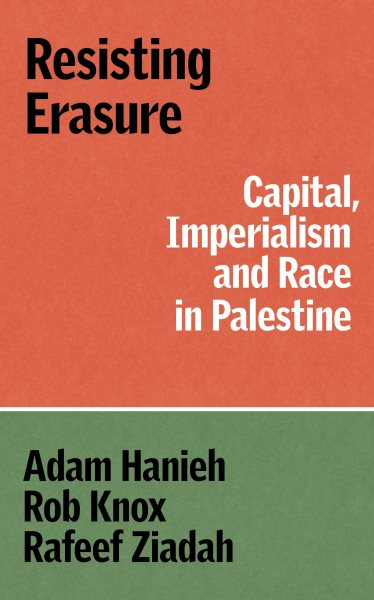
Phil Chetwynd reviews Resisting Erasure – Capitalism, Imperialism, and Race in Palestine by Adam Hanieh, Robert Knox and Rafeef Ziadah (Verso Books: £9.99. 2025)
Erasure is a term that has increasingly found currency in the work of Palestinian commentators.This is doubtlessly a result of the escalating attempts by Trump and Netanyahu to wipe out the Palestinian people in its entirety. Hanieh, Knox and Ziadah are certainly well aware of this new phase of Zionist policy, and seek to analyse it from a Marxist point of view.
The book firstly offers a critique of various ideological perspectives common in the current climate of support for the Palestinian struggle. The authors take issue with three common inflections of the pro-Palestinian struggle today: a) the essentialist view (Palestinians as innately aggressive/helpless), b) the humanitarian focus on ‘suffering’, and c) the legalistic appeal to ‘human rights’. These three expressions of solidarity all in their own ways serve to undermine an effective solidarity movement, by deflecting attention away from the fundamental materialist nature of the struggle.
The book contributes to the analysis of the Middle East conflict by situating the class nature of settler colonialism within the broader framework of European capitalism. Settler-colonial capitalism has a different relationship to labour than that found in traditional colonialism. Racism is central to settler colonialism. Palestinians are reduced to a single undifferentiated mass in the service of the Israeli state.
Roughly one-third of the West Bank labour force worked in Israel prior to the Al Aqsa Flood of October 2023. Half of these worked in construction, a vital sector for the large business conglomerates that sat at the heart of the Israeli economy at this time. This integration of Palestinian labour into the Israeli economy not only served Israel’s economic needs but further solidified its control over the West Bank and Gaza Strip by making Palestinian livelihoods dependent upon access to employment in Israel. Things changed, of course, after the Al Aqsa Flood, when thousands of Palestinian workers were refused work permits. Israeli capital has not managed to replace these workers, even after frantic attempts to recruit Indian workers in their place.1
The effect on the Israeli economy has been immense. Military spending surged to unprecedented levels, costing millions of shekels daily. At the same time, domestic and foreign investment plummeted, and key sectors such as technology, tourism, agriculture, and trade have contracted. The budget deficit has ballooned, and national debt now stands at around 70% of GDP. Rising prices, diminished purchasing power, and a labour shortage due to the mass mobilisation of reservists have been the result.
Addressing anti-Palestinian racism, the authors challenge the notion that race is a natural and inherent category. The opposite is true, they claim. “Race is produced through racism”, which “is to say in order to marginalise, oppress and exploit particular groups of people, specific differences – real or imagined – are abstracted and said to be the main characteristic of each member of the group (skin colour, culture etc.). These differences allow groups to be compared and placed in a hierarchy which in part determines (and justifies) their treatment.” This ideological oppression had the effect of reducing the vast majority of the Palestinian working class to a mass of exploited workers waiting in line at unearthly hours of the day for the chance to work in the Israeli economy. Those working in Palestine for the Palestine Authority are primarily made up of bureaucrats working in health, education and administration. They are the Palestinian middle class. Meanwhile, the Palestinian capitalist class has long assembled itself outside of Palestine in the diaspora.2 The authors thus characterise three layers of the Palestinian class system, and highlight how racism weaves a thread through these layers to embed Palestinians in the global imperialist order.
Western Governments provide military aid, economic support, and diplomatic cover for Israeli actions while also suppressing dissent, through censorship, criminalisation and legislation against activist movements. We do not have to look much farther than the Filton 24 and the proscription and subsequent hunger strikes of Palestine Action supporters to see how that has permeated the British scene. So what then of the future for Palestine?
It is a moot point as to whether Trump’s latest plan for ‘The Gaza Riviera’ was part of Netanyahu’s vision for Gaza, or whether the Israeli PM simply jumped on the back of Trump’s pipe dream. It is, of course, a nonsensical fiction that largely serves to hide the scorched earth destruction by Israel’s war machine. What is important here, however, is not so much whether these plans match reality but how they work to ideologically project a vision of the future in which, through ‘normalisation’, Israel is integrated into the regional economy and Palestinians in Gaza return to becoming a pool of cheap labour jointly exploited by both Israeli and Arab investors.
Phil Chetwynd is an erstwhile clinical psychologist who took up photography when he retired some 25 years ago. He is a member of the Network of Photographers for Palestine.