Henry Stead reviews the National Theatre of Scotland production, Stand and Deliver: the Lee Jeans Sit-In.
Pop songs that topped the charts in 1981 provide the pulse for this up-beat play, written by Frances Poet and directed by Jemima Levick, while class struggle provides the life blood. Adam Ant’s kitsch highwayman, who gives the play its title, is just one of several 80s ghosts that locate the play firmly in Greenock of 1981. Duran Duran’s ‘Girls On Film’ and Kim Wilde’s ‘Kids in America’, also bring suitably synthetic period colour, with the anthems of rapidly deindustrialising Britain, The Specials’ ‘Ghost Town’ and John Lennon’s ‘Working Class Hero’, striking the deeper notes. Poet wanted the show to be a ‘good night out’, threaded through with the songs of the moment. It does not disappoint on this front. The music sugars well the medicine of a play that bears witness to class war in Thatcher’s Britain. The songs, all performed live on stage by the cast, create the kind of uplifting atmosphere (apart from the Lennon) that those 140 plus brave workers – nearly all of them women – needed to sustain morale for seven long months of 24-hour occupation of their workplace.
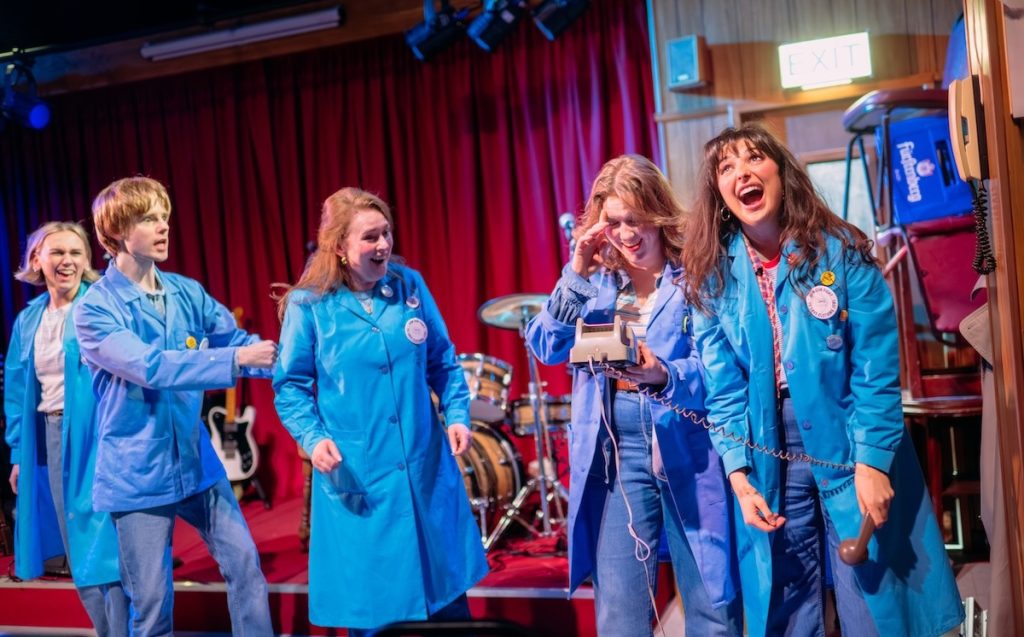
The Lee Jeans sit-in was a high profile, successful and influential direct action against capital movement and unfair job loss. It was triggered by the need to protect hundreds of jobs in Greenock, Inverclyde, an area where female unemployment was already at over 13%. After a decade of high profitability, buoyed up by low rent and generous subsidies, the US-based multinational clothing manufacturer Vanity Fair co. (VF) decided to shift production to Northern Ireland, where they could capitalise on new and more generous state subsidies. As Andy Clark, author of Fighting Deindustrialisation: Scottish Women’s Factory Occupations, 1981-1982 (2022), explains, this was just good business sense for the corporation and its shareholders. But, as ever, the worker was left to foot the bill for corporate greed. The prospect of plant closure was devastating for the 240 Greenock workers, whose livelihood depended on sewing those popular blue denim jeans. Their offer of going down to a three day week was rejected.
To begin production in Northern Ireland VF would need the machines and materials in the Greenock plant, so occupation offered itself as a way to resist closure. During their struggle the workers were repeatedly failed by the National Union of Tailor and Garment Workers (NUTGW), who are almost up there with ‘the Americans’ of VF as the villains in this story. On 5 February 1981, the workers’ Shop Steward Helen Monoghan (aged 44), played by Jo Freer, called a vote and by majority the workers decided to occupy the factory with immediate effect. Since this is a true story and not so long ago, the theatremakers have been careful to respect and reflect the reality of the situation. They manage to capture an authenticity that could easily have been lost. For example, Maggie Wallace (aged 19), played by Chiara Sparkes, snuck out of a window on the first night returning somehow with over 200 fish suppers from Aldo’s. On the same night the pay phone jammed. It was full of two-pence pieces from all the workers phoning home, and they had no key to empty it. At first these might seem like mere details, but exactly how you maintain security and feed people is a serious matter, as is establishing a stable means of communication with the outside world.
Over the months, while news came in of the deaths of the Irish hunger strikers proving the violence of the system they were fighting, the workers learned the hard way (and with no manual) how to maintain an occupation of this kind. Radical groups who approached them were given short shrift. In fact, a Liverpudlian representative of the revolutionary socialist feminist organisation Big Flame draws as much of Poet’s satire as the inept NUTGW boss in London. The Lee Jeans sit-in is such an important story to tell because the success of their action was not only limited to the victory in their own factory. It was no small feat for 140 workers to keep up pressure on employers for seven months and along the way raise enough public interest and national support to negotiate a job-saving deal. VF sold the plant to local management for an undisclosed sum. But the Lee Jeans workers also created a blueprint and an inspiring precedent for factory occupation that would be followed by other threatened workforces in this period of accelerated deindustrialisation in Scotland, notably Lovable Bra, Cumbernauld, and Plessey Capacitors, Bathgate.
This vital story of collective action is told with a special focus on the personal experiences of two small family groups: Helen Monaghan and her son Finlay (aged 17), Aron Dochard, and the sisters Maggie and Cathie Wallace (aged 21), played by Hannah Jarret-Scott. All other characters are played by a talented cast of six, including the two ensemble parts, played by the musical director Shonagh Murray and Madeline Grieve. For the extroverted Maggie the show is a coming-of-age drama, which sees her grow from a carefree late-teen rebel to a highly capable fundraiser, who delights in her brushes with fame while campaigning. Helen’s arc is less expansive, but just as essential. She has to overcome a natural aversion to the spotlight in order to fight for the cause. At a crucial moment of choice when popular agency manifests in brave individual actions, the two narrative arcs intersect. It takes both Maggie’s youthful rebellious energy and Helen’s experience, respect and authority to take the stand they did. The brave decision was made and the moment passed into history.
It is at once a cautionary tale of corporate greed and an inspiring one of collective empowerment. Vitalised by their action, the characters transcend their day-to-day lives. Both Helen and Maggie found themselves propelled into the public eye, mixing with politicians and celebrities. But what happened to them afterwards? The workers were victors for only so long. Maggie, marked out as a militant for her role in the action, had to move to Jersey, where no one knew her, to find work. When Helen quit, she hid her identity from the old women she worked with as a carer (home help) so as not to scare them. The aftermath of the sit-in is a reminder, in case we needed one, that the Lee Jeans sit-in was a victorious battle in a war the workers could not win. Unlike Orgreave (1984), the state did not resort to violence, though it was a constant threat. As we learn in the play, the police were watching and waiting for the Lee Jeans workers to put a foot wrong.
An exciting moment comes after rumours circulate of VF plans to send in their ‘heavies’. The workers hear over the radio that a convoy of vehicles is approaching the factory. The fear is that ‘the Americans’ will evict them by force. It comes as a huge relief when they see that the convoy is made up of double-decker buses and coal trucks full of miners and shipyard workers, who have been sent by the Transport and General Workers’ Union to protect the picket. A ‘good night out’ it most certainly is, and one you won’t forget in a while.
Henry Stead is a Classical Reception scholar with a special interest in the reception of ancient Greek and Roman culture among the British working classes and the international left.