Precarious migrant work is experienced as an individual struggle which poisons solidarity, but community collaboration is the cure. Xabier Villares reviews The Precarious Migrant Worker by Panos Theodoropoulos.
This book by sociologist Panos Theodoropoulos had the power to speak to me directly as an organiser and, even more, as a migrant worker myself. In fact, any migrant who has felt the weight of a precarious job on their shoulders will see themselves across its pages. The piece could not be timelier, posing questions that are gaining traction and relevance. It specifically addresses key and intertwined matters such as the absence of unions in many precarious occupations, the fragmentation of struggles due to racist and xenophobic narratives permeating the working class, and the self-organisation of migrant precarious workers in Scotland.
Furthermore, it is a very engaging and entertaining read. Set mostly in Glasgow, you can follow its stories almost like a novel, from La Dama’s restaurant dramas to the radiator factory friendships. It is impossible not to empathise with the lives you learn about. The twist is a sharp analysis of race, class and power dynamics which, conceived as a whole, explains how oppression operates upon migrant workers.
The whole book revolves around what Theodoropoulos calls the “socialisation of precarity”. This central notion encompasses “multiple complex mentalities, tendencies and behaviours” that precarious workers develop due to their constant exposure to the harmful consequences of working in precarious occupations. Under its influence, workers prioritise competition with each other rather than collaboration. They overexert themselves to be more productive, whilst simultaneously reducing the need of the employer to hire them (Theodoropoulos calls this the “good worker paradox”), and developing a survival mindset under a constant threat of dismissal and deportation. However, it takes more than workers’ subjectivity for this framework to operate effectively. A national economic structure that allows zero-hour contracts and gig work in its present form elevates employer demands over workers’ basic needs. Combined with a migration law that perpetuates insecurity, this structure leads to migrants becoming highly exploitable and profitable subjects for capital.
Under these circumstances, for precarious migrant workers, capitalist realism takes the stage, with no chance to envision a horizon of change beyond our own situation. And here is another crucial factor: when collective problems are naturalised as individual struggles, reality appears as immutable and eternal for those under this spell. Exploitation then exists, independently of how we perceive it, because there is an objectifiable transmission of surplus produced and not received. This is something acknowledged by virtually all of the workers featured in this story, regardless of their position: from George, a Scottish head chef with some remorse, to Suzanne, a warehouse employee who managed with her coworkers to strike a collective bargain. Yet the intersubjectivity created under conditions of precarity does not allow us to see the big picture, poisoning all our relationships to the point of making precarious even the manifestations of solidarity. You notice it when the radiator factory worker wonders: are my colleagues helping me because they want me to succeed, or because they don’t want me to be a burden around them?

Luckily, the author also offers hope. He mentions the migrants’ “dual frame of reference”, which enables workers to comparatively evaluate conditions between their origin and host countries. While in some ways this dual frame disempowers migrants, it can also be decisive in fostering political action when migrant workers bring previous experience into the field. Moreover, the same drives that lead to individual resistance, such as the hunger for dignity, security and autonomy that precarious employees use as a survival strategy, can become material for a “socialisation of solidarity”, the ultimate opposite of the book’s ominous subtitle, “the socialisation of precarity”.
In this analysis, “community embeddedness” arises as the only effective way to fight back. If subjective conditions (internal, personal experiences) are the great challenge we face, structures need to pre-exist and be accessible to migrant workers to build upon the predisposition to take action. Social movements and unions need to develop strategies that go beyond tokenism and “ticking boxes”, recognising the specific characteristics of this segment of the working class.
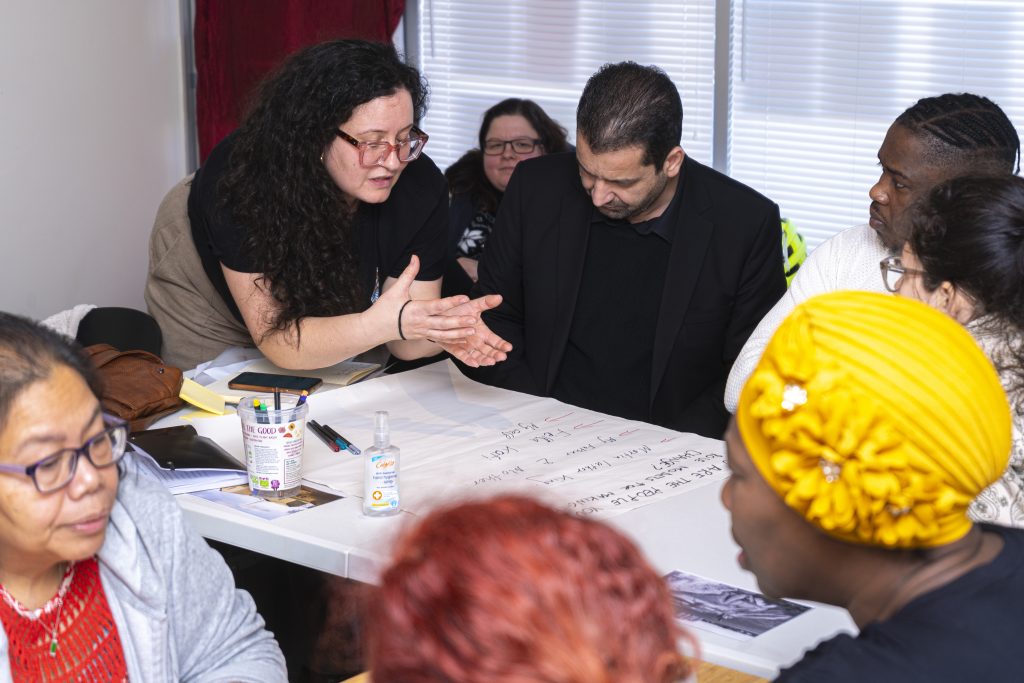
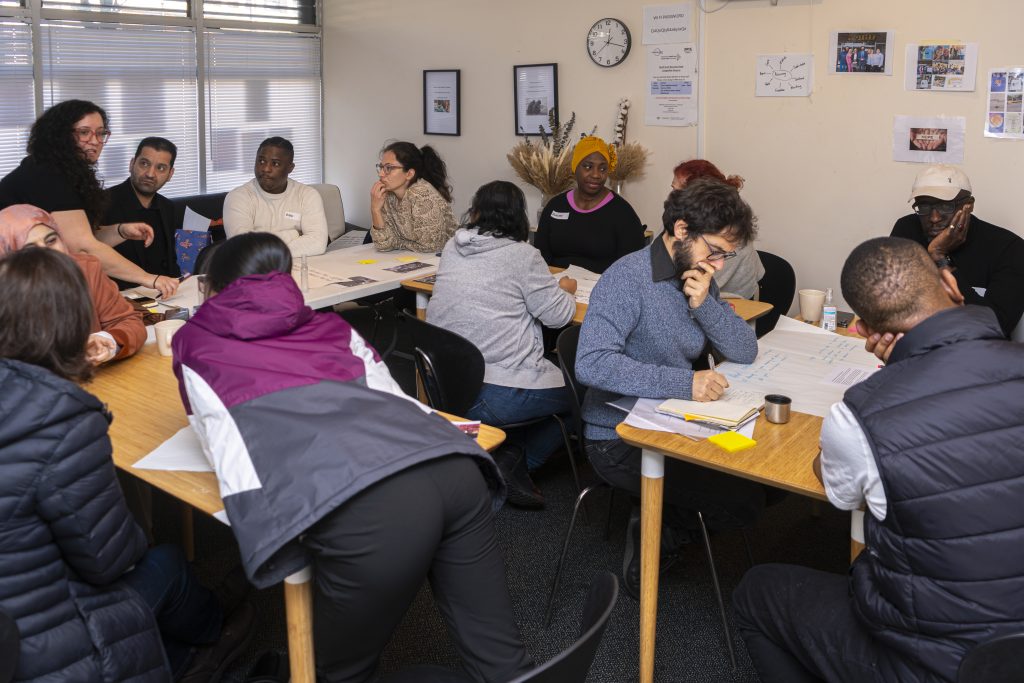
While Theodoropoulos focuses his efforts on describing the phenomena, the clues offered about how to achieve social change align with my own experience with the Workers’ Observatory. In Edinburgh and other Scottish cities, the Observatory has built spaces for gig workers’ self-organisation among racialised food delivery riders. Through this work, we reached an enlightening conclusion. If the precarious work we have to perform atomises and divides us, including through isolation-by-design in the case of delivery apps, we must foster solidarity across boundaries to find a way around these divisions. In line with some of the author’s notes, by going beyond the initial scope of organising in specific kinds of gig work, we are now striving to foster safe spaces for broader migrant communities, as part of Migrant Justice Edinburgh (MJE). The long-term plan is to create a network of migrant worker communities across the city, facilitating grassroots collaboration in neighbourhoods, leveraging what unites the myriad of communities that shape Edinburgh, bypassing top-down charity, and ultimately empowering ourselves to take action as a group.
All in all, as someone on the battleground, the magic of the book resides in its effort to grasp the messy and complex subjectivity of the migrant worker, and in its intention to catalyse structural change, fuelled by those who know what it feels like to work on the fringe of Scottish society.
Xabier Villares is the Secretary of the Workers’ Observatory.