Everybody to Kenmure Street, the new film by Felipe Bustos Sierra, portrays the power of laying our bodies on the line, writes Christopher Silver.
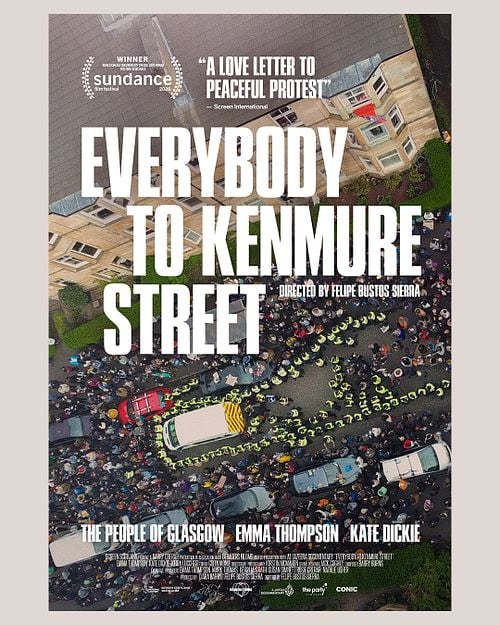
Just after 9am on Thursday 13 May 2021 a member of Glasgow No Evictions Network left his morning muesli unfinished, got on his bike, and proceeded to spend the next eight hours clinging to the axle of a Home Office Immigration Enforcement van.
This anonymous ‘Van Man’ – whose words are, improbably, performed by Emma Thompson – correctly takes the lead in Felipe Bustos Sierra’s Everybody to Kenmure Street.
The film makes ‘Van Man,’ and his split-second decision to dive beneath the vehicle at an early moment, central to everything that followed. Without this action, without that vulnerable body within the machine, the state’s planned detention of two long-term Pollokshields residents would have gone on uninterrupted.
With this unlikely protagonist, the film makes one of the confusing things about competing accounts of that day’s events clearer. Look online and you will find multiple references to the Kenmure Street protests. And yes, many of the familiar aspects of protest – chants, banners and a megaphone – were vividly present. But the actual power of that day was a far more contested form of radical politics – direct action.
The difference might seem pedantic, but the significance of this film is its insistent portrayal of a thorny truth: without the contingency created by bodies on the line, radical action is doomed to replay itself as empty spectacle.
I couldn’t watch Everybody to Kenmure Street without comparing it to Vincent Bevins’ influential account of street politics in the 2010s, If We Burn.1 Despite an unprecedented decade of mass contention, Bevins argues, communicative protests aimed at existing elites have overwhelmingly failed to deliver substantive social change. In the 2020s, with the banning of Palestine Action and the neutering of Extinction Rebellion and its various offshoots, acts of civil disobedience have been demonised and criminalised to a degree previously unknown in peacetime. To an extent, this is because these actions are amplified by ubiquitous smartphone use. It is also because many institutional forms of counterpower that aided 20th century movements for global justice – in civil society, the labour movement, or local government – have been hollowed out. Streets and communities are what we have left.
“Everybody put a day in that day and a day in your life is nothing,” notes one local who arrived early on the scene. The film does not pretend, nor could it, to suggest that this was a victory for an ever more constrained politics of mass mobilisation. Instead, it invites us to consider our own agency, and to ask ourselves what we might do today to advance the freedom of others.
Scotland’s sometimes overstated reputation for radicalism makes many people want a slice of the kudos that these events radiate. Fewer are willing to place their bodies on the line or risk arrest to see a radical politics realised before them. In this sense Kenmure Street was the opposite of the many vast, unanchored, and rudderless marching movements of recent decades. But on that May morning in 2021, just the right number of people who knew the stakes and were willing to play for them arrived at precisely the right moment. The work of generations of political educators and community leaders converged on a state apparatus of detention and removal that could only, in the end, concede.
In 2023 then Scottish Green co-leader Lorna Slater’s clunky slogan “Let’s be the Scotland of Kenmure Street not Downing Street” rightly drew pelters from many of those who participated in the action. To have witnessed those events up close, as I did, was to see a vast public order operation unspool with all the inevitability of blind authority, to see desperate attempts to reconcile the state within the van with the state outside it, and witness hundreds of officers poised, on a hair trigger, to deploy the whole sorry escalatory repertoire that peaceful political actions are often subject to. Sierra’s film pays close attention to the particularly brutal arrest of a young woman who sought to emulate Van Man’s tactics as parked cars were cleared from the street. Those decisions to escalate, although reversed at the eleventh hour, were made in Scotland too.
That said, there was something present on Kenmure Street which channelled various streams of radical tradition into one. This reached back across decades: the city’s vote to leave the United Kingdom in 2014, the Glasgow Girls and the campaign against child detention, Pollok Free State in the nineties, the anti-Poll Tax networks, and occupations at Lee Jeans and Caterpillar in the eighties, back to and beyond UCS in the seventies.
The latter is arguably the moment when modern Scottish politics as we practice it today came into being. Like Kenmure Street, it was a defiant action, not a protest filled with pious speeches. Jimmy Reid’s words, which are movingly referred to in the film by his daughter Eileen (a Kenmure Street resident who filmed some of the key viral videos of the day) underscore that if radical politics is not pragmatic, disciplined, moral, and visible, it is nothing. It is this laser focus on the dignity of the people that day which makes Everybody to Kenmure Street a landmark work of radical independent film making. People came out to defend their neighbours not for a political cause or to engineer a stunt, but because it is simply what you do in a living community.
Sierra’s film is a powerful testament to the importance of an independent film sector. This was evident in the absence of establishment talking heads providing the ‘balance’ that many mainstream producers demand. There is a lesser story to be told about lawyers, cops and politicos hashing out the niceties of the Scotland Act and the leeway granted to Police Scotland’s top brass in operational matters. But that is a story for a dying political class. Sierra’s lens never leaves the street because it is there, ultimately, that history must be made.
Like UCS, Kenmure Street can easily be cast as a pyrrhic victory. Both moments of struggle are largely symbolic: emotionally potent stays of execution rather than strategic advances. The sole active shipyard on the upper Clyde and the establishment’s ongoing concessions to a neo-fascist immigration agenda are hard realities unshaken by even the most vibrant festivals of the oppressed.
But this is perhaps to misunderstand the power that made Kenmure Street. Cast aside the clear overlaps with left-nationalist, anti-racist and anti-capitalist movements, and you see a community made stronger by the wounds of past division. Without the activist and WhatsApp groups nurtured by the need for mutual aid during the pandemic, the community in East Pollokshields would have struggled to find the critical mass necessary to halt the raid. Nonetheless: the action hinged on one of Scotland’s most cosmopolitan community marking its boundaries, on a holy day, demonstrating its resilience.
Unlike many areas of Glasgow’s southside, Pollokshields was saved from the marauding forces of post-war development that levelled most of Kinning Park, Tradeston and the Gorbals. But like its sister tenement community of Govanhill, Pollokshields has often been a target of tabloid and fascist propaganda. Seventeen years before it became a byword for solidarity, Kenmure Street was notorious as the site where teenager Kriss Donald was abducted and later brutally murdered. This incident brought the British National Party to the area in an effort to inflame tensions.
So, the events in May 2021 can also be read as a final cleansing of that stain by neighbours, old and young, of all faiths and none, queer and straight, engaged in the slow but rewarding work of learning to live together. As in the Rent Strikes of the last century, the film also demonstrates how the dense, deeply interconnected, tenement community is an affront to authority. While much of Glasgow drifted to sterile suburbs and atomised lives lived in cars and on motorways in the last century, the late Victorian city itself is another key player in Sierra’s piece.
Just as crucial to the spontaneous actions of Van Man, and the strength of Pollokshields as a community, were the leadership roles assumed by Glasgow Girl Roza Salih, activist Mohammad Asif and lawyer Aamer Anwar. This is another key departure from the mass contention approach critiqued by Bevins: horizontal decision making was never an option. The contingency of bodies on the line was too stark.
There was also the unusual make-up of the crowd: those who had just left the peace of Eid prayers in the mosque, babies in prams, cyclists, pensioners, lefty middle-class knowledge workers who’d popped out from their home office, and a sprinkling of highly experienced political organisers. It was the stuff of public order policing nightmares: a group that could neither be provoked, nor battered into submission, but that everyone thought was going to be kettled for most of the day.
Like lots of millennial Glaswegians, I didn’t quite imbibe radical politics with my mother’s milk, but I was carted about in a pushchair to experience it. Being taken to see Mandela in George Square is an established part of family lore. The ANC leader features in Sierra’s film and the connection is explicit. The decision to award the Freedom of the City in the teeth of Thatcherite opposition and British capital’s deep entanglement with Apartheid was, as the man himself explained, a specific turning point in one of the world’s great freedom struggles. Its impact should not be overstated, but like the day’s events that Everybody to Kenmure Street pays tribute to, it shows what a city, at its best, can be.
The film does not shy away from acknowledging that Glasgow is also a city of contradictions: of harsh and sometimes terrible contingencies. But out of those struggles the urge to freedom – more resilient than a tenement in an Atlantic winter – abides.
‘How might you define the lived reality of freedom?’ For Van Man, in the moment, it meant ‘buying time for other people’. That is what we did.
Everbody to Kemure Street premieres at the Glasgow Film Festival 2026 on Wednesday 25 February 2026.
- If We Burn was reviewed by Coll McCail in issue 141: https://scottishleftreview.scot/the-evaporating-protest-left/ ↩︎