The Left’s lack of interest in rural workers is helping drive more people into the arms of the far right, but now land workers are organising, write Suhail Merchant and Tara Wight.
By now, none of this will come as news: the advance of fascism and authoritarianism in the Western world, the genocide in Gaza, the rolling back of climate commitments, the alignment of big tech with the far right, and the increasingly militarised anti-migrant and anti-activist posture of states such as the US and the UK. These developments are not coincidental. Billionaires, global corporations and right-wing governments are deliberately funding and amplifying far-right rhetoric and misinformation, presenting it as a popular movement, while preying on communities that are economically squeezed and politically ignored.
Farming communities, neglected by successive governments and exploited by supermarkets and globalised agribusiness, are fed up and hungry for change. Knowing this, the far-right are weaponising feelings of abandonment to twist the narrative away from blaming inequality and capitalist greed, towards blaming migrants and scapegoating other marginalised groups.
We have watched these ideas take root in rural communities south of the border, reassuring ourselves that Scotland was in some way different, better, exceptional. By 2025, this comfort has worn thin. It has become difficult to tell whether a Scottish flag hung in the street or painted across a field signals a commitment to independence, or a banner for racist, anti-migrant sentiment. Sturgeon’s narrative of a Scotland that is fundamentally welcoming is under threat. In the Highlands, at the Cameron Barracks protest in Inverness, saltires were carried both by far-right demonstrators and anti-fascist counter-protestors. The question of what it means to be Scottish, and indeed to be a Gael, is very much on the table.
Far-right narratives exploit legitimate frustrations in rural and farming communities, creating pipelines into anti-immigration, climate denialist, and exclusionary thinking. Scotland’s relatively decent reputation on migrant rights is under pressure from the far-right. Telling ourselves that we are not as bad as England should be no comfort, particularly as anti-migrant rhetoric and policy south of the border reach frightening extremes.
Farming in Scotland is a hard, isolating and undervalued job. While some farmers may appear asset rich on paper, their land is their livelihood, not an easily sellable commodity. Many operate on low incomes or in significant precarity, often carrying huge amounts of debt. Suicide rates among farmers and agricultural workers are among the highest of any profession (Scot Gov, 2023).
Festering Frustration
Farmers are often blamed for the environmental crisis, yet this rhetoric ignores the economic and policy pressures that have shaped their decisions for decades. Corporate-driven initiatives such as carbon offsetting, natural capital projects, and rewilding, often supported by both the Scottish Government and the mainstream environmentalist movement, are adding further pressure to farming communities and deepening a sense of alienation.
As David Carruth, a farmer in Ayrshire and Landworkers’ Alliance member, explains:
“Rural communities and farmers have been under real pressure for a long time, and this has basically been ignored by the left. What unites farmers is the simple desire to stay on the land and keep farming, yet people can see land being further consolidated into wealthy hands while economic conditions get harsher.
“When that frustration goes unaddressed, it creates space for the far-right to step in, claim solidarity, and offer simple explanations. If people feel no one else is listening, it’s hardly surprising that some are drawn towards those offering support, even when it comes with dangerous politics.
“I find it so frustrating that there are no parties on the left who are up for contesting the far right in the rural context. Why are they not interested in championing the rural working class?”
Agriculture is the least ethnically diverse job sector in the UK.In many predominantly white rural areas, people have little everyday contact with people of colour, making it easier for racist ideas to circulate unchallenged. There is existing and often legitimate resentment towards ‘incomers’, particularly wealthy retirees and second home owners who drive up land and housing costs beyond the reach of locals. This anger risks being deliberately redirected, towards migrants and refugees, transforming structural grievances into racialised hostility.
We have seen exclusionary ideas about who belongs hardening in community land projects, where narrow definitions of social value at times prioritise heteronormative family units over others. We have heard of queer people forced, as a result, to leave the communities they grew up in because they cannot access housing. Far-right narratives that promise protection and belonging quietly shrink the boundaries of who is deemed worthy of either.
Kicking Back on Hate
Far right messaging has entered the mainstream of farming in Scotland. In late 2024, Martin Kennedy, president of NFU Scotland, falselyclaimed that the revenue raised from proposed inheritance tax changes would be equivalent to the amount the UK government spends on overseas agricultural aid, implying that British farmers’ money was being diverted to support farmers abroad. AFerret investigation showed this comparison to be entirely inaccurate, but the framing stoked resentment of migrants and the global South, redirecting anger away from the drivers of the crisis in farming.
In this context, a group of farmers, crofters and growers from the Landworkers’ Alliance have come together to organise theHate Out Of Farming (HOOF) campaign. Our starting point is simple: we are people who work on the land. We understand the pressures facing farmers and rural communities because we experience them daily. We are a union with a diverse membership, including queer and Black and people of colour landworkers, in rural areas where the rise of the far right poses real danger. We see it as our responsibility to organise against the growing influence of the far right.
HOOF’s approach is rooted in inclusive political education, mutual support, and relationship-building. Rather than shaming or excluding people, we aim to reduce isolation, build confidence, and support farmers and landworkers to challenge far-right narratives within their own communities. Many of our members have witnessed attempts to exploit legitimate grievances, around livelihoods, land access, climate policy, and food production, as entry points for racism, xenophobia, and climate denial. HOOF exists to change that narrative, fostering collective organising rather than division, and redirecting anger toward the market forces and climate pressures actually driving these challenges.
HOOF emerged from growing concern among landworkers about rising far-right rhetoric in farming communities that is often co-opting ideas of local food, heritage, and tradition that are central to rural identity. The far-right is deliberately targeting these communities, and in particular isolated young men, with a ‘homestead’ fantasy: white, Christian, heteronormative, self-sufficient, offering a sense of identity and purpose through the exclusion of others. Organising as farmers, crofters and landworkers, we want to assert that the future of agriculture in Scotland lies instead in solidarity across differences: defending migrant workers, queer people, Black people and people of colour, and building food systems that are just, ecological, and rooted in collective care.
It is also crucial to recognise that fascism poses a direct threat to the land itself. Unrestrained extractivism sits at the core of far-right ideology: land, labour and nature are to be exploited until nothing remains. In the short term, this manifests through environmental destruction, authoritarian control and the further concentration of land and wealth, accelerating dispossession and hollowing out working-class power. In the longer term, it represents an existential threat to rural livelihoods and, ultimately, to our collective ability to live on this land and feed ourselves. Anti-fascism is not abstract moral posturing. It is a practical and urgent necessity. And this requires broad, well-organised forces, spanning urban and rural communities alike.
The Left’s Inheritance
The Left in Scotland needs to engage with rural politics and rebuild relationships with land and those who work it. Supporting and strengthening rural communities and workers who are organising against the far right is essential, not through condescending education, but through genuine solidarity, practical support networks, and spaces for dialogue that counter isolation and misinformation, as advanced by the HOOF campaign. Listening seriously to the frustrations and concerns of farmers and crofters, and collaborating to build credible alternatives, can help prevent the spread of far-right ideology. Connecting urban and rural struggles builds resilience against attempts to divide and manipulate communities.
The Irish situation provides a stark warning, where far-right groups, boosted by American fascists, have co-opted historical language like ‘plantation’ to target migrants and refugees. In Scotland we see the potential for similar distortions, through language of the clearances being repurposed to stoke fear and exclusion within the Gàidhealtachd. Outmanoeuvring the right on this issue requires identifying the sources of exploitation and oppression, and sharing stories of struggle from below, that represent the true history of the clearances.
Embracing indigenous culture, language and tradition must be a force for solidarity. Gaelic and Scots cultural traditions are not relics to be defended from the outside world; they are living inheritances forged through struggle, resistance and internationalism. From the Battle of the Braes to the highlanders involved in Red Clydeside, from the rural networks that mobilised against Franco, to the Palestine solidarity groups active in many villages, Scotland’s rural communities have a long and proud traditions of aligning local and global struggles. As the far right seeks to weaponise land, culture and belonging, the Left cannot afford to cede this ground. The task is to redefine what it means to be Scottish in a way that builds belonging across urban and rural divides and does not rely on the exclusion of others.
In the poetry of Sorley MacLean, struggles for land in the Highlands sit alongside the Paris Commune, the Spanish Civil War, anti-colonial movements, and revolutionary figures from James Connolly to Toussaint Louverture. This tradition rejects narrow nationalism and insists that solidarity stretches beyond place, race or nation. If the far right is attempting to rewrite our history to justify exclusion and domination, we must reclaim it, telling stories that connect land, labour and liberation. MacLean’s An Cuilithionn reminds us that this lineage already exists, and that the work of carrying it forward belongs to all of us:
dh’obraich mi m’ aiseag air Saothach nan Daoine,
bha mi aig Batal a’ Chumhaing
agus an Leningrad san iomairt
mun Phàileis nuair thàinig sruth
dhe na Boilseabhaich ‘nan ruith.
I worked my passage on the Ship of the People,
I was at the Battle of Braes
and in Leningrad in the stir
about the Palace when a stream
of the Bolsheviks came running.
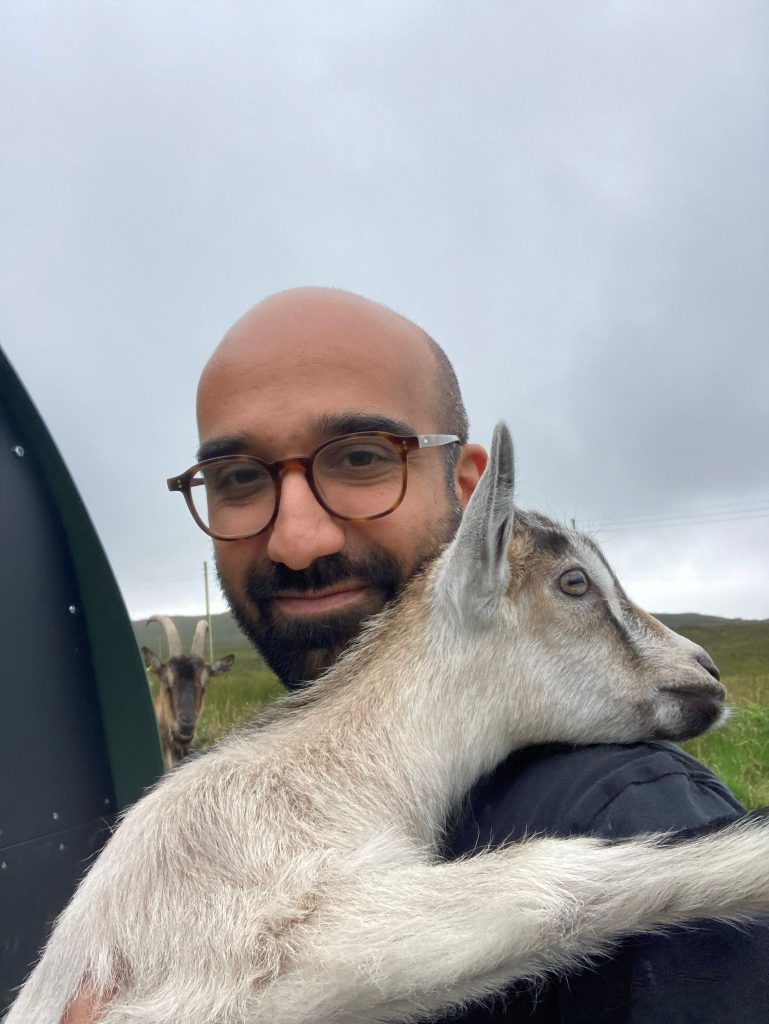
Suhail Merchant is a musician and filmmaker from Bombay who works an eight-acre croft in Skye, and is also an antifascist organiser with HOOF (Hate Out Of Farming).
Tara Wight is the campaigns coordinator for the Landworkers’ Alliance in Scotland.