As Scotland exits oil and gas, Craig Stockwell investigates its tightening ties to Transatlantic defence procurement and the military-industrial complex.
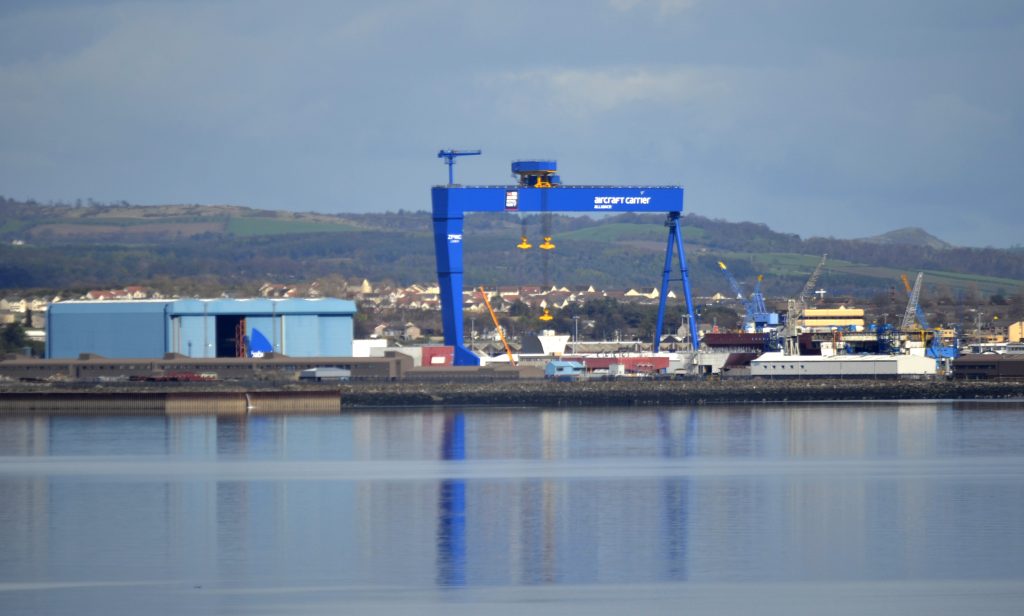
Scotland’s ‘Just Transition’ is unlikely to absorb the employment losses from North Sea decline. Capital is reducing investment in North Sea oil and gas. In contrast, demand for Scottish naval shipbuilding and submarine-support capacity is increasing. Both the Royal Navy and NATO allies are placing orders with BAE and Babcock. Demand for skilled shipyard labour has outstripped local supply, resulting in shipyards recruiting foreign welders. Capital is deprioritising ‘Just Transition’ in favour of the consistent, low-risk cash flows of defence procurement, maintaining Scotland’s economic dependence on outside capital.
Since the return of Donald Trump to the White House, money and capital have been flowing between the US and UK because of instability in US markets caused by Trump. Much of the profit from US investments in the UK will flow back to US investors, not Scots. Capital will only invest in industries it believes to be profitable, like defence, deepening reliance on one industry as primary employer. As Glasgow has long known, once capital pulls out, residents feel the consequences for generations.
After World War II, Clyde commercial shipbuilding became unprofitable, forcing a defence-first portfolio during the 1960s and 70s. From the 70s to 2000s, defence became the only stable order backlog, but even then the shipbuilding workforce shrank from 9,400 in 1982 to about 2,000 in 2002. This mirrors the long history of Scottish labour cycle implosions: ‘Clearance’ and ‘Improvement’. Kelp crashed in the 1800s, to be replaced by whisky, sheep, and estates for aristocratic hunting. Likewise, commercial shipbuilding and oil and gas are being incompletely replaced by the service industry, promises of renewable energy, and military shipbuilding. Military procurement is now returning as one of the few scalable employers. Through all these industries value created by Scottish workers flows out of the country.
The Coming Boom
Since 2022, central banks have maintained the course of disciplining labour by keeping interest rates around 3.5–5.25% to ‘cool’ labour markets. Even after recent Bank of England (BoE) rate cuts, however, capital’s costs of borrowing and doing business remain high. Banks have consistently called for a reduction of interest rates. Bonapartist regimes and parties are attempting to increase political oversight over central banks, as shown by Project 2025 and Reform UK’s Our Contract with You. With higher borrowing costs, capital is disinclined to invest in high-cost regions such as Scotland, specifically the North East and offshore North Sea oil and gas fields. British gilt yields and corporate borrowing can move with the US Federal Reserve (Fed) rate, even without BoE action. Likewise, the dollar remains the global reserve currency. Britain is structurally dependent on the Fed. Combined with British need for American investment, American dollar diplomacy has uniquely strong leverage over the British economy, including Scotland. This creates two layers of financial imperialism by external powers over Scotland: first by London, second by Washington.
In contrast to the declining energy sector, defence spending is booming. Demand for naval shipbuilding in the US, UK, and Australia is at unprecedented levels because of the AUKUS agreement. Indeed, the US is now outsourcing some Virginia-class nuclear submarine component production to Babcock’s Rosyth dockyards. Rosyth is also building five Type 31 frigates, as well as handling final assembly of the Queen Elizabeth-class aircraft carriers. Likewise, BAE shipyards around Glasgow are receiving orders for both UK MoD and Norwegian Type 26 frigates. Finally, Saab and Babcock are discussing a joint construction programme of corvettes at Rosyth.
As of October 2025, Scotland had 66,000 ‘direct and indirect’ oil and gas jobs. This is slightly more than half of all UK oil and gas industry jobs. 1 in 6 jobs in Scotland’s North East are oil and gas related, versus 1 in 30 for the rest of the country. The same sources state that oil and gas jobs in Scotland are shrinking at about 5,000 per year, using 2023-24 as a benchmark. This is expected to increase to 1,000 jobs lost per month between October 2025 and 2030. In contrast, military-supporting shipyards will likely ‘support’ and create an estimated few thousand jobs between now and 2030. Shipbuilding facilities allow for scaled growth; the more money that goes into facilities, the more ships can be built over time, subject to bottlenecks like skilled labour, facilities, and funding.
The War Dividend
Defence employment deepens neocolonial control over places like Scotland because geopolitics influence what governments buy and when. Building naval vessels for a profit is not merely ‘manufacturing’, but rather, conditional status-dependent employment, tied to security clearance, export-control rules, and procurement cycles that can be tightened for external political, financial, or diplomatic reasons. When defence budgets decrease, jobs in the sector become political leverage over the people who need the work.
For instance, in the US, areas experiencing their own blue-collar job losses are similarly turning to naval shipyards as a job ‘sponge’; the best such example is Electric Boat, America’s premier submarine builder, in Connecticut and Rhode Island. These two states are now in a similar position to Scotland: economically dependent on the military-industrial complex for jobs, but under a hostile political regime as liberal states under Trump’s patronage system. In Scotland, this problem would cut two ways: Holyrood does not control the fiscal or monetary regime that sets the cost of capital, nor the procurement regime that decides whether the workstream continues, while eating the social and regional consequences of defence-led industrial policy. Tying the local economy to defence prime contractors narrows local political options when ‘austerity’ comes knocking. ‘Jobs’ become hostage to procurement cycles and budgets set elsewhere.
Training for defence work also requires multi-year pipelines, such as apprenticeships. Bringing students, from teens to PhDs, into defence-related work pipelines pulls money away from public services and towards expanding the military-industrial complex, as Daire Ní Chnáimh described in the last issue. Think of an inversion of the ‘Peace Dividend’ of the 1990s and 2000s: money leaving the public purse to fund prime contractors, not schools or communities.
A False Transition
Despite these trends, oil and gas jobs are declining too fast to be replaced by any sector, defence included. This gap does not decrease structural dependence on outside capital, but increases it, as investors will force Scotland to fight for every job creation programme sent its way. Defence jobs are heavily regulated and gatekept through security clearance. Moreover, the jobs being created are hundreds of miles from the oil and gas jobs that are being lost in the North East. Besides, working on an oil rig does not mean having skills needed in a shipyard. Shipyards like Rosyth are hiring foreign workers, like welders, because the local labour market cannot fill demand. There is no ‘replacement’: jobs in the North East in oil and gas are collapsing without any industry filling the gap.
The reality is that shipyards are expensive, fixed assets, and often centuries old. Shipyards can expand but are geographically restricted: they rely on deep-water access and river frontage, like the Clyde or Walney Channel. Thus, labour moves to the yards. For North Sea oil and gas workers, ‘transition’ into shipbuilding means relocation elsewhere in Scotland or beyond.
But what about renewables? While there are about 10,000 workers at sea on the United Kingdom Continental Shelf at any time, to regularly maintain each large offshore wind project wind farm requires about fifty to a hundred workers. Renewables employment needs are weighted less toward long-term operations than toward manufacturing, construction, grid build-out, and retrofit work. Those are precisely the categories most exposed to international competition from firms with existing supply chains and greater economies of scale, and thus with lower costs.
Any planned ‘Just Transition’ for Scotland, especially the North East, must account for where jobs are being lost now, lest the depopulation of the North East continues. Defence shipbuilding is not a true replacement for oil and gas job losses in the North East because the yards are hundreds of miles away and oil rig workers would need years of training to start welding hulls. Even if defence was a viable replacement for oil and gas jobs, relying on one major industry deepens, rather than reduces, dependence on external capital. To ensure democratic economic self-sufficiency, structural dependence on outside capital needs to lessen, not increase.
Craig Stockwell is a queer American now living in Scotland, who attends the University of Aberdeen’s MLitt in Creative Writing and writes about political economy.