Kat Hunfeld reflects on a doom-defying gathering of land activists and the small steps being taken towards collective land ownership in Scotland.
What does it mean to be invested in land struggles in Scotland? What do our visions of land justice entail, and how are they connected to ongoing colonial entanglements, inequalities of health outcomes and land ownership, food systems and the climate crisis? These and many more questions were discussed at last year’s Land Moot in Glasgow, the second iteration of this event driven by a desire to create a space “for building, resisting, strategizing, and embodying our relationships to land”.
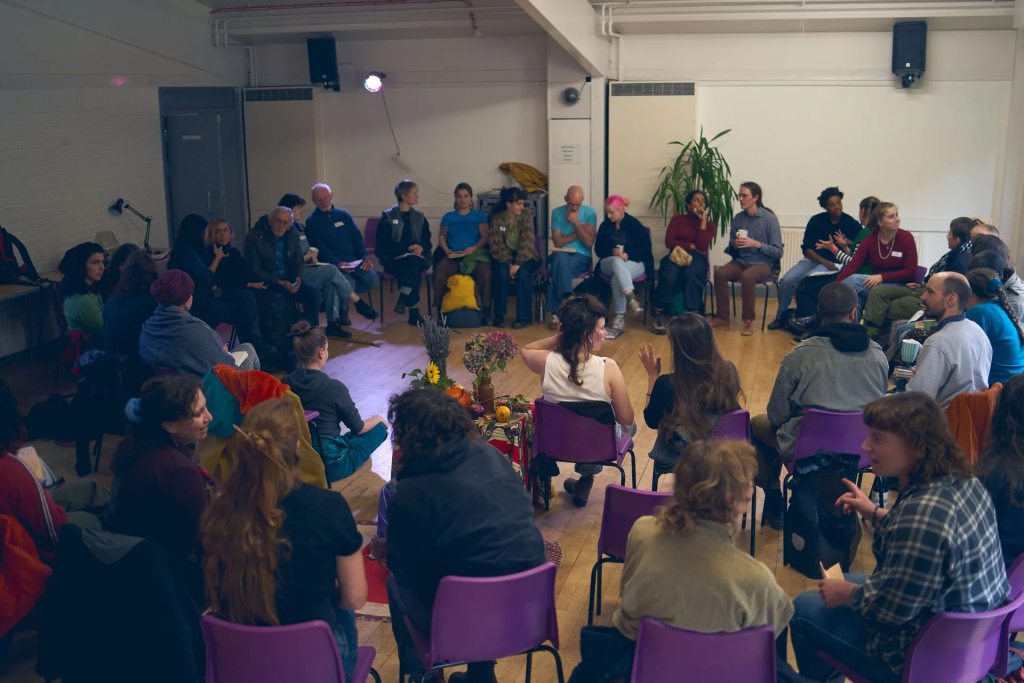
Last October around 100 activists accepted the invitation “to moot – to vitalise our assembly” via talks and workshops, songs and rituals, crafts, and a ceilidh. Autonomously organised by various working groups, the Land Moot emphasised that the organisation of land use is one of the most important dimensions of concern for the ecological Left, playing a central role in human and more-than-human flourishing. It attracted community organisers, researchers, and practitioners united in their commitment to doing radical politics: inspiring and enacting resistance, politically educating and emboldening, reclaiming and establishing commons, learning how to butcher and ferment. Sans the figure of the armchair comrade, sessions were designed to consolidate collective efforts already taking place, and scheming up new ones: how to address rampant housing inequality, fresh food deserts, lack of access to communal growing spaces; what concrete steps we can collectively take to dismantle concentrated patterns of private land ownership and Scottish complicity in global systems of oppression.
Green Grabbing
Facilitating and co-creating such spaces has never been more urgent, particularly when the intensification of land grabs plays out through the greenwashing of capital’s stranglehold over common resources. As a result of Scotland’s poorly regulated land market, Scottish land isruled by carbon markets. Since speculative investment into carbon offsetting programs by asset managers like Gresham House and Oxygen Conservation is skyrocketing the price of land, communities are consistently outpriced and unable to compete, further entrenching land inequality.
This commodification of Scottish wilderness is beneficial to neither humans nor nature per se. The financial incentive structures in place marginalise crofters, smallholders, and community trusts. Only larger single landowners, who have historically benefitted from degrading the land, can expect meaningful returns from the carbon market. Moreover, carbon offsetting programs are a dangerous myth, complicit in climate denial, as they effectively allow polluters to offset some emissions while continuing to profit from carbon-intensive activities (comrades wishing to read more on this topic could check out the latest two books co-authored by Andreas Malm and Wim Carton). To be sure, while the ‘green grabbing’ of land continues to be largely advertised as positive climate action, calls for ‘repeopling’ are also gaining political purchase. Nonetheless, it is becoming more and more difficult to contest the sedimentation of capital’s ideological ‘common sense’. The natural capital paradigm, according to which climate change and ecological breakdown represent nothing but a repairable failure of markets, constantly reproduces capitalism as the only conceivable economic and social model for delivering a carbon-neutral global economy.
A Politics of the Commons
Strategically repoliticising the value of the commons could be an essential part of concerted efforts at resisting this bleak status quo. ‘Commons’ generally means social practices undertaken by communities to govern and care for common resources. These commoning practices also carry a promising political vision of sustainable, post-capitalist social relations. After all, as Karl Marx pointed out in volume one of Capital, it was precisely the enclosure of the commons and the expropriation of the land that made modern capitalism possible. By foregrounding the idea of common ownership of environmental resources, struggles for land justice posit land not just as means of production, but also the means of reproduction of ecological and social life.
Collective land ownership could be crucial for ensuring the restoration not only of biodiversity, but also of democratic participation. While still operating within highly constrained terrain set up by Scottish land reform developments including the 2015 Community Empowerment Act and 2025 Land Reform Act, state-assisted community appropriation of land could be a first step towards a politics of the commons. Such politics can bring ecology inside the structures of local democracy, while working with, not against, existing entanglements between a people and their landscape. The Isle of Eigg provides a glimpse into what becomes possible through such a radically widened sphere of democratic participation. The community recently made a unanimous decision to support the BDS movement in solidarity with the people of Palestine.
Despite a sense of despair in the context of impending climate disaster, the rise of the far right, and the hellscape that is capitalist social relations, the Land Moot was a remarkable experience of abundance – of ideas, incredible food, commitment, and energy to take concrete steps forward. We were reminded how much joy there is in collaborating across groups, and what strength and support there is in working through fractures of the Left. Together, we dreamt of ecologies untethered from the needs and desires of capital. There is much to be done: it is no small task to unsettle extractivism, the practice that views land primarily in terms of the private profit it can generate.
Despite the enormous challenges ahead, witnessing the many groups and initiatives collectively working on the project of denaturalising private land ownership patterns was a hopeful experience. We ended the weekend with a song – written by Davey Anderson – the chorus of which gets at the heart of what brought us together: “Ding Doon the Dyke / We’ll ding doon the dyke / For land held in common / We’ll ding doon the dyke”. I believe that we can win!
Katharina Hunfeld is an associate lecturer at the University of St Andrews and a member of the Historical Materialism editorial collective.