Moira MacFarlane speaks with Mahmoud Zwahra, a Palestinian activist, farmer and academic, about the immunity that land provides for Palestine.
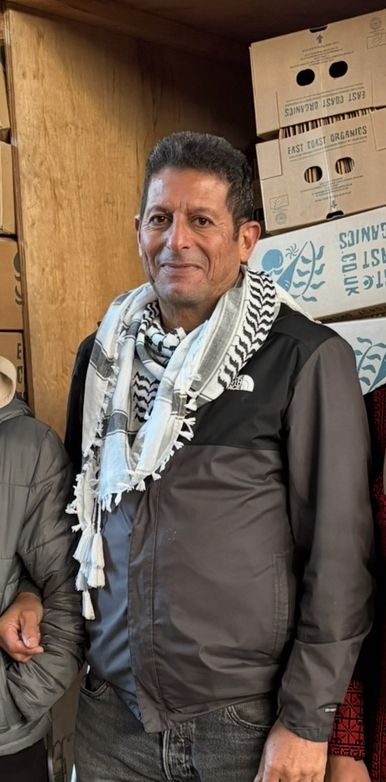
For two decades Mahmoud Zwahra has been involved in non-violent popular resistance, particularly protesting the construction of the Occupation apartheid wall which was threatened to be built directly through his village of Al-Ma’sara, in the hills south of Bethlehem. Mahmoud divides his time between the farming community of Al-Ma’sara in the occupied West Bank, and in the UK, where he is pursuing a PhD at Coventry University.
Mahmoud is an important partner in two Scottish Palestine Solidarity Campaign (SPSC) projects: Stop the JNF and Plant a Tree in Palestine. In October 2025, SPSC hosted Mahmoud as he delivered two talks, at East Coast Organics Farm, East Lothian, and at St Augustine’s Church in central Edinburgh. He spoke to Moira MacFarlane during his visit.
In the past two years, all eyes have been on the genocide in Gaza. What has been happening on the land of the Occupied West Bank during this time?
How life looks like in the West Bank after October 7 is day and night; everything has changed. It’s as if the settlers were ready with their plan to attack and expel Palestinians from their villages. The 7th October marked a jump, a turning point, exponential change in the settler attacks against the Palestinians.
Before that, we witnessed that they established pastoral outposts. These settlers with their sheep on the mountains and on the hills of the West Bank, became soldiers with their sheep. They burn trees and crops, and they use their sheep as instruments of colonialism. Their main targets were Palestinian farmers, including shepherds, who they aimed to push out from the area they call area C to other areas called area B and area A.1 They have already expelled some Palestinian villages from area C, and this situation continues to date.
Billions of shekels were invested in digging the land, then digging bypass roads When we look at the West Bank, we can understand the future and how it will be. Israel have established more than 1,500 gates in the West Bank, including at my village. More than 500 gates have been established in the last two months. They open them and close them whenever. Imagine a country with a key and a lock. What kind of state is this, when the citizens are not allowed to move until the soldier or a settler gives permission to move? You do not let your sheep go out until they want, until they open the shelter. This is exactly what is happening. Whenever Israel wants to block the three-and-a-half million Palestinians in the West Bank, they can literally jail them at home without any cost. And this is because of the colonial geography that they have designed, and thanks also to Oslo,2 which makes this easy for the settlers.
This aspect of movement is an aspect of colonial geography. There is also an economic aspect of this, since there are no workers going to work in the Israeli settlements or in Israel, which, in my opinion, is good. On the other hand, no more European funding is coming to the Palestinians. And Israel keeps Palestinian tax. We are talking about a frozen economy of 3.5 million in the West Bank and more than 2 million in Gaza. Some small communities can produce milk, vegetables, and fruit, but they are also under the attack of the sun. The aim of all these measures together is to make people lose hope, to lead to frustration, so there will be a smooth Nakba. People will leave the country because life is unlivable in Palestine. The settlers, the army, the police, the government, everyone is playing their role with the aim to kick the Palestinians out from their homes.
Can you describe the relationship between the land and Palestinians?
Why are Palestinian stubbornly not leaving the land? Because the land is not a piece of geography or whatever that they can leave and replace. Because land means more than a site. First, the land traditionally is the mother, it is the honour, it is everything. It’s worth sacrificing. This land is worth your sacrifice. This is how the Palestinians become ready to die for their land. What makes an elderly Palestinian woman attached to her land not escape from a young settler who is carrying his gun or a stick to attack her? She is ready to see her blood mixed with the soil of the land under an olive tree.
This explains the relationship. It goes beyond the soil, goes beyond geography. It speaks to a relationship. It speaks to the attachment. If you have land, you will survive. Whatever is happening, war, peace, justice, and injustice, you will survive. Because land is the place where you can find what you want from food, from whatever. These people are practicing food sovereignty when they foster the relationship with the land. Here is Israel’s dilemma, that the Palestinians’ immunity comes from the relationship between the people and the land. This is what the occupation wants to weaken. They tried through political money, through funds, through development, fake development, taking down development, offering jobs to the Palestinians in the settlements with high salaries. None of this worked.
Therefore, they are trying the toughest thing: killing, threatening and harassing people to push them out of their own land. But land for the Palestinians is honour, is the mother. Therefore, you can see the contrary happening. The more you push the Palestinians, the more they are attached to their land. And this is what the Israelis don’t want. Even if you cannot reach your land, you still seek ways to reach it, despite all the challenges. You know that you will find settlers, and that they will attack you, and this may cost you your life, but still you do it. This is stubbornness, madness; it is a way of resistance that you cannot explain, but you can in it see the value of the land, the relationship between the people and the land. This relationship is the seed of the Sumud, the seed of resistance.
I was working on my land from July up to October, and I was asking myself, ‘why all this tiredness’. I have pain in my back from pushing stones to build terraces. Why? But when I came to a shaded area in hot weather and I saw cold air coming from the soil, which is under an edge in a shadow area, where the sun cannot reach, I saw a kind of energy coming to my body. And then, I understand what the land is worth, because this tiredness will go. And you will see; you will see the land as something that belongs to you, not on the material level, on the feeling level. So that’s something special.
Believe me, when you come closer to the trees, when you come closer to the land, you value it more, and not in terms of what the land will give you. The land will give you nothing compared to the work you do on the land. But there is some spirit, a spiritual thing inside you, that makes you feel happy when you do this work.
It’s difficult, it’s hard, but it makes you comfortable from inside. And that is the relationship between the land and the indigenous people, like the Palestinians. Not, how are we going to bring bulldozers to make huge areas, to make massive industrial farms. Our relationship to the land is different. I was looking at how many grape trees we planted in Masafer Yatta, and in one month, the settlers planted three mountains, maybe three times more than we did in four years. Their aim is to push the Palestinians away. Our aim is to bring the people to the land. There is the difference between how colonials look at the land and how the indigenous look at the land. Their image is based on replacing the skin of the land, benefiting to the extent that they exploit the land.
For us, no, there is homogeneity between the original colours of the land and the indigenous. The relationship is full of mercy, full of warmness, not based on benefits and loss. The Palestinian economy is based on small family businesses. Each family have their own piece of land that they plant, they produce, they sell, and they also store. It is a community business. It is not based on a system.
There are no words that can describe the relationship with the land.
Environmentally and economically, I can see how that model of sustainability feeds into the land, playing that integral role in daily resistance.
The land is the belly. The land is the mother and, without the mother, there is no family. There are no children. The land is the incubator for resistance, and it closes its wings around the people. And this creates an environment of resistance because of the land. The olive tree means something here. The olive tree is the oil of the light that guides the Palestinians for the future. The light of our house, the place where we are protected.
Can you tell us about Plant a Tree in Palestine project and how it began?
Plant a Tree in Palestine is a great initiative that for me is like drops of water for a thirsty person. Since we started this initiative in 2011, farmers now have the time to return and start to work on their land as there is no other work. Through the project farmers access resources that also motivate them. We focus on the land that is close to the settlements. It makes the people more rooted in the land to see hope in the production of the land. They look at the grape and olive trees that they started with, which now are giving products. People are benefiting at the house level and the community level, and some can sell their produce.
When you work with a project like Plant A Tree, you foster that relationship with the land. You help enhance the economy of the people. You create a more resilient society. A more resilient community can stay on their land and resist the occupation.
Moira MacFarlane is a member of the Scottish Palestine Solidarity Campaign and project officer of its Stop the JNF Campaign and Plant a Tree in Palestine. She was part of the SPSC delegation that visited Al-Ma’sara in May 2025.
This is the part of the interview with Mahmoud. The full interview contains more detail about the recent developments in the West Bank, and continues by exploring the connections between the Plant a Tree campaign and the Stop the JNF campaign. The second part of this interview will be published in the next issue.
- The Oslo II Accord divided the Israeli-occupied West Bank into three administrative divisions: Area A (18%): full Palestinian administrative and police control. Area B (22%): controlled by both Israel and Palestian Authority. Area C (60%): full Israeli control. ↩︎
- The Oslo Accords are a series of agreements signed between Israel and the Palestine Liberation Organization (PLO) between 1993 and 1999. They established the Palestinian Authority (PA) to govern Palestinians in pockets of the occupied West Bank and Gaza under the control of Israel’s occupying army. ↩︎