After ten years of working on the Just Transition Partnership,
Matthew Crighton reflects that we cannot solve our major
environmental problems without changing the economic system
which is driving them.
When the STUC General Council in 2016 agreed to the proposal from Friends of the Earth Scotland (FOES) to establish a partnership around “the industrial changes needed to achieve a just transition to a modern low-carbon economy” it was taking an unusual step. There were not many precedents anywhere for unions having formal relations with environmental organisations. Indeed sometimes the two movements had been perceived, incorrectly, as enemies.
The decision represented a recognition of the importance of climate change, following the Paris Agreement in 2015 and in light of government targets; and the importance of a specifically union-based framing of the issues. Both STUC and FOES thought that it was likely that bringing their voices together would get more attention than speaking separately and that was soon confirmed.
One of the first proposals by the Just Transition Partnership (JTP) was the creation of a Just Transition Commission and that was soon Scottish Government policy, though it took a few years to then actually start meeting. The framing of Just Transition, a concept which came from the unions, soon became adopted across the climate movement in Scotland and then in Scottish Government policy.
In the climate and environment movement FOES was unique in recognising the potential value of a strong trade union voice on these topics and it was open to the benefits for its own advocacy of a just transition narrative. It took care to frame its proposal for the partnership specifically around industrial change and employment. These are not topics on which the environmental movement had a lot of expertise but it was willing to learn from the experience of its new partners. The work of the JTP has involved learnings in both directions and a look at these can help both movements address future challenges, within and without Scotland.
At the start of the process we were following the lead of the International Trade Union Confederation and some trade unions in the UK in applying the concept of Just Transition to climate change – it can logically be applied to many kinds of environmental problem. Examination of the initial Joint Statement on Just Transition re veals the core elements of the framing agreed then by the partners:
1. The seriousness and urgency of climate change
2. Recognition of the need to move to a ‘modern low-carbon economy’
3. Economic justice, foregrounding fossil fuel workers but covering all of society
4. Industrial policy – rebalance the economy; sectoral plans; new jobs; investment
5. Social justice — climate policies should deliver social benefits and a more equal society
6. Leadership and intervention by government is needed.
Implicitly, the Statement refers to both the supply and demand of energy and therefore to the impacts on the whole economy, not just energy sectors. In retrospect it is a little surprising that it doesn’t mention either UN agreements or Scottish legislation but perhaps these were the assumed context of a statement which sought brevity. Certainly, as the work of the Partnership developed, the social consensus around the targets set in the 2009 Climate Change Act provided an important baseline.
Circumstances which are specific to Scotland have influenced significantly this framing. The primary one is the juxtaposition of a large oil and gas sector which is approaching the end of its life with enormous renewable energy potential. This has perhaps enabled Scotland to capture clearly some central features of a progressive vision of a just transition, even if the results in workplaces have so far been disappointing.
All partners accepted that meeting climate targets requires large-scale decarbonisation but within that framework they held differing views about the extent and the pace of change. For those reasons, the JTP hasn’t taken a position on the place of negative emissions technologies like Carbon Capture and Storage in climate change plans; nor the support from some unions for continuing oil and gas exploration. The ground-breaking work which FOES did with oil and gas workers was not done through the JTP. However, the relationships of trust established within the Partnership were vital to it and the resulting Our Power report, a just transition plan for the sector, which received support from the trade unions.
Since the start of the JTP in 2016 many additional elements of its platform have been added. Some are straightforward developments from this starting point, for example a focus on sectoral planning, drawing attention to the investment gap and to the offer of support which should be available to affected workers. Others developed in response to experience, in particular drawing attention to unjust transitions for the oil and gas workforce, at Grangemouth and at Mossmorran. The outstandingly poor record of job creation in Scot land from the large-scale investment in renewables has drawn attention to the neo-liberal foundations of Scottish Government policy, which asks little of private capital and gets less.
Ten years ago there were some prospects of action by the Scottish Government which would match its positive statements in sup port of a just transition. The record has in fact been poor and doubts about whether the current system is even capable of delivering on these promises have come to the fore. Hence the strong advocacy by the Partnership for public ownership in the energy system, from nationalisation by the UK government, through a Scottish public energy company to municipal enterprise.
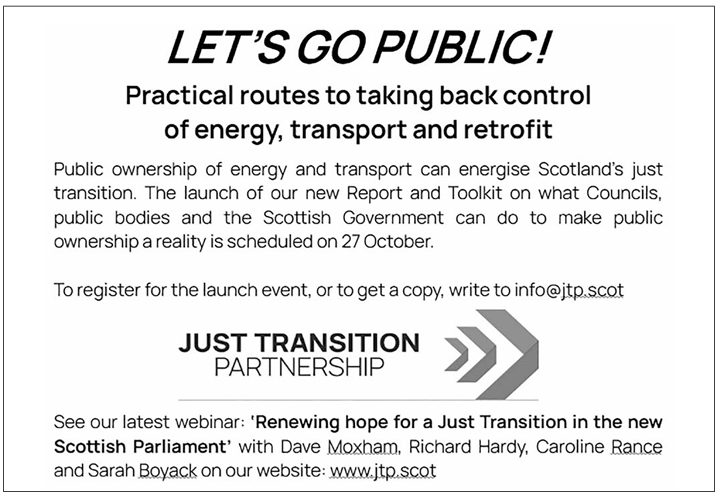
The current focus of the Partnership is to show the opportunities for extensions of public ownership. It has contracted with the Centre for Local Economic Strategies to produce a toolkit which lo cal authorities can use to drive forward rapid transformations on the ground, for example on housing insulation, local energy generation, heat networks and bus companies. Alongside this it will publish Let’s Go Public, a report which will make recommendations about how the Scottish Government can encourage this and remove barriers put in the way.
Lastly it should be noted that there are aspects of policy which would be given much more prominence if being developed at UK level, such as the importance of high quality social protections and the fiscal and monetary policies necessary to enable delivery of JT policies.
My summary of what can be learnt from this rich track record is: Abandon neoliberalism or continue to fail! We won’t solve our major environmental problems without changing the economic system which is driving them. Public agencies, not the private sector, have to direct the radical and rapid changes which are needed. The just transition approach links long-term solutions with tackling immediate needs in ways which ensure justice, equality and social benefits. The current system will not deliver these changes. We need to build a movement which understands all this and can grow strong enough to ensure change happens.